
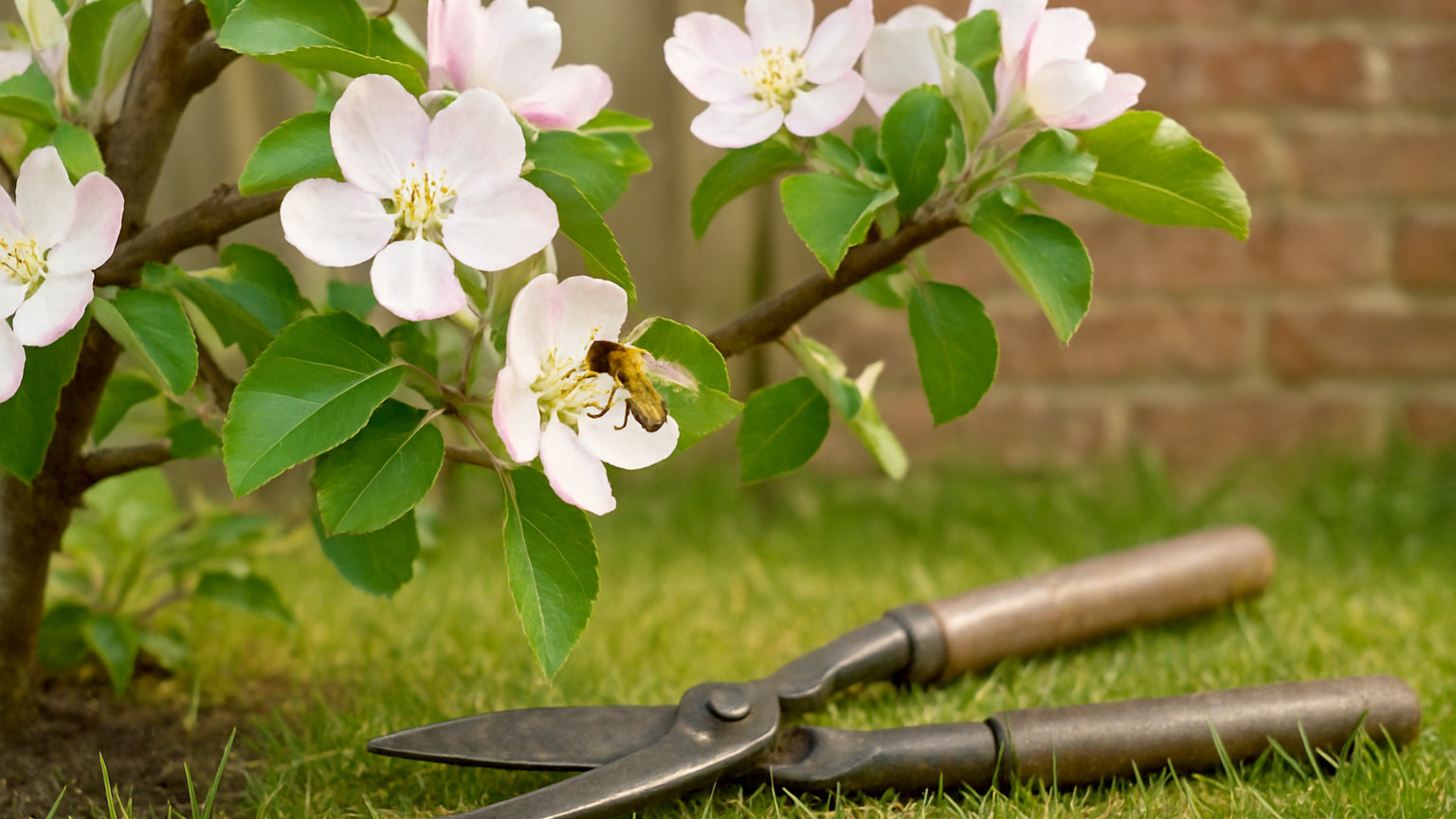
Most apples and pears need pollen from a different variety of the same fruit, flowering at the same time, to set a decent crop. Getting this wrong produces a healthy tree that blossoms beautifully every spring and carries almost nothing.
How the groups work
Varieties are assigned to flowering groups, usually numbered one to seven, where group one flowers earliest and group seven latest.
A tree needs a partner in the same group, or in the group immediately either side, since flowering periods overlap at the edges. A group three apple is pollinated by another group two, three or four apple.
The groups are relative rather than fixed dates. A cold spring delays everything, but the sequence stays the same, so the relationship between varieties holds.
It must be a different variety
Two trees of the same variety will not pollinate each other, however close they are, because they are genetically identical. A row of six Cox will crop no better than one.
Nor will a different fruit help. Pears flower earlier than apples and cannot pollinate them, and plums and cherries are different again.
A crab apple is the useful exception among apples, since most flower over a long period and will pollinate almost anything. One crab apple in a garden or a hedgerow serves several trees.
Triploids
A few well-known varieties are triploid, meaning their pollen is sterile and they cannot pollinate anything. Bramley is the one most people have, along with Jupiter, Blenheim Orange and Ribston Pippin.
A triploid still needs pollinating itself, so it requires two other compatible varieties nearby, which then pollinate each other as well as the triploid.
This makes Bramley a poor choice as a single tree in an isolated garden, despite being the cooking apple everyone knows.
Self-fertile varieties
Some fruit sets a full crop with its own pollen and needs no partner at all. This is the answer where there is room for only one tree.
- Plums - many, including Victoria, Opal and Czar
- Cherries - most modern sweet varieties, and all acid cherries such as Morello
- Peaches, apricots and figs - self-fertile
- Apples - a few, though none is fully reliable alone
- Pears - Conference sets fruit alone, often narrow and misshapen without a partner
Even self-fertile varieties usually crop more heavily with a partner nearby.
How close does it need to be
Bees do the work, so the practical limit is how far they travel between flowers. Within about fifty metres is comfortable, and in a town or suburb there are frequently apples, crab apples or ornamental Malus in neighbouring gardens well within range.
This is why single apple trees in urban gardens often crop perfectly well while the same tree in an isolated rural garden does not.
Family trees
A family tree has two or three compatible varieties grafted onto one rootstock, so it pollinates itself and gives a spread of picking dates from a single position.
They suit small gardens well. The one thing to watch is that the varieties often grow at different rates, so the most vigorous needs pruning back harder to stop it taking over.
Helping pollination
Frost at blossom time is the commonest reason a well-pollinated tree still fails. Fleece thrown over a small tree on a frosty night protects the flowers, and should be removed during the day so insects can reach them.
Grow flowers nearby that attract bees, avoid spraying anything while blossom is open, and be aware that cold wet weather during the flowering week reduces insect activity regardless of what varieties you have.
Checking before you buy
Ornamental crab apples
If you have space for only one fruiting tree but want reliable pollination, planting a crab apple alongside solves it. Most flower over a long period and pollinate almost every apple variety, including triploids, and they are worth having in their own right for the blossom, the autumn fruit and the birds that come for it.
Golden Hornet, John Downie and Evereste are all good garden crabs, and their fruit makes jelly.
Checking before you buy
A good nursery lists the flowering group and any triploid status for every variety. A garden centre label frequently does not.
Establish what is already growing nearby before choosing, since that may mean you need no partner at all, and check the group of anything you are buying rather than assuming two apples will suffice.


