
Fruit trees need very little feeding on reasonable soil, and the wrong feed does active harm. The distinction that matters is between nitrogen, which produces leaves and shoots, and potassium, which supports flowering and fruiting.
Potash, not nitrogen
A fruit tree standing in a regularly fed lawn is being given exactly the wrong thing. Lawn fertiliser is high in nitrogen, and a tree receiving it produces vigorous dark green growth and very little fruit.
It also makes the tree more susceptible to scab, mildew, canker and aphids, since soft sappy growth is what those problems prefer.
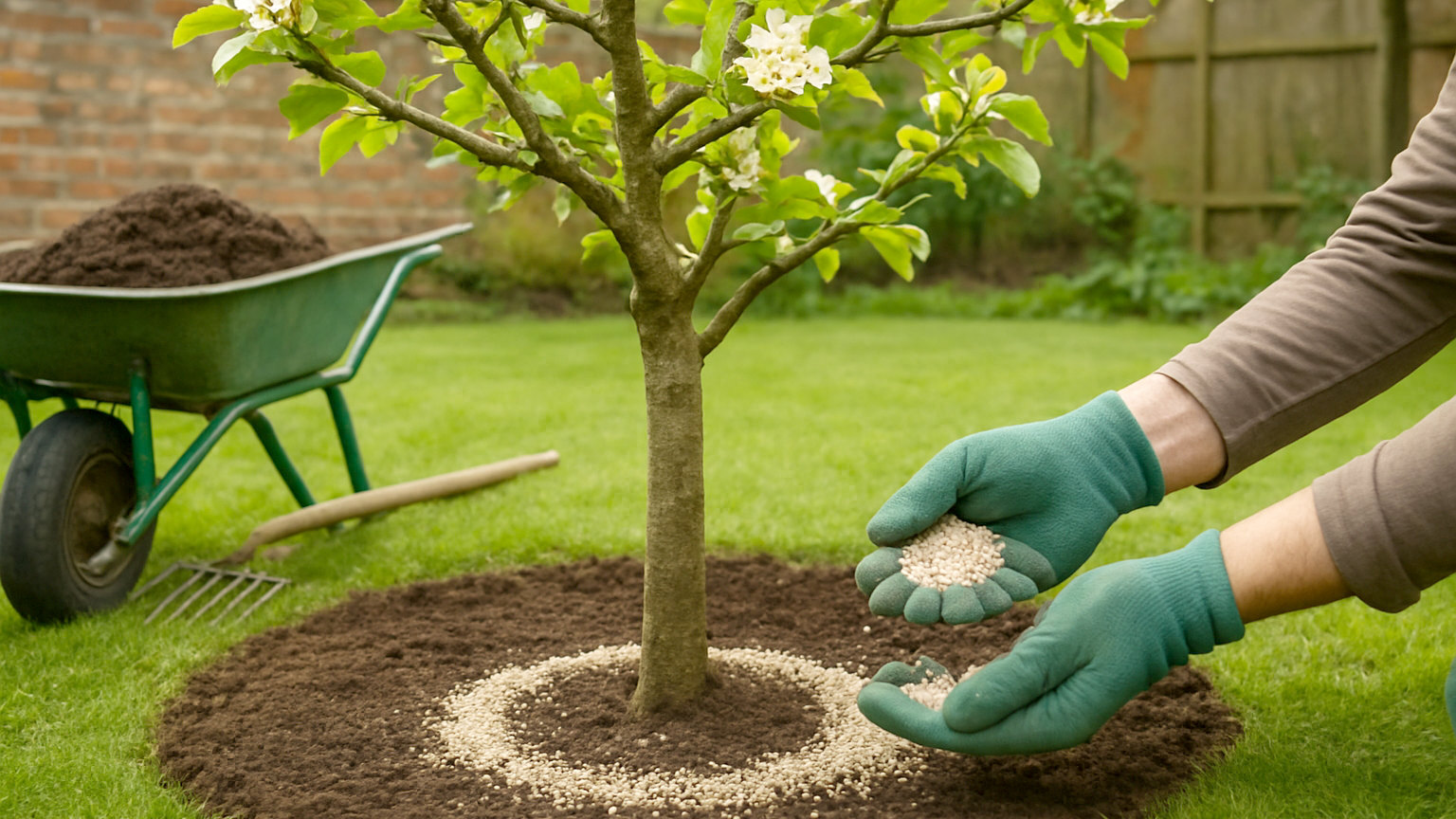
Apply sulphate of potash in late winter, around February, at the rate on the packet, spread over the root area. That is the main feed of the year and for most garden trees it is enough.
Nitrogen is only worth adding where growth is genuinely poor, meaning less than about twenty centimetres of new shoot in a season, and then sparingly in early spring.
Where to spread it
Roots extend at least as far as the canopy and usually further, so scattering fertiliser around the trunk achieves very little.
Spread it in a broad band from about halfway out from the trunk to a metre beyond the outer edge of the branches. That is where the active feeding roots are.
Water it in if rain is not expected.
Mulching
An annual mulch does more for a fruit tree than any fertiliser. Spread five to seven centimetres of well-rotted manure, garden compost or leaf mould over the root area in early spring, after rain when the soil is moist.
It conserves moisture, suppresses weeds, feeds slowly as it breaks down and improves soil structure year on year.
Keep mulch clear of the trunk by at least ten centimetres. Material piled against bark holds moisture there and causes collar rot, which kills trees. A ring rather than a mound.
Keep the grass off
Grass growing right up to the trunk is one of the main reasons young trees grow slowly. It competes aggressively for water and nitrogen at exactly the level the tree's feeding roots occupy.
Maintain a clear circle at least a metre across, and preferably a metre and a half, for the first four or five years. Mulch it rather than leaving bare soil.
It also keeps mowers and strimmers away from the trunk. Bark damage at the base is frequently fatal and is one of the commonest ways young trees are lost.
Watering
Newly planted trees need thorough watering through their first two growing seasons, twenty to forty litres at a time, weekly in dry spells. A daily sprinkle achieves nothing.
Established trees usually look after themselves, but two periods matter. Drought while fruit is swelling causes fruit drop, small fruit and bitter pit. Drought in late summer, when next year's flower buds are forming, reduces the following season's crop, which is why a dry August can produce a poor spring the year after.
Container-grown trees are entirely dependent on you and need daily watering through summer.
Soil pH and deficiencies
Most fruit is content between pH 6 and 7. On very alkaline chalk, trees may show iron and manganese shortage as yellowing between the veins on young leaves, and chelated iron gives a temporary correction.
Yellowing between the veins on older leaves usually indicates magnesium, common on light soils, and is corrected with Epsom salts as a foliar spray or soil drench.
What not to do
Do not feed heavily in the hope of forcing a poor cropper into production. If a tree is not fruiting, the cause is more likely age, frost, pollination, shade or over-pruning, and adding fertiliser to a tree that is already too vigorous makes it worse rather than better.
Trees in grass
An established tree in a lawn is generally fine once it is past its first five years, provided the lawn is not being fed heavily. If you want both, feed the lawn only in areas away from the tree, or accept a lower-input lawn around it.
Leaving a circle of longer grass and wildflowers around the trunk rather than mown turf reduces competition, looks deliberate, and supports the pollinators the tree depends on.
What not to do
Do not feed heavily in the hope of forcing a poor cropper into production. If a tree is not fruiting, the cause is more likely age, frost, pollination, shade or over-pruning, and adding fertiliser to a tree that is already too vigorous makes it worse rather than better.
Do not dig around the base, since fruit tree roots are shallow and easily damaged. Mulch on the surface and let the worms do the work.


