
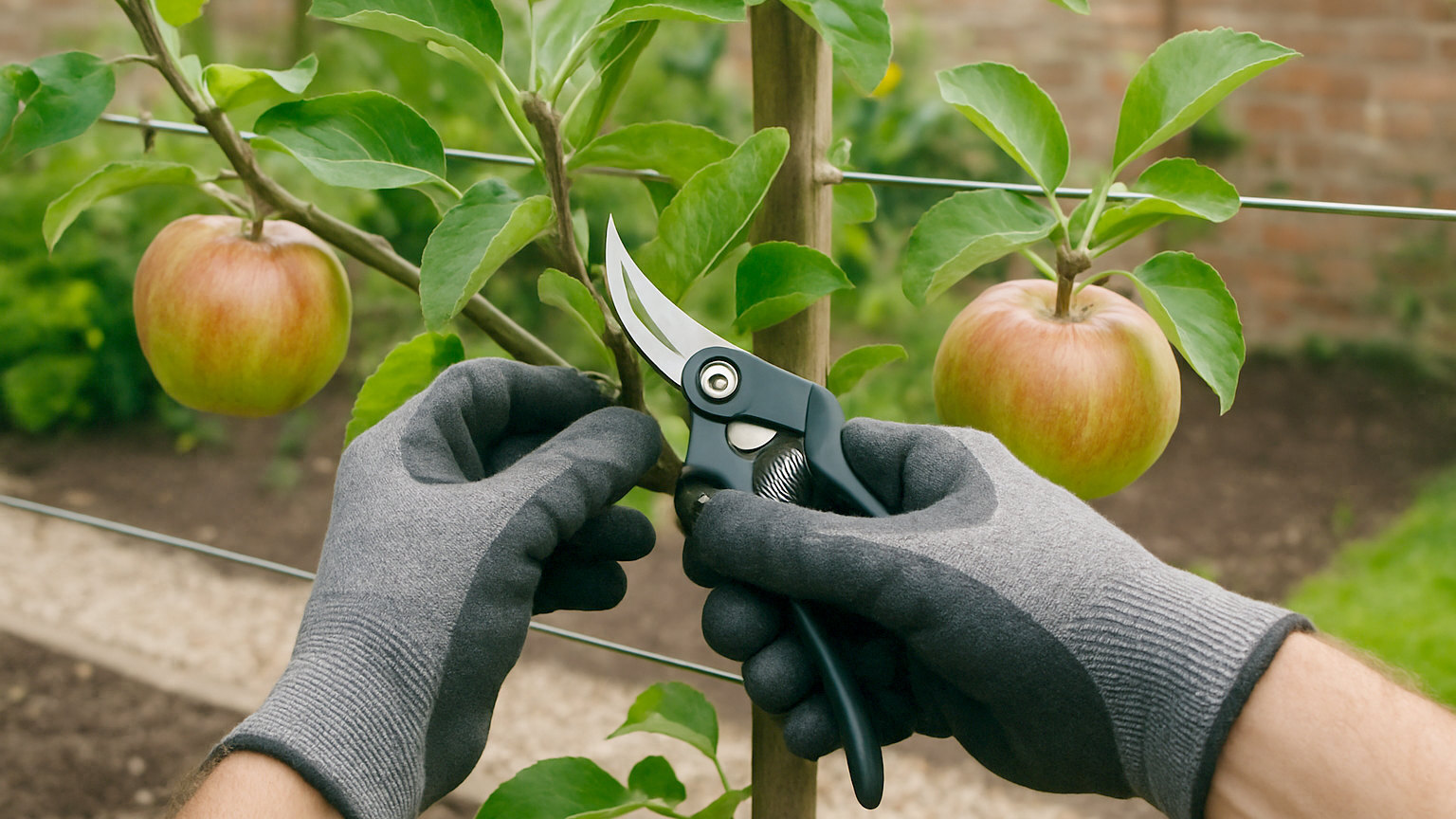
Trained fruit is the answer to a small garden. A single fence can carry six or eight cordons of different varieties, cropping heavily for the ground they occupy, and the trees stay at a height you can reach from standing.
The forms
Cordon - a single stem planted at forty-five degrees, with fruiting spurs along its length. The most space-efficient form, planted seventy-five centimetres apart.
Espalier - a central vertical stem with horizontal tiers each side, spaced about forty-five centimetres apart vertically. Formal and productive, needing three to four metres of width.
Fan - branches radiating from a short trunk, covering a wall. The form for stone fruit.
Stepover - a single horizontal tier at about forty-five centimetres, used to edge a path or a bed. Decorative and surprisingly productive.
Which fruit suits which form
Apples and pears train well as cordons, espaliers, fans and stepovers, and they are the fruits most commonly grown this way.
One important limitation: cordons and espaliers rely on fruiting spurs, so they only work with spur-bearing varieties. A tip-bearer such as Bramley or Worcester Pearmain will not produce on a cordon, since the pruning removes the wood that would carry the fruit.
Stone fruit, meaning plums, cherries, peaches and apricots, is trained as a fan rather than a cordon, since it does not spur in the same way. Figs also suit a fan.
Rootstocks
Trained forms need a rootstock with enough vigour to fill the framework but not so much that it fights you.
For apples, M26 or MM106 suit cordons and espaliers. For pears, Quince A. Very dwarfing rootstocks such as M27 lack the vigour to build an espalier.
Supports
Trained fruit needs a permanent wire framework, and it is worth doing properly because retro-fitting is awkward.
Use heavy-gauge galvanised wire on vine eyes, held ten centimetres clear of the wall or fence so air circulates behind. Space wires about forty-five centimetres apart vertically.
Against a free-standing post-and-wire structure, use stout end posts braced properly, since the tension and the eventual weight are considerable.
The August prune
Trained forms are maintained by summer pruning, not winter pruning. This is the essential difference and the reason they stay small.
Winter pruning stimulates growth; summer pruning restricts it. A cordon pruned in winter puts out a mass of vigorous shoots and rapidly outgrows its space.
In August, using the Modified Lorette system, cut back the current season's side shoots that are longer than about twenty centimetres and have woody bases. Shorten those growing directly from the main stem to three leaves above the basal cluster, and those growing from existing spurs to one leaf.
Leave anything soft and still growing until later, and tidy any regrowth in September.
Building the framework
For a cordon, plant at forty-five degrees with the graft union uppermost, tie the stem to a cane fixed to the wires, and do not shorten the leader until it reaches the top wire.
For an espalier, cut the maiden tree back to just above the lowest wire at planting. Train the top shoot vertically and two side shoots at forty-five degrees during the first season, lowering them to horizontal in autumn. Repeat for each tier.
It takes three or four years to build a full espalier, and the tree crops while you are doing it.
Where to put them
Thinning and picking
Trained trees still need their fruit thinned, to one or two per cluster after the June drop, since the framework carries a lot of fruit in a small space and crowded fruit stays small.
The compensation is that everything is at eye level and reachable, which makes thinning, picking, netting and inspecting for pests far quicker than on a standing tree.
Where to put them
South or west-facing walls give the best results and suit stone fruit and pears. Apples tolerate an east-facing wall. A north wall will grow a Morello cherry and little else.
Plant about forty-five centimetres out from the base of a wall, leaning the tree inwards, since the ground immediately against a wall is dry and often full of rubble.
Improve that ground before planting with plenty of compost, and expect to water more than you would for a tree in the open, since a wall keeps rain off the soil directly beneath it even in a wet summer.


