
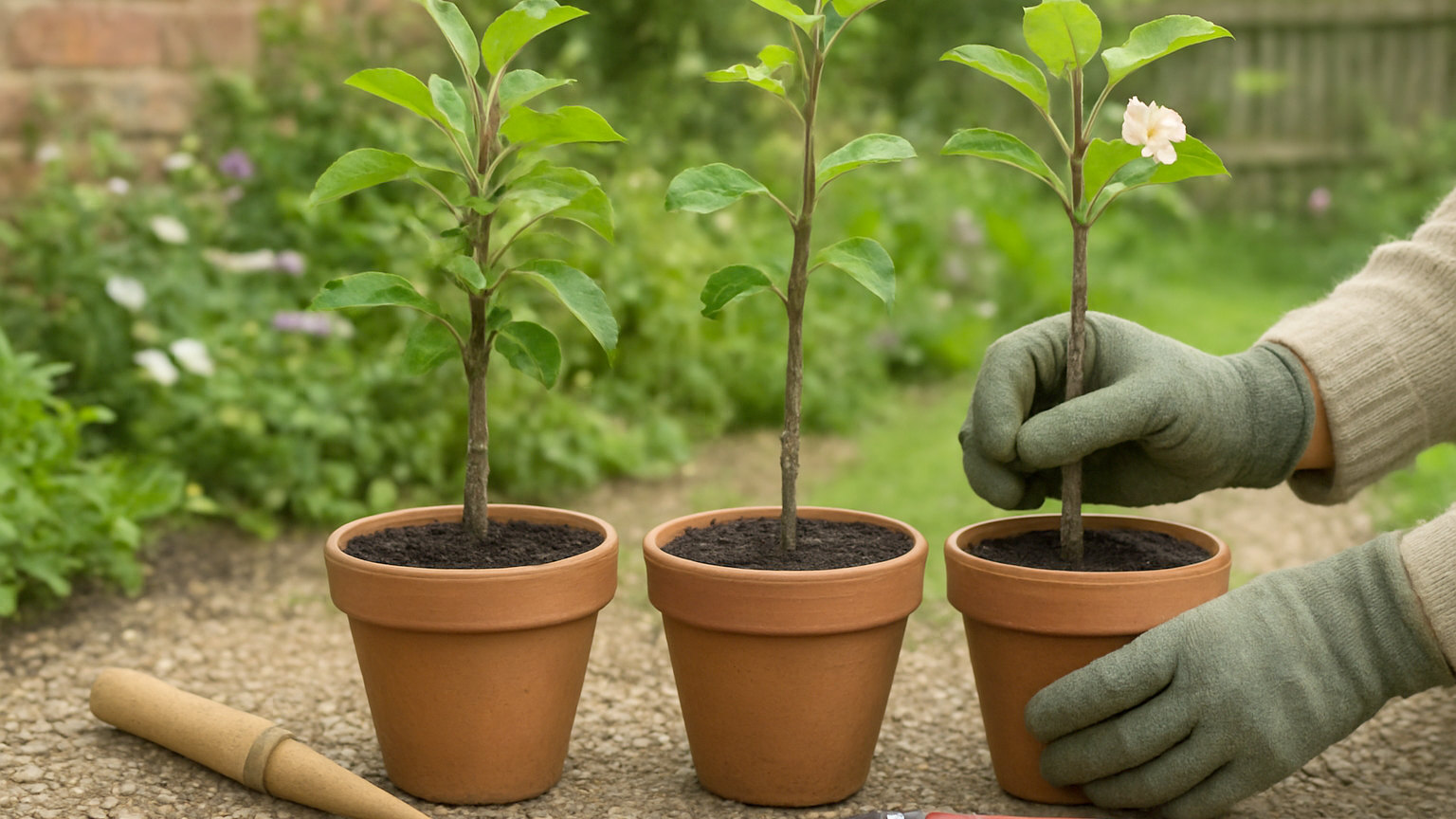
When buying an apple tree, most people choose the variety and glance at the rest. It is the wrong way round. The rootstock the tree is grafted onto decides how large it will grow, how soon it fruits and whether it needs permanent staking, and getting that wrong produces a tree that swamps a small garden within a decade.
What a rootstock is
Almost every apple tree sold is two plants joined together: a root system chosen for vigour and soil tolerance, and a variety grafted on top for its fruit. The graft union is the visible kink low on the trunk.
Apples do not come true from seed, so a variety can only be reproduced by grafting. The rootstock controls the size of the finished tree, which is why the same variety can be sold as a two-metre patio tree or a full orchard specimen.
The rootstocks you will meet
- M27 - very dwarfing, around one and a half to two metres. Needs permanent staking, good soil and no competition from grass. Suitable for a large pot.
- M9 - dwarfing, around two to three metres. Fruits early, needs permanent staking and does not tolerate drought.
- M26 - semi-dwarfing, around two and a half to three and a half metres. The most useful for an average garden, staked for the first few years.
- MM106 - semi-vigorous, around three to five metres. Good for a larger garden or a trained form, tolerant of a wider range of soils.
- M25 - vigorous, six metres or more. A traditional orchard tree, too large for most gardens.
The dwarfing rootstocks are less forgiving, not more. M27 and M9 have weak root systems, so they need staking for life, they cannot compete with grass around the trunk, and they suffer badly in dry summers. M26 or MM106 in a smaller trained form is often a better bet than the smallest rootstock available.
Pollination
Most apples need pollen from a different variety flowering at the same time to set a decent crop. Varieties are grouped by flowering period, usually numbered one to seven, and you need a partner in the same group or an adjacent one.
In a town or suburb there are frequently apples or crab apples in neighbouring gardens within range, so a single tree often crops perfectly well. In an isolated position it may not. A crab apple is a useful universal pollinator with a long flowering season.
A few varieties are triploid, including Bramley, and cannot pollinate anything. A triploid needs two other varieties nearby to crop properly, which makes Bramley a poor choice as a lone tree despite being the one everyone knows.
Self-fertile varieties exist and will set a crop alone, though even these do better with a partner.
Trained forms for small spaces
If you have a wall, fence or a boundary line rather than an open space, a trained form is usually the better answer. Cordons are single stems planted at forty-five degrees, spaced under a metre apart, so several varieties fit along one fence. Espaliers have horizontal tiers against a wall. Stepovers are knee-high and edge a path.
These take annual summer pruning to maintain, which is a modest job, and they crop heavily for the space they occupy.
Choosing the variety
Think about when you want to eat it. Early varieties ripen in August and do not keep at all. Mid-season crop in September. Late varieties are picked in October and store into the new year, which is where the real value lies.
Consider disease resistance, particularly scab and canker, if you are in a wet part of the country. Local varieties bred for your region are often a sound choice and are worth seeking from a specialist nursery, who will also tell you the rootstock and pollination group properly rather than leaving it off the label.
Spur-bearing or tip-bearing
Most apples fruit on short spurs along older wood, and these are pruned in the familiar way by shortening side shoots. A minority, including Bramley and Worcester Pearmain, fruit mainly at the tips of last year's growth, and pruning those as if they were spur-bearers removes the crop. Check which type a variety is before the first winter prune.
What to buy
Bare-root trees, available from November to March, are cheaper, establish better and offer far more choice than the containerised trees sold in garden centres in summer. Buy a maiden or a two-year-old tree rather than something larger, as young trees establish faster and you can shape them from the start.


