
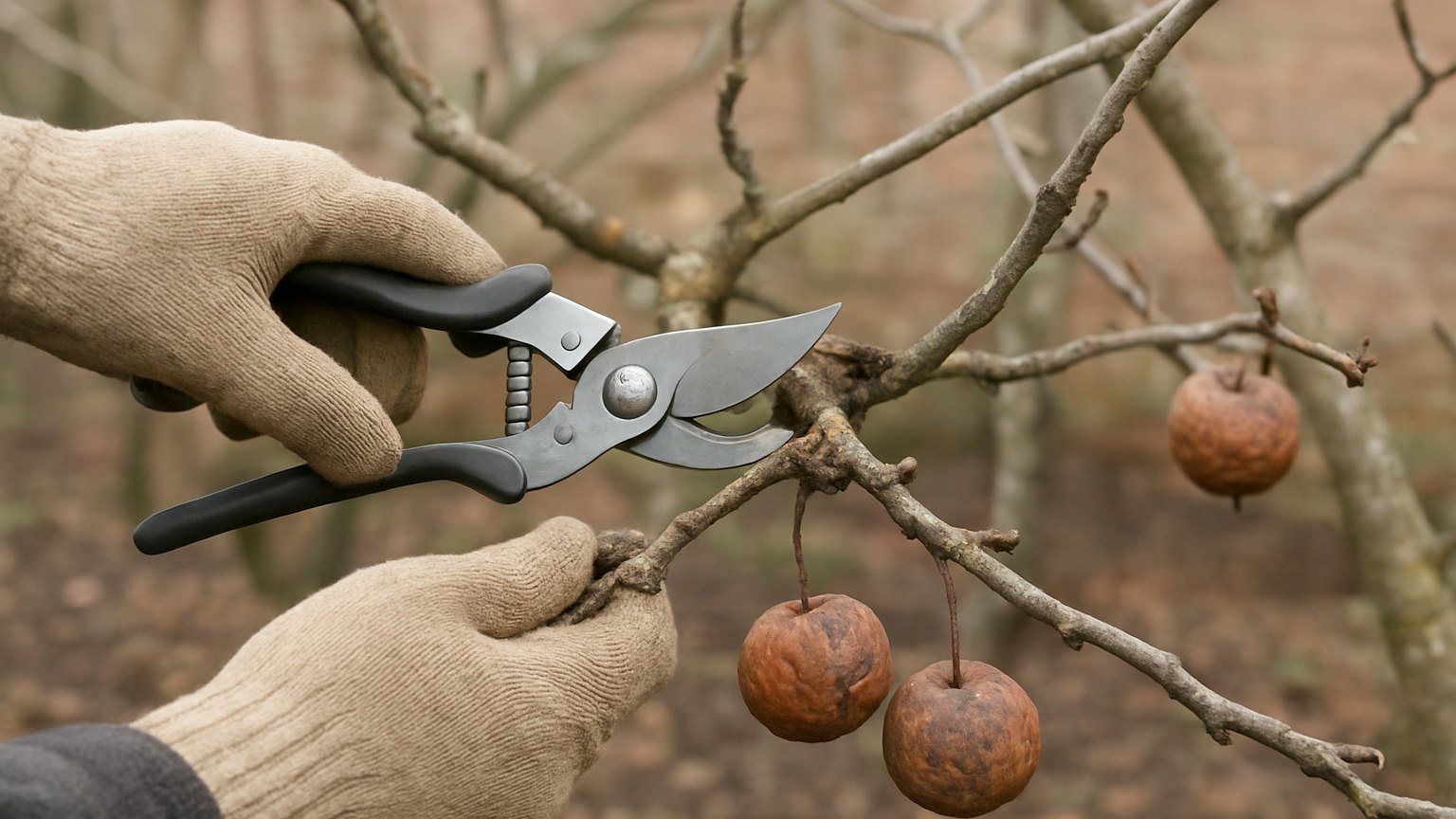
Four problems account for most disease on apples and pears, and all four respond better to airflow, hygiene and variety choice than to anything you spray. Amateur fungicides for tree fruit have largely been withdrawn, which makes the cultural measures the whole of the treatment.
Apple and pear scab
Olive-green or brown blotches on the leaves, and dark corky scabs on the fruit which may crack. Badly affected leaves fall early.
The fruit is still edible, if unattractive, and the main harm is a weakened tree and fruit that will not store.
It overwinters on fallen leaves, so raking them up and binning them in autumn is the most effective single measure. Prune to keep the centre of the tree open so foliage dries quickly, and choose scab-resistant varieties when planting, particularly in a wet part of the country.
Canker
The most serious of the four. Sunken, cracked patches on the bark, often around a wound or a pruning cut, sometimes with concentric rings and white or red pustules. The bark dies and the branch above it eventually dies back.
Canker must be cut out, and cutting it out promptly is the whole treatment. Prune the affected branch back well into clean healthy wood, at least fifteen centimetres beyond the visible damage.
On a main trunk where removal is impossible, pare the dead bark back to healthy tissue with a sharp knife.
Bin or burn everything removed, and disinfect tools between cuts, since canker is spread very readily on blades. It is worse on heavy wet soils and on trees under stress, so improving drainage and general vigour helps. Some varieties, including Cox and Bramley, are notably susceptible.
Powdery mildew
A white dusty coating on shoots, leaves and blossom, with affected shoots becoming distorted and silvery. Infected blossom sets no fruit.
It is caused by dry roots combined with humid air, which is the opposite of what people assume. Water and mulch the tree, and improve airflow through the canopy.
Prune out affected shoots in winter, cutting back to healthy wood, since the fungus overwinters in the buds. Removing silvered shoots as you see them in spring reduces the spread considerably.
Brown rot
Fruit developing a brown patch that spreads, with concentric rings of buff-coloured pustules. Affected fruit shrivels into hard mummified remains that often stay hanging on the tree through winter.
Those mummies are the reservoir of infection. Remove and bin every one, along with fallen affected fruit, and do not compost any of it.
The fungus enters through damage, so anything that breaks the skin makes it worse: codling moth, wasps, birds, hail and careless handling at picking. Thinning fruit so it is not touching also reduces spread from one to the next.
Pear rust
Honey fungus
Less common but the most serious of all. It shows as sudden dieback or death, with white fungal sheets under the bark at the base smelling strongly of mushrooms, and black bootlace-like strands in the soil.
There is no cure. Remove the tree with as much of the root system as possible, and do not replant a susceptible species in the same position.
Pear rust
Bright orange spots on the upper leaf surface, increasingly common. The fungus alternates with junipers, so removing nearby junipers helps where practical. Rake and bin fallen leaves, and prune out any swellings on branches.
Bitter pit, which is not a disease
Small sunken brown spots through the flesh of apples, most common on large fruit and on varieties such as Bramley.
It is a calcium problem, but almost never a shortage of calcium in the soil. The cause is irregular watering preventing the tree from moving calcium into the fruit, sometimes compounded by too much nitrogen.
Water consistently, mulch, avoid heavy nitrogen feeding, and thin the crop so fruit does not become oversized.
The measures that cover all of them
- Rake up and bin fallen leaves and fruit each autumn
- Prune for an open centre so air moves through
- Thin fruit so it is not touching
- Disinfect tools between cuts, especially on cankered wood
- Feed with potash rather than nitrogen, mulch, and water in drought
- Choose disease-resistant varieties when planting
- Avoid high-nitrogen feeds, which produce the soft growth these problems prefer


