
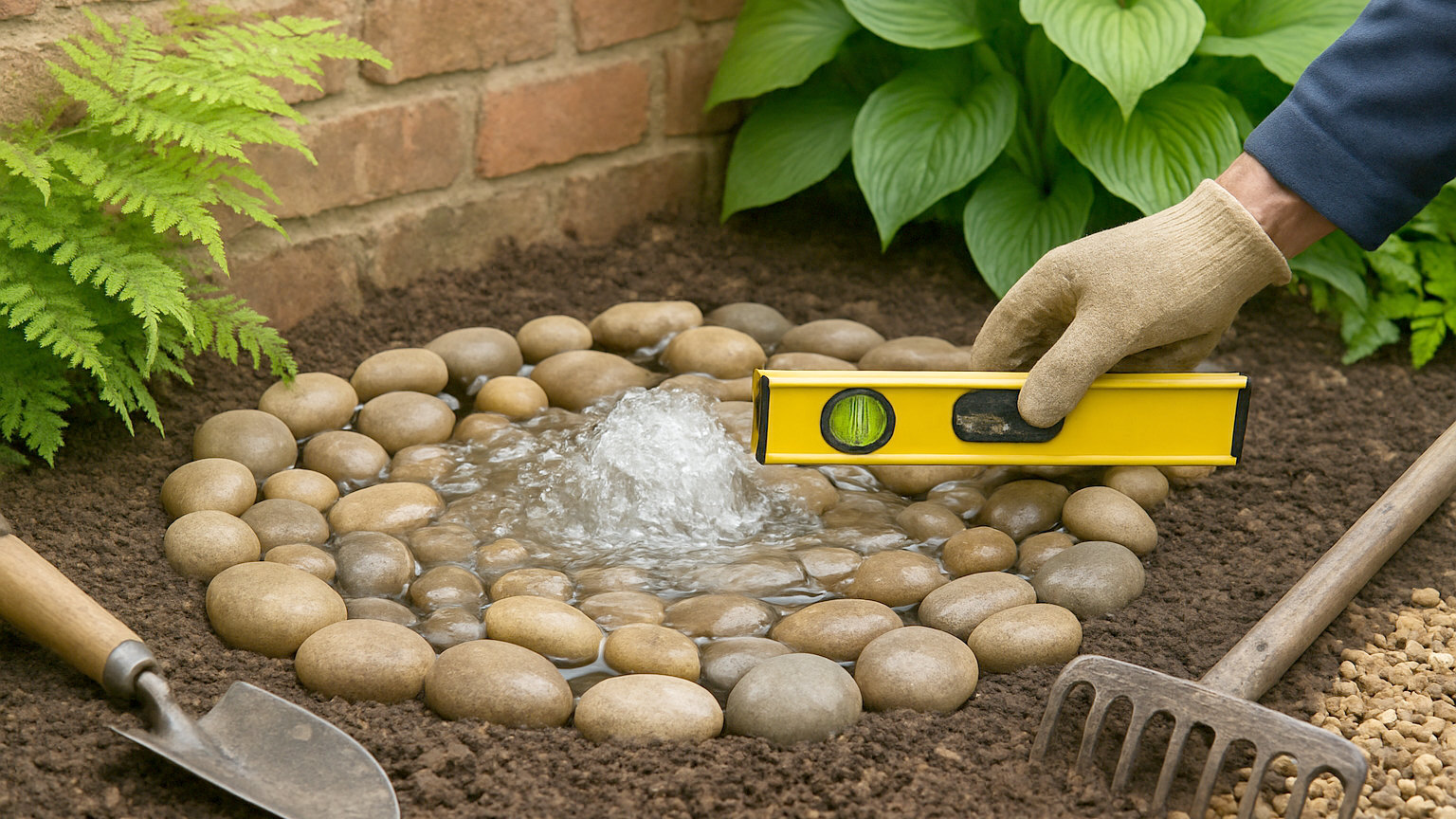
A small water feature gives you the sound and movement of water without the space, cost or safety considerations of a pond. Done well it is the most effective thing you can add to a small garden, since moving water masks traffic noise remarkably effectively.
The pebble pool
The most useful design for most gardens is a pebble pool: an underground reservoir with a pump, covered by a rigid grille and a layer of cobbles, with water bubbling up through a drilled stone, an urn or a millstone and draining back through the pebbles.
Its advantage is that there is no open water at all, which makes it the sensible choice where small children are around. It also uses very little water and is easy to hide within planting.
Birds use the wet pebbles for drinking and bathing, so it has genuine wildlife value even though it is not a pond.
Sizing the reservoir
Make the reservoir larger than seems necessary. A bigger volume means less frequent topping up and less risk of the pump running dry, which is what kills pumps.
For a modest bubbling feature, a reservoir holding around fifty to a hundred litres is sensible. Proprietary reservoir units are available, or a plastic water tank or dustbin sunk into the ground works perfectly well.
The grille over the top must be rigid enough to take the weight of the cobbles and of someone standing on it. Do not rely on a thin plastic lid.
Choosing a pump
Pumps are rated by flow rate in litres per hour, and by maximum head, which is the vertical height they can lift water.
For a small bubbling feature, something in the region of a thousand litres per hour is usually ample. For a spout or a small cascade, work out the height the water must rise and check the pump's head rating exceeds it comfortably, since flow drops sharply as head increases.
A flow adjuster on the pump or a tap in the pipework lets you tune the effect, which matters because too vigorous a flow on a small feature both looks wrong and splashes water outside the reservoir, emptying it.
Electrics, which must be done properly
Water and electricity require care rather than optimism. Any mains-powered pump must be run through a residual current device, and outdoor sockets and cabling must be to the correct external specification.
Installing an outdoor socket or running a permanent supply into the garden is notifiable work under the Building Regulations in England and Wales, and should be done by a qualified electrician. This is not a corner worth cutting.
Cable should be armoured or run in conduit, buried at a sensible depth, and its route recorded so nobody puts a spade through it later.
Solar and battery options
Solar pumps avoid the electrical work entirely and suit small features. The panel needs direct sun to run, so the feature stops when a cloud passes, and output falls considerably in winter.
Models with a battery buffer keep running through cloud and into the evening, and are worth the extra. For a feature you want running reliably, a mains pump is still the more dependable choice.
Containers and other options
A glazed pot or half barrel sealed and planted makes a container pond, which supports far more wildlife than a bubbling feature. Include a ramp or a stack of stones so anything falling in can climb out, and remember it is open water.
Wall-mounted spouts suit a courtyard, taking almost no floor space. A simple bird bath needs no pump at all and is the cheapest useful water in any garden.
Maintenance
Top up regularly, particularly in warm weather, since evaporation from a splashing feature is faster than expected and a pump run dry burns out quickly.
Clean the pump filter every few weeks. Blocked filters are the usual reason a feature stops working.
In winter, drain the feature and remove the pump, cleaning it and storing it indoors in a bucket of water so the seals do not dry out. Water left in pipework and reservoirs freezes and cracks them.
Placing it
Put it where you will hear it: near a seating area, beside a door, or under a window. Water heard from indoors earns its keep far more than water at the bottom of the garden.


