
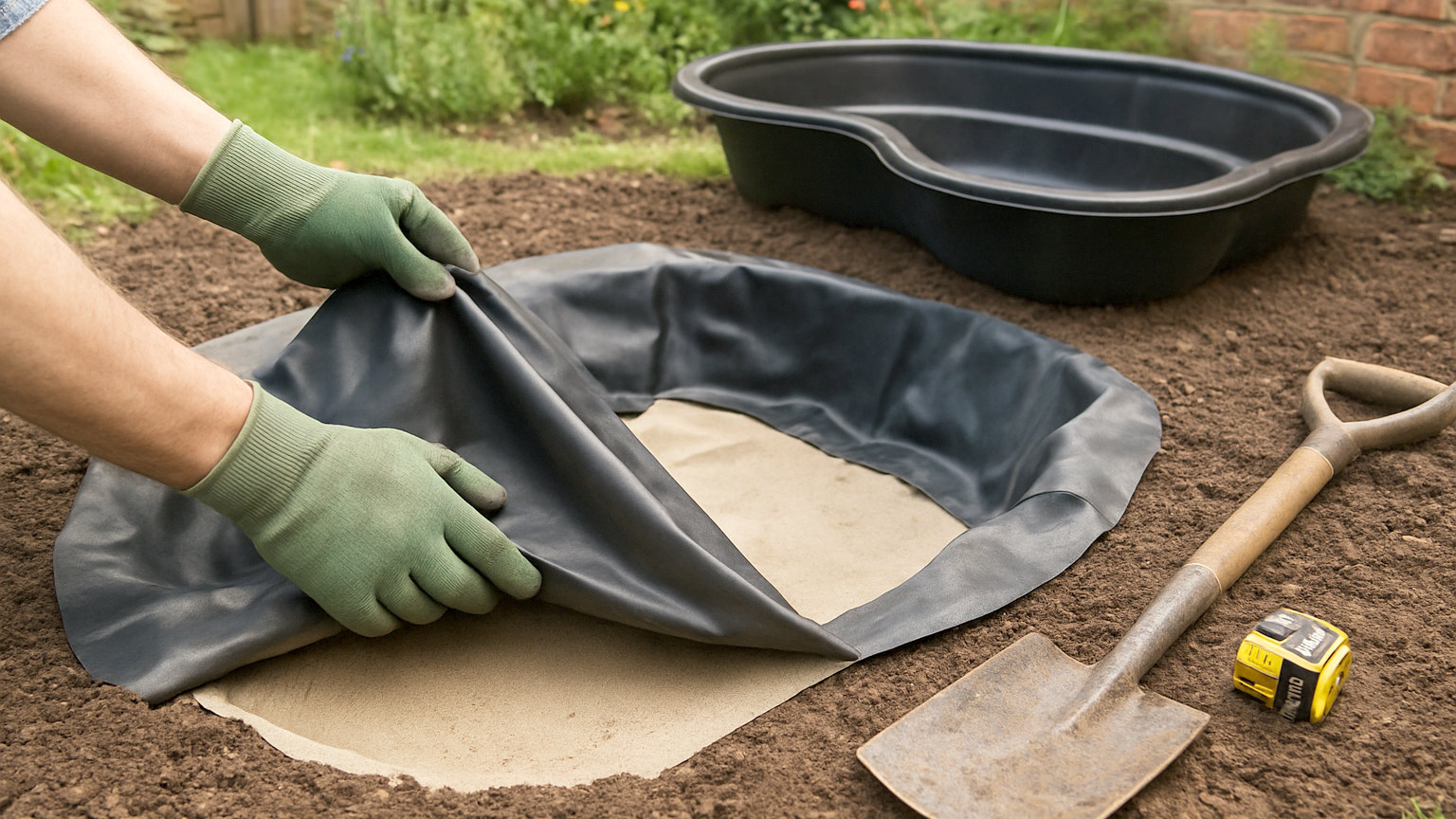
The liner determines the shape you can build, how long the pond lasts and how much of the work is excavation. It is worth choosing before designing the pond rather than afterwards.
Flexible liners
The usual choice for anything other than a very small pond, since the shape is entirely up to you.
Butyl and EPDM rubber are the standard for a permanent pond. They are flexible even in cold weather, conform to an irregular excavation, resist ultraviolet degradation, and are commonly guaranteed for twenty years or more with a practical life considerably longer.
They cost more than the alternatives and are heavy, so a large liner needs several people to position.
PVC liners are cheaper and less durable, becoming brittle with ultraviolet exposure over perhaps ten to fifteen years. Reasonable for a small or temporary pond.
LDPE and cheap builders' polythene should not be used. They puncture readily and fail within a few years.
Underlay is essential
Never lay a liner directly onto excavated soil.
Stones, roots and sharp fragments puncture liners, and a puncture beneath a full pond is difficult to find and unpleasant to repair.
Use a proper geotextile pond underlay, which is cheap compared with the liner and the labour.
Old carpet and thick layers of sand are sometimes used and are less reliable, since sand washes down the slopes and carpet rots and may contain treatments.
Remove all stones and roots from the excavation first, and firm the surface, then lay the underlay generously with overlaps.
Calculating liner size
The usual formula is straightforward.
Length needed is the maximum length plus twice the maximum depth, plus an allowance for the edges of about half a metre in total.
Width needed is the maximum width plus twice the maximum depth, plus the same edge allowance.
Measure the excavation rather than the plan, and be generous. A liner that is slightly too small cannot be corrected.
Preformed ponds
Rigid moulded units in fibreglass or plastic.
Quick to install, no risk of puncture from stones, and available in small sizes suited to a modest garden.
The limitations are real. The shape is fixed, they usually look smaller once installed than they did in the shop, the shelves are often too narrow for planting baskets, and the sides are frequently too steep for wildlife to climb out.
The excavation must match the shape closely and be well backfilled, or the unit distorts and the levels go out.
Fibreglass units last considerably longer than the cheap plastic ones.
Concrete and clay
Concrete gives a permanent formal pond and needs proper reinforcement, adequate thickness and correct detailing to avoid cracking with ground movement and frost. Fresh concrete also leaches lime, so it must be sealed or weathered before adding plants or fish. It is a skilled job.
Puddled clay is the traditional method and needs a large volume of suitable clay, considerable labour, and it must never dry out, since a clay pond that dries cracks and leaks.
Both are worth considering only in specific circumstances.
Fitting a flexible liner
Lay it on a warm day, when the material is more flexible.
Drape it loosely into the excavation, letting it settle rather than stretching it into place.
Fill slowly with water and let the weight pull the liner into shape, easing out the largest creases as it fills. Some creasing is unavoidable and does not matter.
Trim the surplus only when the pond is full and settled, leaving a generous overlap of at least three hundred millimetres all round.
Edging
The liner edge must be hidden and protected from sunlight, which degrades it.
Bury it in a shallow trench behind the edge, and cover with paving, turf, stone or planting.
Ensure the edge is level all round, since water finds its own level and any low point will overflow while the high side shows liner.
Repairs
Butyl and EPDM can be repaired with proprietary patches and adhesive, provided the area is drained, cleaned and thoroughly dry.
Finding a leak is the hard part. Let the pond drop until the level stabilises, which indicates the height of the hole, then inspect that band carefully.
Preformed units in fibreglass can be repaired with a glass fibre kit; cracked plastic ones usually cannot.


