
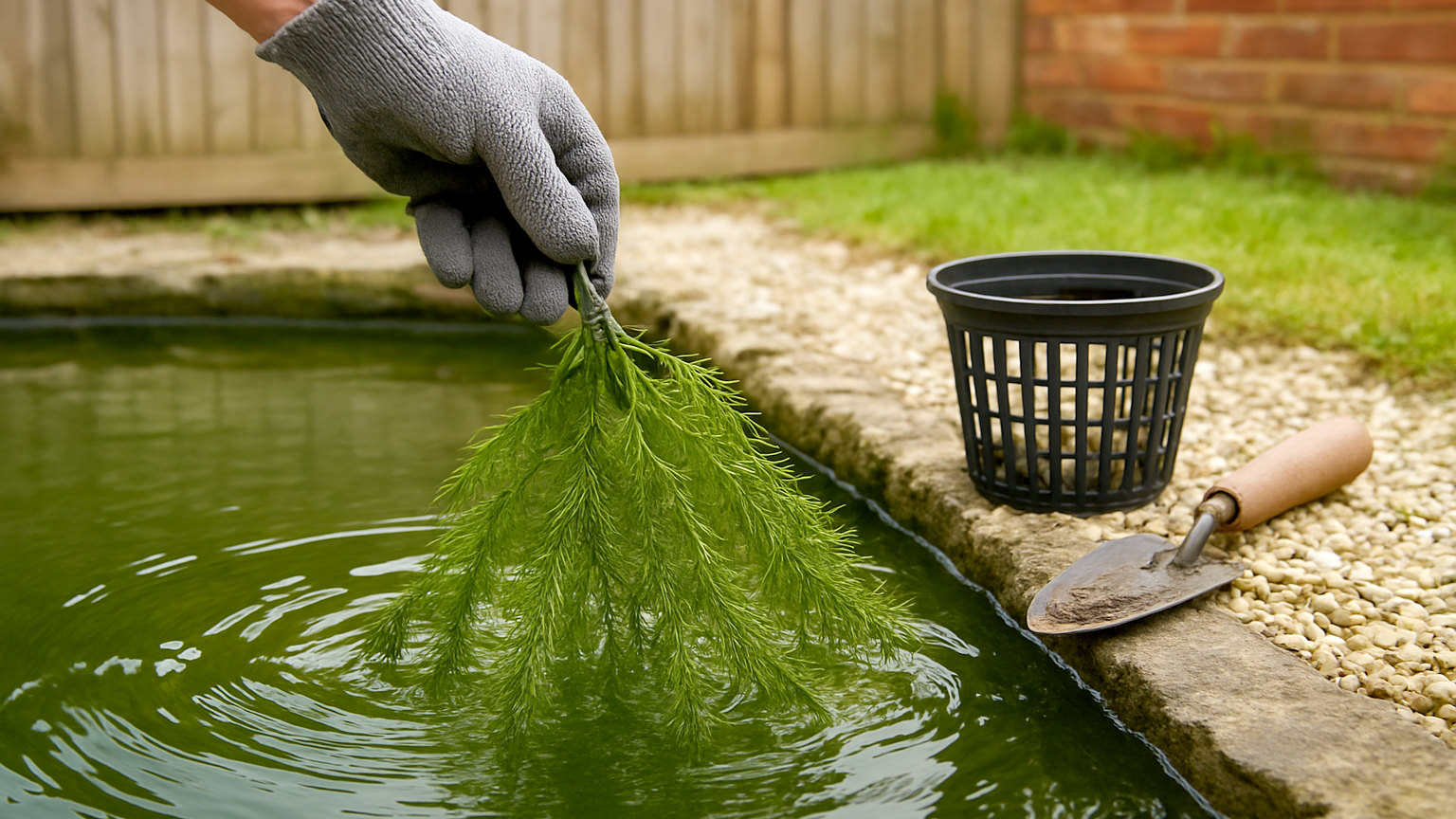
Clear water in a garden pond is the result of a balance between nutrients, light and plants, not of filtration. A well-balanced pond with no pump at all runs clear; an unbalanced one with an expensive filter still goes green.
What makes water green
Single-celled algae suspended in the water, multiplying rapidly when there is plenty of light and plenty of dissolved nutrient.
Algae are simply the fastest organism to take advantage of those conditions. They are not a disease and they do no harm in themselves.
The way to reduce them is to remove what they need rather than to kill them.
The three levers
Nutrients. Algae feed on dissolved nitrates and phosphates. Reduce the supply and reduce the algae.
Light. Algae need it. Shading the water surface with floating leaves reduces them substantially.
Competition. Submerged and floating plants take up the same nutrients. A well-planted pond starves the algae out.
Oxygenators do the work
Submerged plants growing entirely underwater are the main competitor to algae.
They absorb dissolved nutrients directly from the water, release oxygen during the day, and provide shelter and egg-laying sites for insects and amphibians.
Hornwort, water starwort, water crowfoot and spiked water-milfoil are reliable native choices.
Plant a reasonable quantity from the outset, and thin them when they become dominant, leaving the thinnings beside the pond overnight so anything living in them can return.
Surface cover
Aim for lily pads and floating plants covering roughly a third to a half of the surface.
This shades the water, keeps it cooler, and directly reduces the light available to algae.
Leave some open water, since a completely covered surface reduces oxygen exchange and gives nothing to look at.
Where the nutrients come from
Fallen leaves rotting in the water, which is why a pond under trees is a constant battle. Net the pond in autumn.
Ordinary compost or fertilised soil used in planting baskets. Use low-nutrient aquatic compost.
Tap water, which contains nitrates and phosphates. Top up with rainwater where possible.
Run-off from a fed lawn or a border.
Fish, which produce waste continuously and are the single largest nutrient input in most ponds that have them.
Overfeeding fish, where uneaten food decomposes.
A new pond will go green
Expect a new pond to turn green within weeks, and expect it to clear on its own.
The algae arrive first because they grow fastest. As the planting establishes and takes up the available nutrients, the algae are outcompeted and the water clears, usually within the first season.
Emptying and refilling a green pond restarts the whole cycle and makes matters worse.
Be patient, plant generously, and leave it alone.
Filters and pumps
A wildlife pond needs neither. Moving water is not required, and still water suits amphibians and many insects better.
A pond with fish, particularly koi, does need filtration, because the fish load exceeds what planting can absorb.
Ultraviolet clarifiers kill suspended algae as water passes through them and are effective at treating the symptom. They do nothing about the underlying nutrient level.
A pump moving water adds oxygen, which matters in hot weather and in a pond with fish.
Any electrical supply must be outdoor rated and protected by a residual current device, and permanent installation is work for a qualified electrician.
Barley straw
Widely used and it works slowly, releasing compounds as it decomposes that inhibit algal growth.
Add it in spring before the algae become established rather than as a cure, and remove it when it has rotted.
What not to do
Do not use algicides in a wildlife pond, which affect the whole system.
Do not empty and refill.
Do not add tap water in quantity if you can use rainwater instead.
Do not remove all the algae by hand and expect the problem to be solved, since the conditions that produced it are unchanged.
How long it takes
A new pond usually finds its balance within one growing season, sometimes two.
Expect green water in spring even in an established pond, clearing as the planting comes into growth and takes up the available nutrients.
Judge a pond in late summer rather than in April, when almost every pond in the country is green.


