
Algae in a pond takes two forms that look and behave differently, and confusing them leads to the wrong response.
Green water
Microscopic single-celled algae suspended throughout the water, turning it the colour of pea soup so that nothing below the surface is visible.
Common in spring and in new ponds, and it usually clears on its own as planting establishes and takes up the available nutrients.
It does no harm to wildlife and is largely a matter of appearance.
Blanketweed
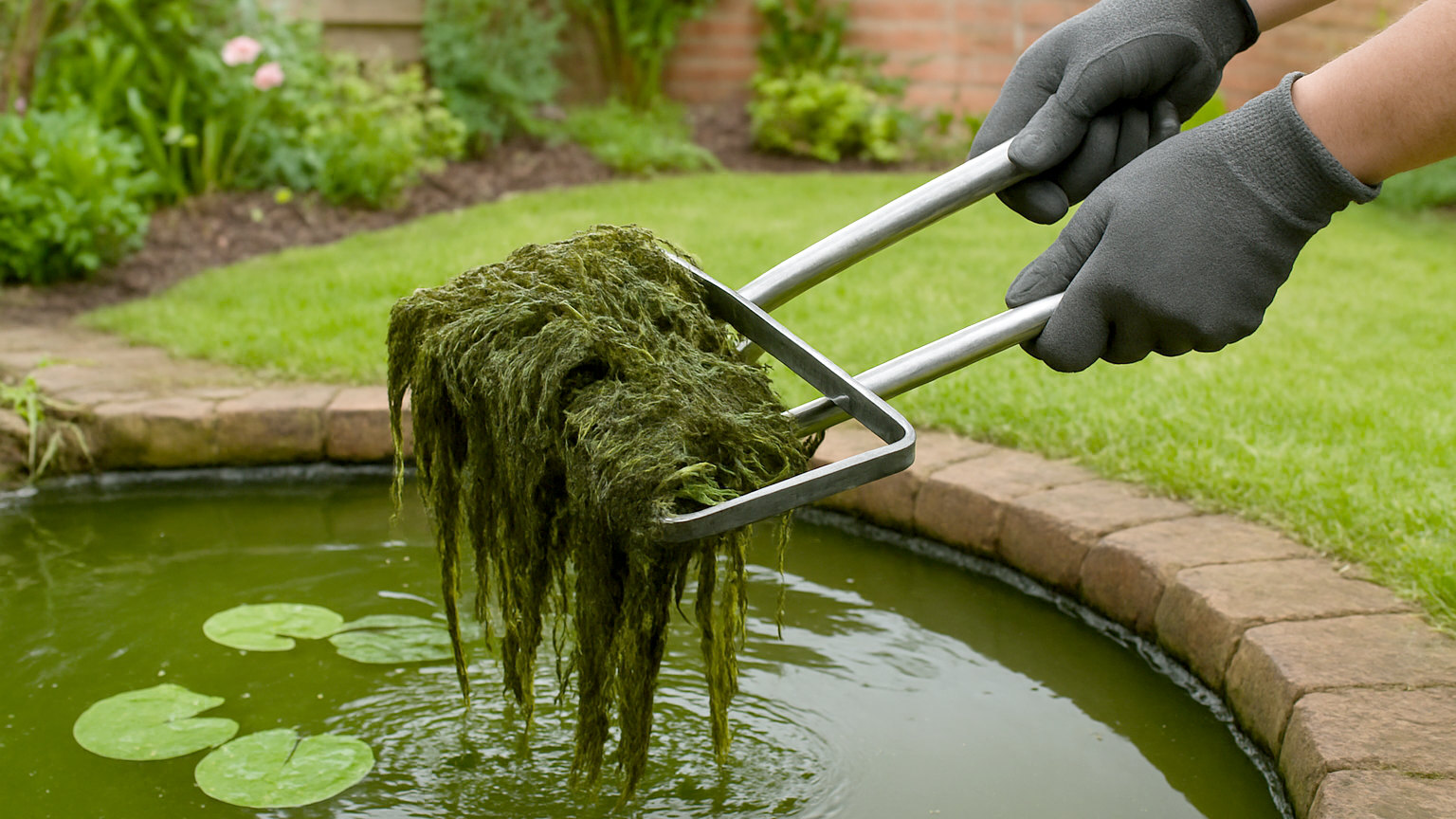
Filamentous algae forming long green strands and dense mats, attaching to plants, baskets and the pond sides.
Quite different from green water. It can grow rapidly in warm weather, smother plants, trap wildlife and, when it dies back in quantity, consume oxygen as it decomposes.
It is the more persistent problem and the more damaging.
Removing blanketweed
Twisting it out on a stick is the standard method, winding the strands around a cane or a rake like candyfloss.
A net works for smaller quantities.
Leave everything you remove beside the pond overnight so that the newts, tadpoles, snails, insect larvae and other creatures caught in it can make their way back to the water.
Compost it afterwards, well away from any watercourse or drain.
Remove it regularly rather than letting it build up, since a large mass dying back at once removes a great deal of oxygen from the water.
Why it grows
The same reasons as green water: plenty of light, plenty of dissolved nutrient, and insufficient competition from other plants.
Blanketweed is particularly favoured by warm shallow water with high nutrient levels, which is why it appears first around the margins and in a hot spring.
Long-term control
The only lasting solution is to change the conditions.
Plant more oxygenators, which compete directly for the same nutrients.
Increase surface cover with lilies and floating plants to about a third to a half, which reduces the light reaching the water.
Reduce nutrient input. Net the pond in autumn to keep leaves out, remove decaying material, use low-nutrient aquatic compost in baskets, top up with rainwater rather than tap water, and prevent run-off from fed lawns and borders reaching the pond.
Reduce or remove fish, which are the largest nutrient input in most ponds that have them, and do not overfeed.
These take a season or two to have an effect and they are what actually works.
Barley straw
Widely used and reasonably effective, releasing compounds as it decomposes that inhibit algal growth.
Add it in spring before algae become established rather than as a cure for an existing bloom, in a mesh bag so it can be removed, and take it out once it has rotted.
It works slowly and prevents rather than clears.
Ultraviolet clarifiers
Effective against green water, since the algae pass through the unit and are killed.
They have little effect on blanketweed, which does not circulate through the pump.
They treat the symptom rather than the cause, and they need a pump running continuously.
Any electrical supply must be outdoor rated and protected by a residual current device, with permanent installation carried out by a qualified electrician.
Chemical treatments
Available and generally best avoided in a wildlife pond.
Killing a large quantity of algae at once causes it to decompose, which removes oxygen and can kill fish and invertebrates.
If you use anything, follow the label exactly, treat a portion of the pond at a time over several weeks, and never allow it to reach a drain or a watercourse.
What not to do
Do not empty and refill the pond. It destroys the established balance, kills the wildlife, and refills with nutrient-rich tap water, which produces a worse bloom within weeks.
A note on blue-green algae
Distinct from both of the above, appearing as a blue-green scum or paint-like film in warm weather.
It can produce toxins that are dangerous to dogs and harmful to people. Keep animals and children away from any pond showing a scum of this kind, and wash hands thoroughly after contact with pond water generally.
It is more common in warm still nutrient-rich water, so the same measures that reduce other algae also reduce the risk of it appearing.


