
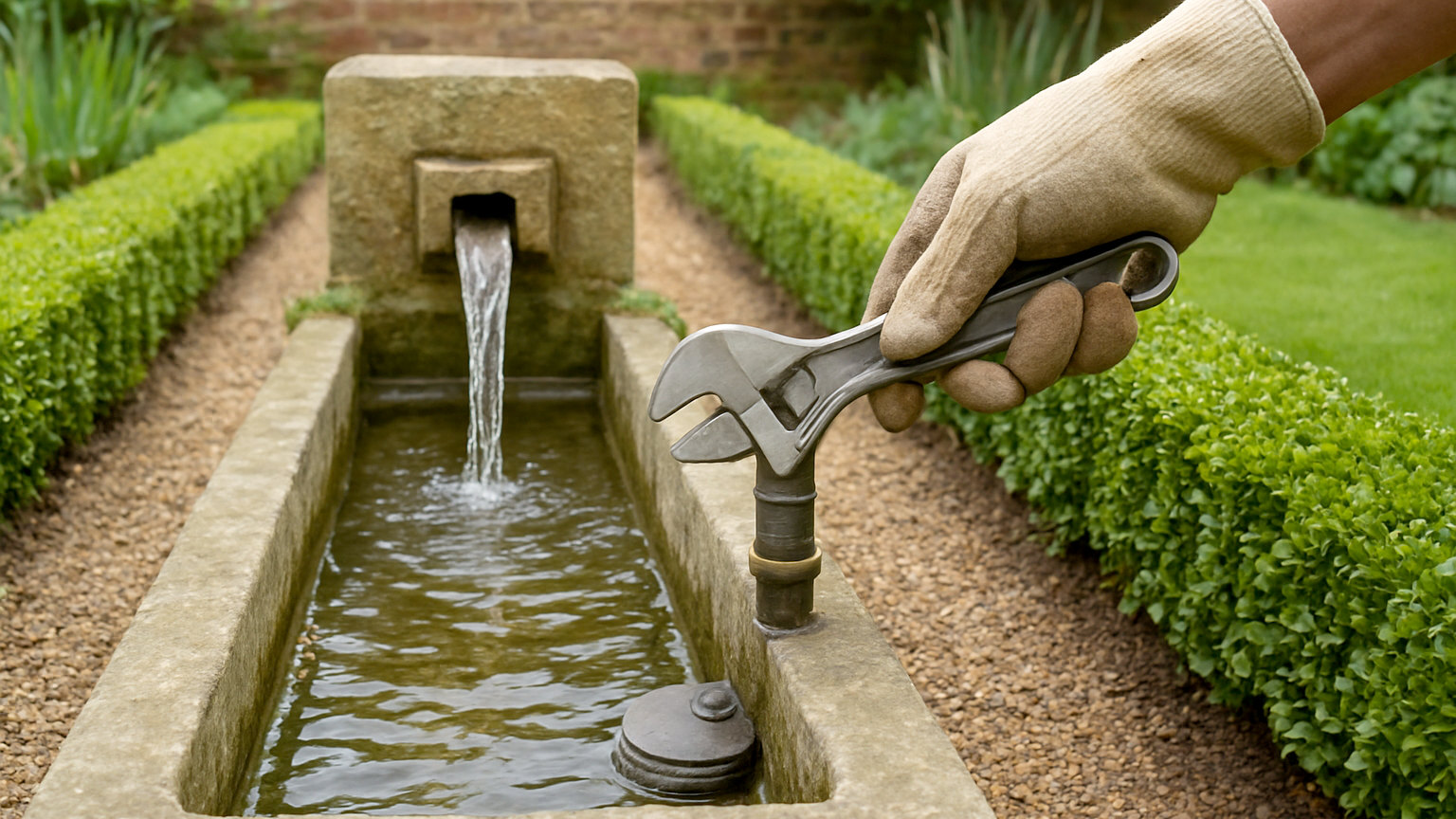
Formal water features treat water as an architectural element: still and reflective, or moving in a controlled way. They suit geometry, courtyards and small spaces, and they are engineering rather than habitat.
Still water
A reflecting pool or a formal canal, usually rectangular, with a crisp edge and no visible planting.
The point is the reflection, which doubles the sky and whatever is placed beside it.
A dark lining reflects far better than a pale one. A black liner or a dark-rendered finish gives a mirror; a pale blue one looks like a swimming pool.
Keep the water level right up to the edge, which is what makes a formal pool look intentional. A visible band of liner or wall above the water ruins it.
Still water needs shade or depth to stay clear, since there is no planting to compete with algae. Many formal pools use a filter or a clarifier for this reason.
Rills and canals
A narrow channel of water, sometimes moving slowly, used to lead the eye along an axis.
They work best when they relate to a line in the design: an axis from a door, a path, or a change of level.
Construction is usually concrete or blockwork rendered and sealed, or a liner concealed within a built channel.
Falls and levels have to be exact, since any error in a long shallow channel is immediately visible.
Water is recirculated from a reservoir at the lower end back to the head.
Wall spouts and masks
The most practical formal feature for a small garden.
Water falls from a spout into a basin or a concealed reservoir and is pumped back up.
Requires a wall capable of taking the fixing, a route for the pipe, and a power supply.
Where a concealed reservoir is used beneath a grid and pebbles, there is no open water at all, which makes it the usual answer in a family garden.
Fountains
A jet or a bubbler in a formal pool.
Keep the jet modest. A tall jet in a small pool loses a great deal of water to wind drift and to splashing, which then has to be topped up constantly.
The sound of water is often the point, and a small bubbler at close range gives more sound per litre than a tall thin jet.
Pumps
Size the pump to the job. Manufacturers quote flow rate at a given head, and the head is the height the water must be lifted plus losses in the pipework.
A pump that is too small produces a dribble; one that is far too large empties the reservoir over the edges.
Use a flow adjuster or a valve so the effect can be tuned.
Site the pump where it can be reached for cleaning, since the intake blocks with debris and needs regular attention.
Electrical safety
Any electrical supply must be outdoor rated and protected by a residual current device.
Permanent outdoor installation is notifiable work and should be carried out by a qualified electrician.
Low-voltage pumps with a transformer are simpler and safer for a small feature.
Never run a domestic extension lead outside as a permanent arrangement.
Reservoirs
Concealed reservoirs need enough volume that they do not run dry between top-ups, and a rigid lid capable of taking weight.
They must be checked and topped up regularly, since a pump running dry burns out quickly.
Evaporation from moving water is considerable in summer.
Maintenance
Clean the pump intake regularly.
Top up with rainwater where possible, since hard water leaves limescale on stone and around spouts.
Drain or protect the feature in winter, since water freezing in a pump, a pipe or a shallow basin cracks all three.
Clean algae off surfaces before it establishes, since a formal feature depends on looking crisp.
Wildlife
Formal features support far less than a wildlife pond, and adding a shallow sloping edge or a pebble beach at one point costs nothing and lets birds and insects use it.
A few stones breaking the surface let bees drink without drowning, which is worth doing in any water feature whatever its style.
Scale
Formal features work at any size, and a small one done properly reads better than a large one done cheaply.
A single wall spout into a stone trough in a courtyard is as effective as a canal in a large garden, and needs a fraction of the construction.


