
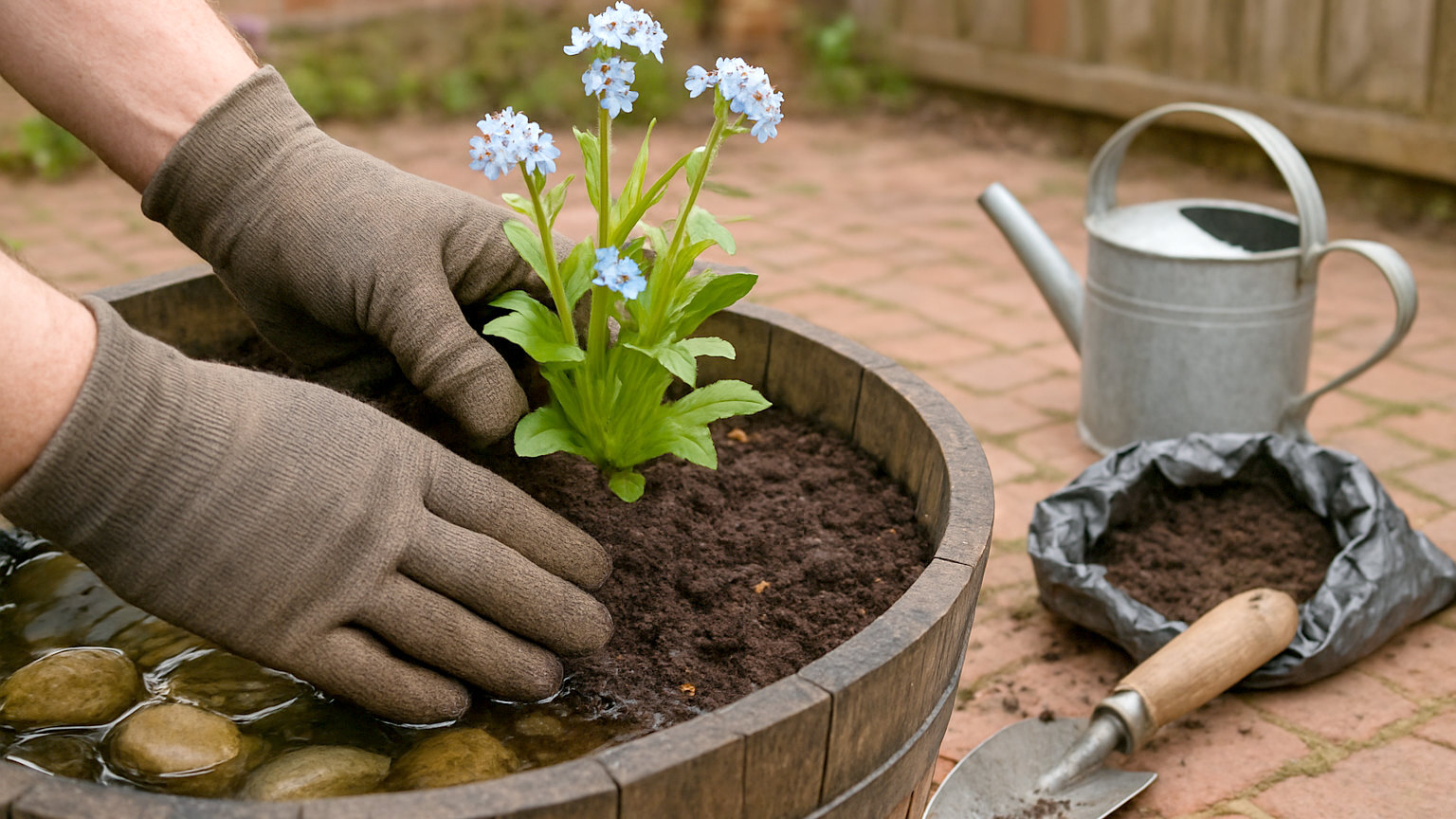
A container pond gives most of what a full pond gives in a fraction of the space, and wildlife finds even a very small volume of water surprisingly quickly.
Choosing a container
Anything watertight and frost proof.
Half barrels are traditional and attractive, and need lining, since the timber dries and shrinks and old barrels may have held something unsuitable.
Galvanised troughs, glazed ceramic pots, stone sinks and purpose-made containers all work.
Bigger is better in every respect. A larger volume is more stable in temperature, holds more oxygen, dilutes nutrients and supports more life.
Around forty litres is a workable minimum, and considerably more is preferable.
Depth of at least three hundred millimetres, and four hundred and fifty or more is better.
Preparing it
Seal any drainage holes thoroughly, or line the container with pond liner.
Line a wooden barrel with butyl or a proprietary liner regardless of whether it appears watertight.
Wash out any new container thoroughly, and avoid anything that has held chemicals, fuel or preservative.
Fill with rainwater where possible. If using tap water, let it stand for a few days before planting so the chlorine dissipates.
Position
Sun for part of the day and shade at the hottest part, since a small volume heats up quickly.
Away from overhanging trees.
Somewhere level and firm, since a full container is extremely heavy. On a balcony or a roof terrace, check the loading limits before installing anything, since water weighs a kilogram per litre.
Planting
Scale everything down, and use small varieties.
Oxygenator: a small quantity of hornwort or water starwort, which keeps the water clear.
Surface cover: a dwarf or pygmy water lily, or frogbit, aiming for about a third to a half of the surface.
Marginal: one or two small plants such as water forget-me-not, brooklime, dwarf reedmace or marsh marigold, raised on bricks to the right depth.
Use aquatic baskets and aquatic compost, topped with gravel.
Resist the temptation to overplant, since a small container fills within a season.
Avoid anything vigorous. Ordinary reedmace and many marginals will fill a container entirely.
Access for wildlife
A container with vertical sides is a trap for anything that falls in.
Provide a way out. A sloping branch, a pile of stones from the bottom to the rim, or a plank propped inside lets frogs, insects and small mammals climb out.
A shallow area of stones at one side also lets birds and bees drink safely.
What arrives
Water boatmen, pond skaters and diving beetles within weeks.
Birds drinking and bathing.
Damselflies laying eggs.
Frogs occasionally, though a container is generally too small to support successful breeding.
Do not add fish, and do not move spawn or animals from elsewhere.
Maintenance
Top up regularly with rainwater, since evaporation from a small surface is proportionally significant.
Skim off duckweed and thin the planting each year.
Remove fallen leaves promptly, since a small volume is quickly overwhelmed by them.
Expect green water in the first season while the balance establishes.
Winter
A small volume freezes readily.
Move a portable container to a sheltered position, or wrap the outside with insulation.
Float a ball on the surface so an opening can be made without breaking the ice.
Do not let it freeze solid if anything is living in it, and do not smash the ice.
Safety
Even a small container is a drowning risk to a toddler. Where young children use the garden, cover it with a rigid fixed grid or choose a pebble fountain instead.
Stand it somewhere it cannot be climbed on or pulled over, and check the surface it sits on can take the weight.
Why they work
A container pond costs very little, takes an afternoon, needs no excavation and can be moved.
For a courtyard, a small garden or a rented property it is often the only realistic way to have water, and the wildlife it brings is out of all proportion to its size.
Several containers grouped together give more surface area and more temperature stability than a single one, and they look deliberate rather than makeshift.
Vary the heights and sizes, and plant around the bases so they read as part of the garden.


