
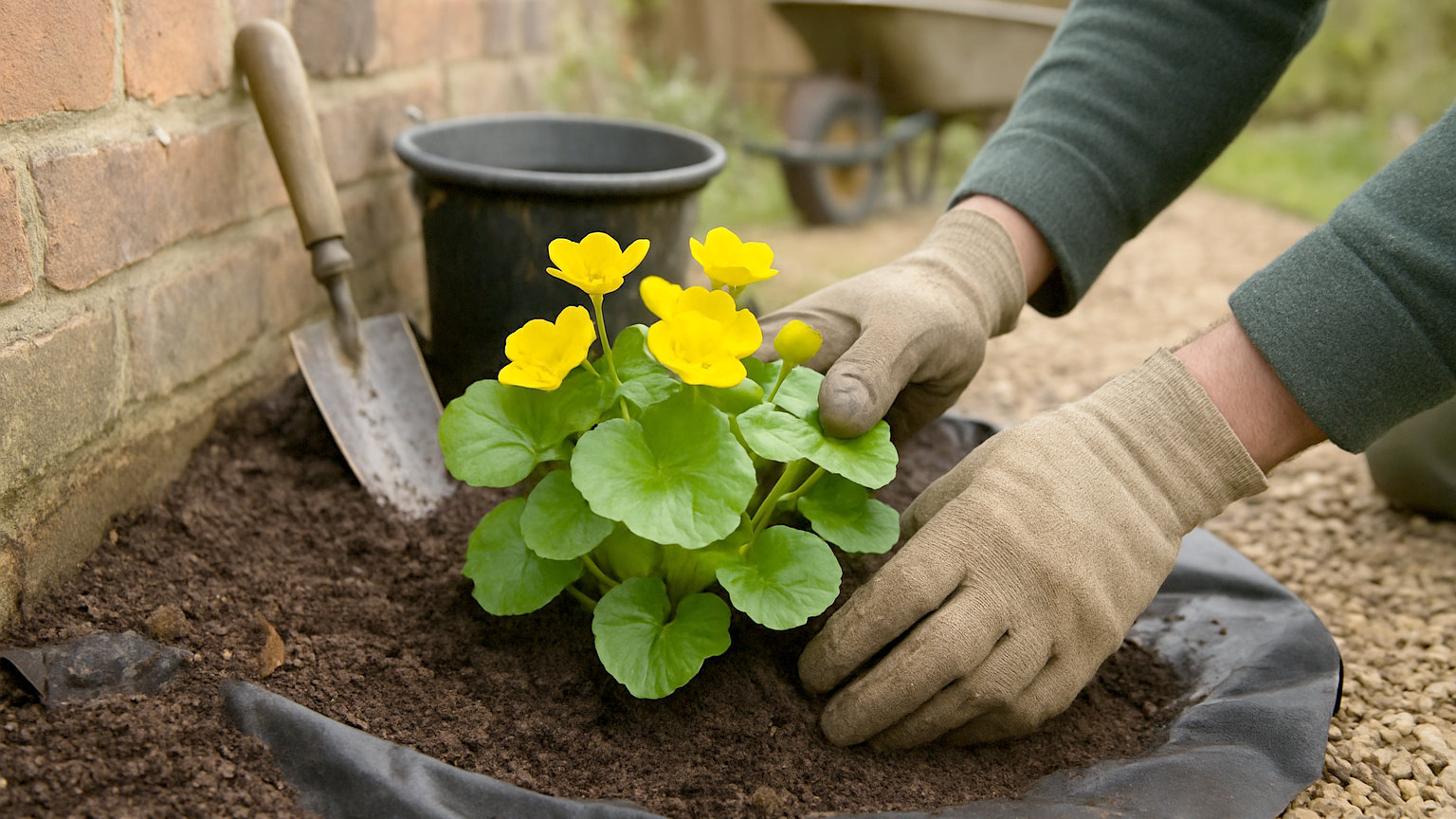
A bog garden is permanently moist ground, not standing water. It supports a distinctive group of plants, gives much of the wildlife value of a pond, and carries none of the drowning risk.
When to build one
Where the ground is naturally wet and fighting it has failed.
Alongside a pond, as a transition between water and dry ground, which is how it occurs naturally.
Where a pond is wanted but children make one unwise.
Where a downpipe or a run-off point delivers water that has to go somewhere.
Building one
Excavate to about four hundred to six hundred millimetres.
Line it with pond liner over underlay, exactly as for a pond.
Puncture the liner at intervals, roughly every metre, so water drains slowly rather than the area becoming a stagnant pool. A few holes in the sides above the base work better than holes in the bottom.
Add a layer of gravel in the base to help distribute moisture.
Backfill with a mixture of the excavated soil and plenty of organic matter, which holds moisture.
Lay a perforated pipe across the area before backfilling, with one end brought to the surface, so the bog can be watered from below in dry weather. This is the detail that makes a bog garden work through a hot summer.
Soak it thoroughly before planting.
Alongside a pond
The most natural arrangement. Run the pond liner up and over into the bog area so water can seep across, or keep the two separate with a low barrier.
The bog is then topped up by the pond, and the transition from water to marginal to bog to border looks entirely coherent.
Keeping it wet
A bog garden dries out faster than people expect, particularly in its first year and in a hot summer.
Water through the pipe rather than the surface, and mulch generously.
Rainwater is better than tap water, and a butt nearby is useful.
A bog garden in full sun needs considerably more water than one in part shade.
Plants
Foliage plants: hostas, rodgersia, ligularia, gunnera for a large space, darmera, rheum, ferns such as osmunda and matteuccia.
Flowering: astilbe, candelabra primulas, iris ensata and sibirica, lythrum, filipendula, trollius, caltha, mimulus, lobelia cardinalis.
Structure: carex, juncus, cyperus and other sedges and rushes.
Many of these are dramatic in leaf as well as flower, and a bog garden is one of the best places for bold foliage in a British garden.
Check the eventual size, since several are very large. Gunnera in particular needs a great deal of room, and some gunnera species are now regulated as invasive, so check the position before buying.
A naturally wet corner
Where ground is already permanently damp, the simplest approach is to plant for it rather than attempt to drain it.
Improve the soil with organic matter, and plant from the list above.
A wet corner treated as an opportunity is far cheaper and more successful than an attempt to change it.
Wildlife
Excellent, particularly alongside a pond.
Frogs, toads and newts spend most of the year out of water and use damp cover.
Dense moist planting shelters a great deal, and the flowers feed pollinators through summer.
Leave the growth standing over winter and cut back in late February.
Maintenance
Divide congested clumps every few years in spring.
Keep it watered, which is the main task.
Watch for slugs and snails, which enjoy the conditions and the soft foliage, particularly on hostas.
Weed carefully, since a bog garden is fertile and moist and weeds enjoy the conditions as much as anything else.
What it is not
A bog garden is not a pond margin and not a rain garden.
A pond margin has standing water over the roots; a bog garden has saturated soil with no free water above it.
A rain garden is designed to flood briefly after rain and drain within a day or so, and takes plants that tolerate both extremes.
The distinction matters when choosing plants, since few tolerate all three conditions equally well.
Safety
A bog garden has no standing water and no drowning risk, which is why it is the usual substitute for a pond in a garden used by very young children.
Make sure the construction does not create any pocket that holds free water.


