
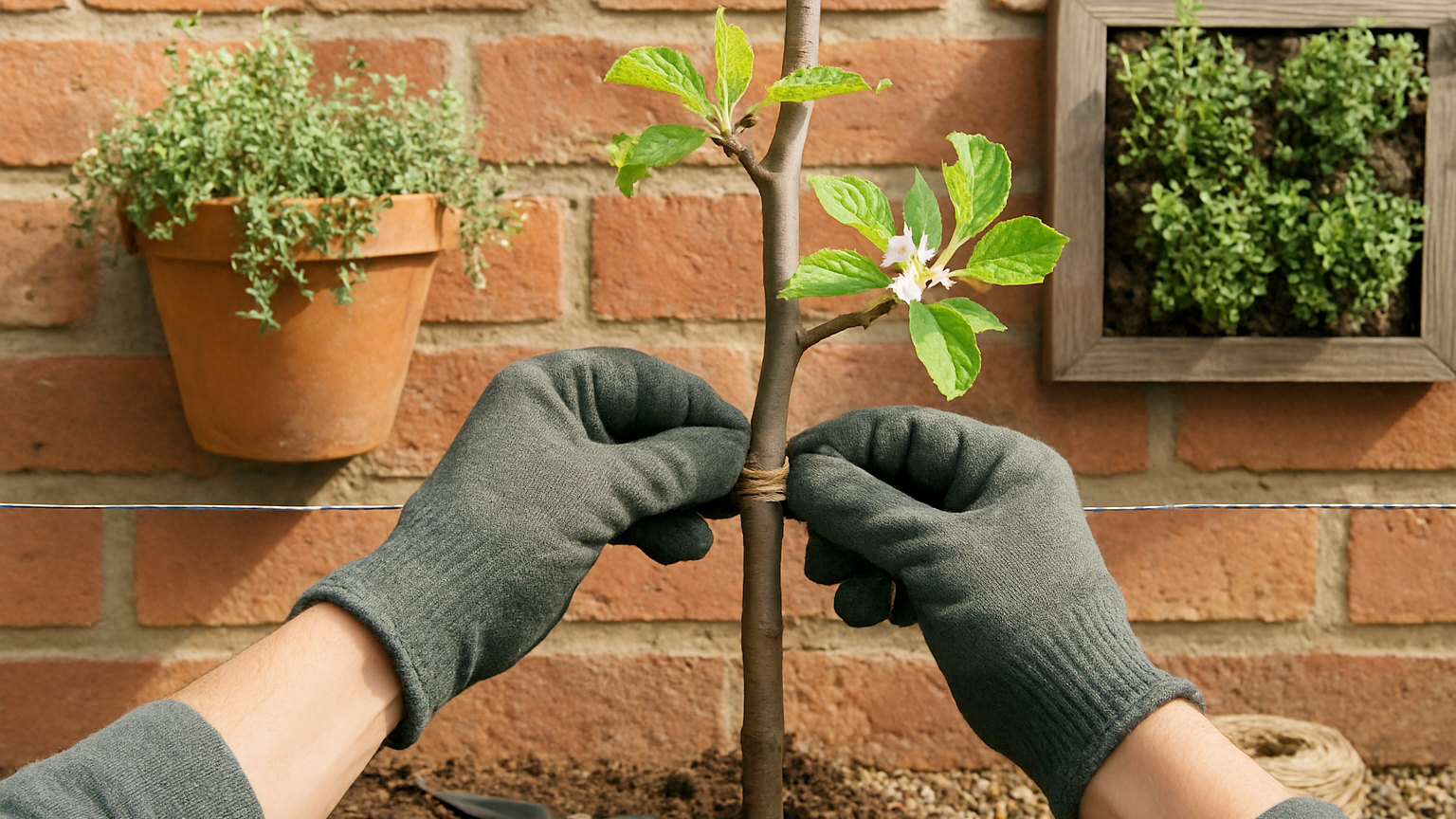
In a small garden the ground area is fixed and the vertical surface is usually several times larger. Using it is the most effective way to fit more into a limited space.
Climbers first
The cheapest and easiest vertical growing, taking almost no ground area and covering several square metres.
Fix horizontal wires on vine eyes, spaced about forty-five centimetres apart and held ten centimetres clear of the wall, or trellis on battens, so air circulates behind and stems can grip.
Plant at least forty-five centimetres out from the base, leaning inwards, since the ground at the foot of a wall is the driest in the garden.
Train stems horizontally where you can, since a stem trained sideways flowers along its whole length while an upright one flowers only at the top.
Match the climber to the aspect, and remember that clematis grips thin supports with its leaf stalks while roses must be tied in.
Trained fruit
Espaliers, fans and cordons against a wall produce a serious crop from a strip of ground a few centimetres wide.
A south or west wall suits peaches, apricots, figs and dessert apples and pears. A north wall suits morello cherries and some acid cherries.
Stepover apples along a path edge take almost no room at all.
All of these need annual pruning to a system, which is the trade for the productivity.
Wall-mounted containers
Pots, troughs, mangers and pouches fixed to a wall or fence.
Simple, cheap and effective, and they dry out extremely fast, since they are small, exposed and often against a warm surface.
Use the largest containers the fixings will take, choose plants that tolerate drying, and expect to water daily in summer.
Fix into masonry with appropriate plugs, or into fence posts rather than panels, which are not designed to carry weight.
Remember that a container full of wet compost is heavy, and that it becomes heavier as plants grow.
Living wall systems
Modular panels or pockets covering a whole surface with planting.
They look spectacular and they are the most demanding option in a domestic garden.
Irrigation is not optional. The growing medium is shallow and vertical, and without an automatic system a living wall dries out within a day or two and dies. Every serious system includes irrigation with a timer.
Feeding must be continuous, usually through the irrigation, since the medium holds almost no reserve.
The structure must be waterproofed and drained so that water does not run down the wall behind it, which causes damp.
The weight when saturated is substantial and the fixings must be into sound structure.
Expect to replace plants regularly, since some positions in any living wall are harsher than others.
They are best regarded as a horticultural installation rather than a planting, and a small well-maintained one beats a large neglected one.
Simpler alternatives
Shelves or a ladder frame holding ordinary pots gives height and is far easier to water and replant.
Hanging baskets, which need the same daily watering as any small container.
Obelisks, wigwams and free-standing trellis bring height into a border without needing a wall.
Tall narrow planters, which take less floor area for the same volume.
Fixing safely
Use fixings rated for the load and appropriate to the wall construction.
Do not fix to a fence you do not own without permission, and do not fix anything substantial to a fence panel.
On a rendered or cavity wall, take care not to breach the damp course or create a route for water.
Check the fixings annually, particularly after gales, since a falling planter is dangerous.
Light
A vertical surface has its own aspect, and a north-facing wall in a small garden may receive very little light.
Choose accordingly rather than fighting it, since ferns, ivy and shade-tolerant planting will thrive where sun-lovers will not.
What it achieves
A small garden with planted walls feels enclosed and green rather than boxed in by bare fences, and the growing area is multiplied several times over.
It also softens boundaries, which makes a small space read as larger than it is.
Start with climbers, which cost least and demand least, and add containers and systems only where the watering can realistically be kept up.


