
Storage is the least interesting part of a small garden and the one that most often ruins it. Bins, bikes, tools, cushions and compost all need somewhere to go, and in a small space they are always visible.
Work out what actually needs storing
List it honestly before designing anything: wheelie bins and recycling boxes, bikes, garden tools, a mower if you have grass, cushions, furniture over winter, compost and pots, children's toys, and a hose.
Measure the bins, since they are larger than people remember and are usually the biggest single item.
Decide what could be kept elsewhere, since anything indoors or in a garage is space recovered.
Bins
Usually the most intrusive item and the one nearest the front of the house.
A purpose-made bin store, or a simple slatted timber enclosure, contains them and can be planted or painted to blend in.
Leave enough room to open the lids fully and to wheel the bins in and out without lifting.
Site them where they are convenient to use and to present for collection, since an inconvenient bin store is not used.
Allow ventilation, since a sealed enclosure smells.
Bikes
Bulky, valuable and awkward.
Purpose-made bike stores are compact and secure. A lockable metal or timber unit with a ground anchor inside is the practical answer.
Vertical or wall-mounted racks under a lean-to take far less floor area.
Check the insurance position, since many policies limit cover for bikes stored outside and specify a lock standard.
Compact garden storage
A full shed is frequently too large for a small garden.
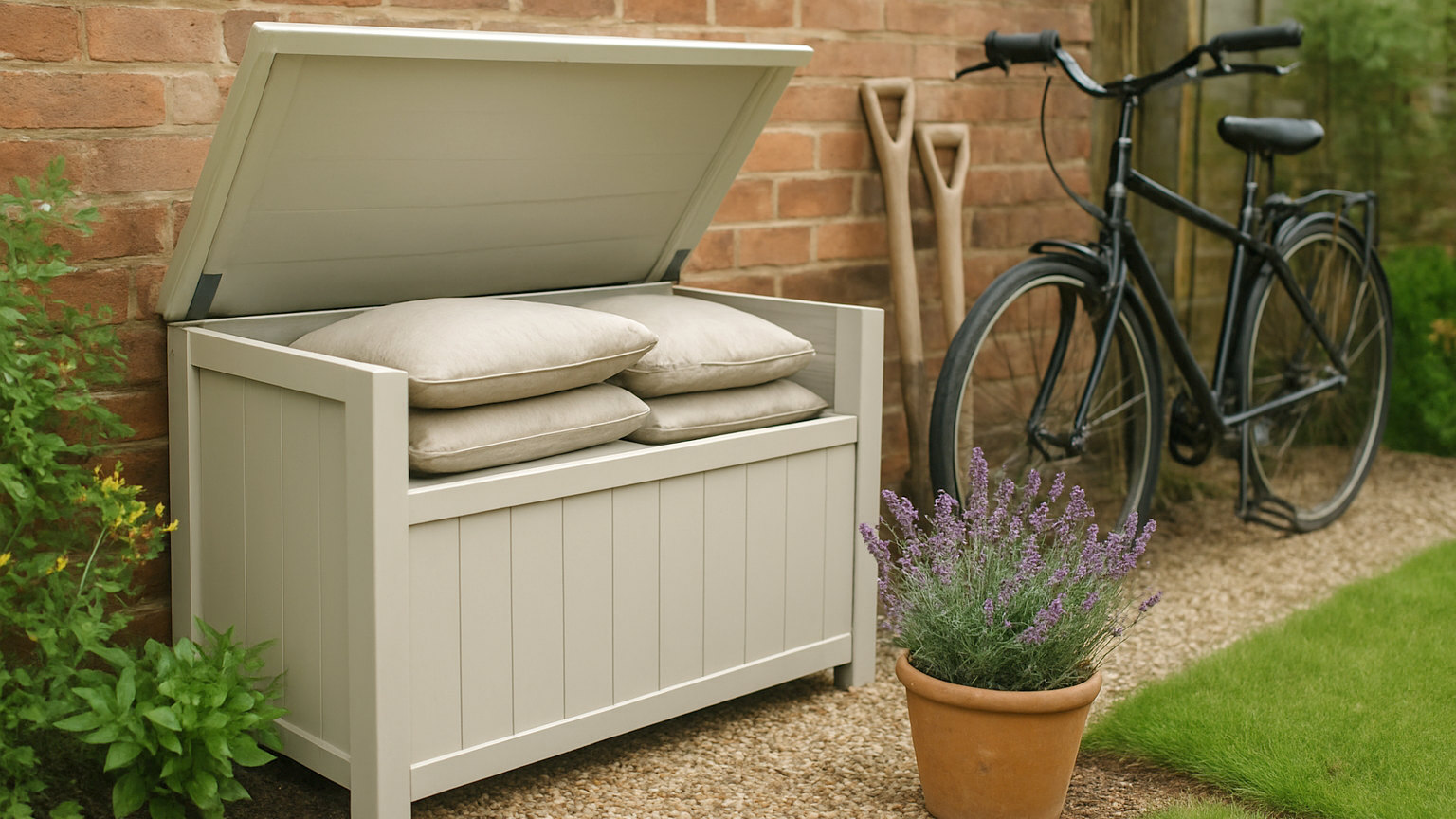
Storage benches do two jobs, giving seating and holding cushions, tools and toys beneath. The single most useful item in a small garden.
Vertical or pent stores, roughly the depth of a cupboard, hold tools and take up very little floor area against a wall or a fence.
Lean-to stores against a house or boundary wall use dead space efficiently.
Under-deck storage uses space that already exists, provided ventilation beneath the deck is maintained and the space can be reached.
Wall-mounted racks and hooks keep tools, hoses and equipment off the floor.
Building it in
Storage designed into the layout is far less intrusive than storage added afterwards.
Built-in seating with lift-up lids along a boundary. Raised beds with storage beneath. A store built into a change of level. A run of cupboards behind a screen at the end of the garden.
Matching the storage to the boundary treatment or the fence colour makes it disappear.
Screening
Where a store cannot be attractive, screen it.
A slatted screen, trellis with a climber, or a group of shrubs hides a utility area effectively.
Green roofs on bin and bike stores turn a flat lid into planting, which works well when the store is overlooked from a window above.
Paint utility items a dark recessive colour, which makes them far less noticeable than a pale one.
Practical points
Keep everything under cover and off the ground, since damp is what ruins tools and cushions.
Site frequently used items near the door and seldom used ones further away.
Secure anything valuable, since garden stores are commonly targeted. Bolt hasps through rather than screwing them, use a closed-shackle padlock, and consider a ground anchor.
Store chemicals and fuel locked away, in original labelled containers, and never in a space where they could be reached by children.
The alternative
Own less. A small garden with three tools, no mower and folding furniture needs very little storage at all.
Hiring a machine for the occasional heavy job removes the need to store it for the other fifty-one weeks of the year.
Composting in a small space
A wormery or a compact hot composting bin handles kitchen and garden waste in a fraction of the room a traditional heap needs, and both can be tucked behind a screen.
Both produce something genuinely useful for containers, which is where a small garden most needs it.
Doing it once
Decide the storage at the design stage rather than after the paving is laid, since retrofitting a bin store into a finished small garden usually means taking something out again.
It is the least rewarding part of a design and the one that most determines whether the finished garden works.


