
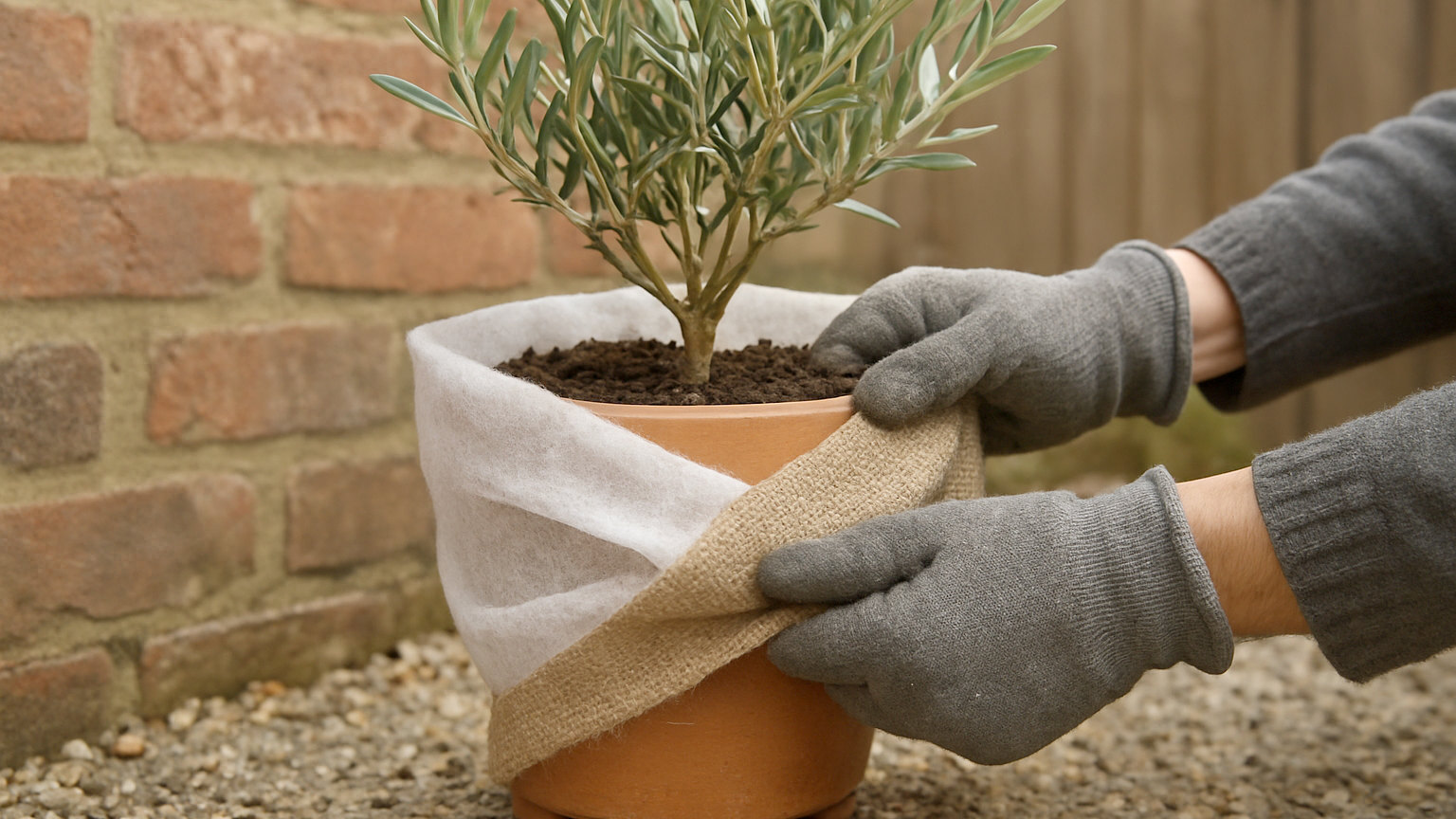
A plant in the ground has the whole mass of the soil insulating its roots. A plant in a container has a few centimetres of compost with cold air on every side, and the rootball can freeze solid.
Winter wet kills more than cold
The commonest cause of container losses over winter is not frost but waterlogging.
Compost that stays saturated through months of rain excludes air, and roots rot. The plant then collapses in spring just as growth should start.
Raise every pot on feet or bricks so water drains away freely, and check the drainage holes are not blocked.
Remove all saucers over winter. A pot standing in a saucer of water is the classic way container plants are lost.
Move pots out of the path of downpipes and gutters, and consider a sheltered position against a wall where they receive less rain.
Add grit to the compost of anything Mediterranean, alpine or otherwise wanting sharp drainage.
Protecting roots from freezing
Wrap the container rather than the plant, since it is the roots that need protection.
Bubble wrap, hessian, fleece or straw tied around the outside of the pot insulates effectively.
Group pots together against a house wall, which is several degrees warmer than open ground and gives mutual shelter.
Stand smaller pots inside larger ones with insulating material between them.
Plunging pots into a spare piece of ground, up to their rims, is the most effective protection of all where space allows.
Frost-proof pots
Check the difference before buying. Frost resistant is not the same as frost proof.
Saturated compost expands as it freezes, and porous terracotta absorbs water and cracks or flakes.
Empty and store any pot not in use, upside down or under cover, so it does not fill with water and split.
Protecting top growth
Borderline evergreens and anything with soft growth benefit from a fleece wrap during hard weather.
Wrap loosely, allowing air movement, and remove it as soon as the cold passes. Permanent wrapping causes rot and encourages soft growth.
Move anything vulnerable into the lee of a wall or a hedge, since cold wind does more damage than still frost.
Tender plants
Anything not hardy needs to come under cover before the first frost.
A frost-free greenhouse, a conservatory, a porch or a light indoor windowsill will do, depending on the plant.
Pelargoniums, fuchsias, citrus, olives in a cold area and most exotics all need this.
Reduce watering substantially in winter, keeping the compost barely moist, and stop feeding entirely.
Check regularly for pests, which thrive in a warm dry indoor winter, and remove dead material before it rots.
Watering in winter
Containers still need occasional water, particularly evergreens and anything against a wall or under an overhang where rain does not reach.
Evergreens lose water through their leaves all winter and can die of drought in a cold dry spell, especially in wind.
Check monthly and water sparingly on a mild day, never when frozen.
Which plants cope
Reliably hardy container plants include box alternatives, yew, holly, dwarf conifers, hardy ferns, heucheras, hellebores, most grasses, sedums and spring bulbs.
Anything borderline in the ground is more vulnerable in a pot, so treat container plants as roughly one hardiness band less hardy than the label suggests.
Spring
Remove wrapping as soon as the weather allows.
Topdress with fresh compost and slow-release fertiliser.
Check for root damage, repot anything congested, and be patient with plants that are slow to start, since many recover from a hard winter later than expected.
Bulbs in pots
Spring bulbs are among the best container subjects and need no protection beyond good drainage.
Keep them somewhere cool over winter rather than warm, since warmth produces weak drawn growth, and protect the pots from squirrels and mice, which dig up crocus and tulips readily.
A layer of chicken wire over the surface until growth appears solves that entirely.
Common winter losses
Waterlogging, from a blocked drainage hole or a saucer left in place.
A cracked pot, from using one that was frost resistant rather than frost proof.
Drought in evergreens, in a cold dry windy spell against a sheltered wall.
Frozen rootballs in small exposed containers.
All four are avoidable, and none of them is really about how cold the winter was.


