
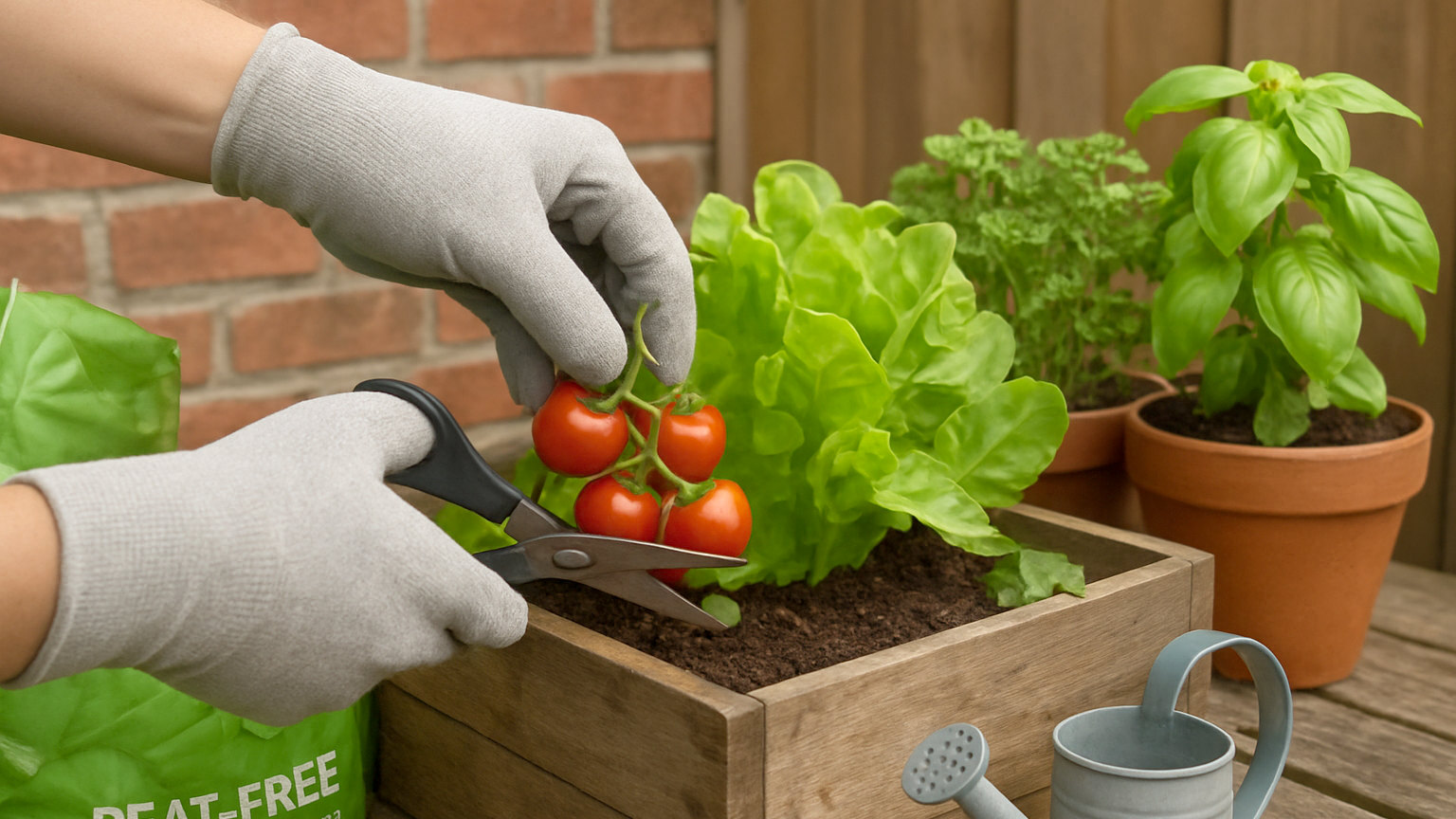
A small space cannot feed a household, and it can produce things that are expensive to buy, better fresh, or simply unavailable. That is the basis for deciding what to grow.
What is worth the space
Salad leaves. Cut-and-come-again mixes crop repeatedly from a small container, are expensive in shops, and deteriorate within days of picking. The clearest win.
Herbs. Sold in tiny quantities at high prices, and better fresh. Most are happy in pots, and several are perennial.
Tomatoes. Productive in containers, and homegrown ones taste unlike shop ones. Bush and tumbling varieties suit small spaces and hanging baskets.
Chillies and peppers. Compact, ornamental and productive on a sunny sill or balcony.
Strawberries. Excellent in containers, hanging baskets and vertical planters.
Runner and climbing French beans. Grown vertically on a wigwam, producing heavily from a small footprint.
Courgettes. One plant in a large container crops abundantly.
Radishes and spring onions. Fast, small and useful for filling gaps.
What is not
Maincrop potatoes, which are cheap and take a great deal of room, though early potatoes in a bag are worth it for the flavour.
Sweetcorn, which needs a block for pollination.
Brassicas, which occupy ground for months, take a lot of space and attract pests.
Onions and carrots in quantity, which are inexpensive and space hungry, although a pot of carrots avoids carrot fly and tastes better.
Anything you do not actually enjoy eating, however easy it is to grow.
The test is whether a crop is expensive to buy, better fresh, or unavailable in the varieties you want.
Containers for food
Use larger containers than you think necessary, since vegetables are thirsty and hungry.
Depth matters: salads and herbs manage in fifteen to twenty centimetres, while tomatoes, courgettes and beans want thirty or more, and potatoes and carrots deeper still.
Growbags, buckets with drainage holes drilled in them, and recycled containers all work.
Use a peat-free multipurpose compost for annual crops, fresh each year.
Feeding and watering
Food crops in containers are heavy feeders and dry out fast.
Water daily in summer, and more than once a day for tomatoes in hot weather. Irregular watering causes splitting and blossom end rot.
Start liquid feeding about six weeks after potting, switching to a high-potash tomato feed once fruit begins to set.
A drip system on a timer makes the whole thing far more reliable.
Growing upwards
Beans, peas, cucumbers, squashes and tomatoes can all be trained vertically, taking a fraction of the ground area.
Trained fruit against a wall takes a strip a few centimetres wide.
Wall-mounted planters and shelves of pots multiply the growing area.
Keeping it productive
Sow small amounts often rather than everything at once, so crops come in succession rather than all in one fortnight.
Replace a finished crop immediately with something else rather than leaving the container empty.
Choose fast crops for gaps: radish, salad leaves, spring onions.
Pick regularly. Beans, courgettes and salads all crop more heavily the more they are picked, and stop when left to mature.
Light
Most food crops need at least six hours of sun, which is the real constraint in a small enclosed garden.
Where light is limited, salad leaves, spinach, chard, mint and parsley cope with less than fruiting crops do.
Tomatoes, peppers, chillies and aubergines need the sunniest position available and will not crop without it.
Making it look good
Food plants can be attractive: chard, kale, herbs, runner bean flowers, chillies and strawberries all earn a place among ornamentals.
Mixing them into containers and borders is more practical than a separate vegetable area in a small space.
Pests in a small space
Concentrated planting means concentrated problems, and slugs find containers readily.
Copper tape, raising pots on feet, and going out after dark with a torch all help. Check under rims and pots, where they shelter during the day.
Fine mesh over carrots and brassicas excludes the main pests entirely and takes very little material at this scale.
Starting out
Begin with salad leaves and herbs in two or three containers, which are the easiest and the most rewarding.
Add a tomato or a courgette the following year once the watering routine is established.
Growing too much at once is the usual reason people give up, since the watering becomes a chore before the harvest arrives.


