
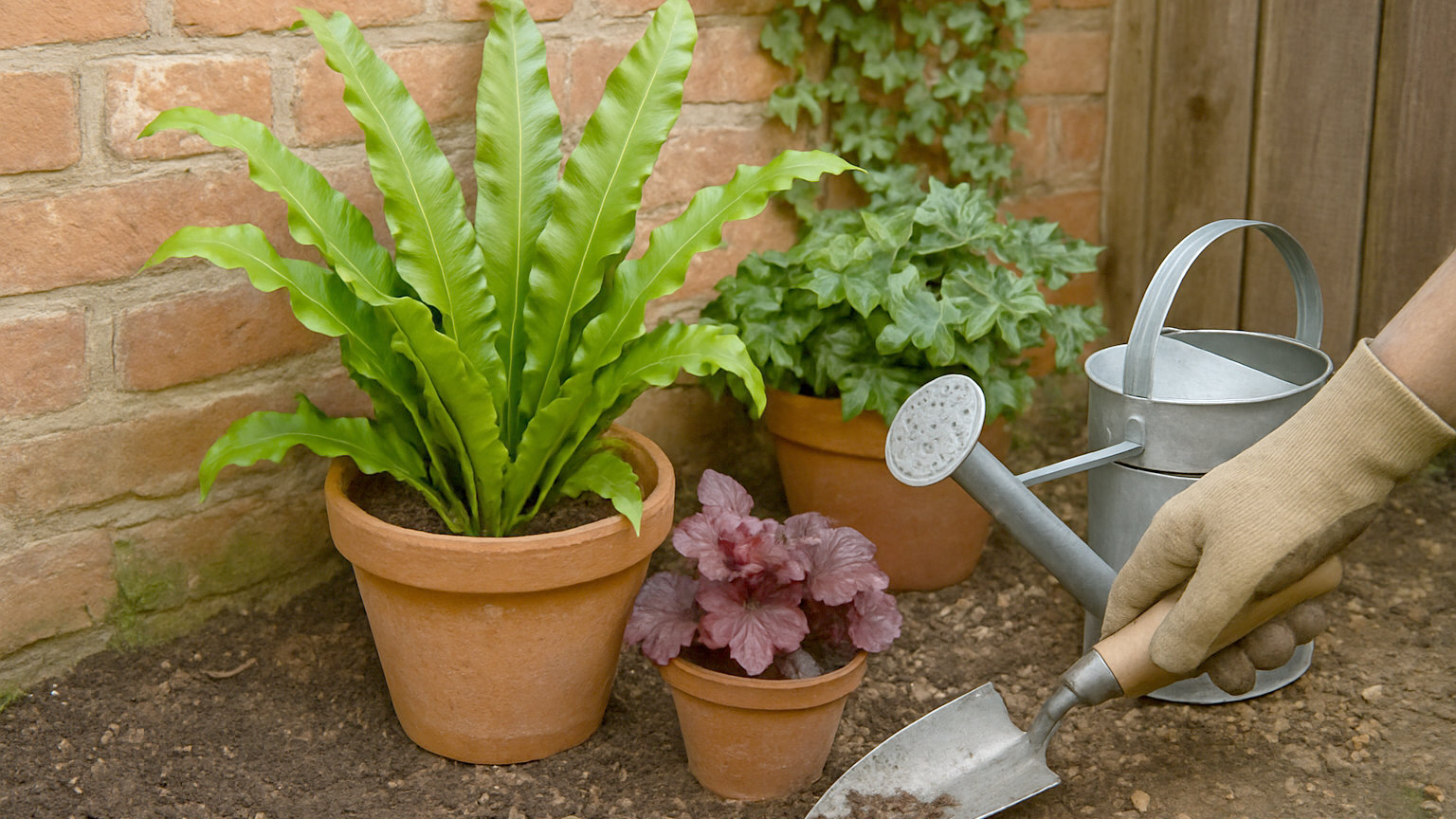
An enclosed courtyard has a microclimate of its own: sheltered, often warmer than the open garden, frequently shaded for much of the day, and reliably dry at the base of the walls.
The conditions
Shelter is the great advantage. Walls on several sides mean almost no wind, which allows plants that would be shredded elsewhere: large-leaved foliage, tree ferns in mild areas, bananas, and anything tender.
Warmth. Masonry absorbs heat and releases it slowly, and an enclosed courtyard is frequently a degree or two warmer and less frost prone than open ground, which extends what is possible.
Shade for much of the day, with a narrow window of direct sun. Track where and when the sun falls before planting.
Dryness. The ground at the base of a wall is the driest in any garden, and a courtyard is mostly base of wall.
Dealing with the dryness
Rain shadow is the main practical problem and defeats more courtyard planting than shade does.
Plant at least forty-five centimetres out from walls where you can.
Check what is in the ground, since courtyard soil is frequently builders' rubble and subsoil rather than topsoil. Excavate, remove the rubble and replace with decent soil and compost.
Mulch generously and water thoroughly through the first two seasons and in dry spells afterwards.
A soaker hose or drip line on a timer removes the daily task in a space that is mostly containers.
Use the walls
In a courtyard the vertical surface is several times the ground area, and using it is the whole point.
Fix horizontal wires or trellis on battens, held clear of the wall so air circulates behind.
Climbers, trained fruit, wall-mounted containers and shelves of pots all multiply the growing space.
Paint the walls a light colour to reflect light into a dark space, which makes a striking difference.
A mirror on a wall, positioned carefully and partly obscured by planting, reflects light and suggests space beyond. Angle it so it does not simply reflect the viewer, and avoid positions where birds will fly into it.
Planting
Build the planting on foliage, since flowers are scarcer in shade and leaves last for months.
Contrast bold leaves with fine ones: fatsia, hosta, acanthus and ligularia beside ferns, hakonechloa and astilbe.
Use pale and variegated foliage to lift dark corners, and white and cream flowers, which glow in low light while deep reds and purples disappear.
Evergreen structure carries a courtyard through winter, which matters because it is looked at from indoors all year.
Scented plants are particularly effective in an enclosed space, where the scent is held rather than dispersed.
Take advantage of the shelter with one or two things that would not survive elsewhere.
Making it feel larger
Limit the palette of materials to two or three, and use the same paving throughout rather than breaking it up.
Use fewer, larger containers rather than many small ones.
Plant densely so boundaries are softened and the eye cannot read the exact extent of the space.
Take the planting up the walls, so the enclosure reads as green rather than as a box.
Avoid a fussy layout, since a small space divided into many small elements feels smaller still.
Practicalities
Consider drainage, since an enclosed paved space with no soakage can flood. Check where water goes.
Access for materials is frequently through the house, which affects what is realistic to build.
Ground levels must stay at least a hundred and fifty millimetres below the damp-proof course.
Consider noise and reflection, since hard surfaces on all sides amplify sound. Planting and a small water feature both help.
Furniture and use
A courtyard is usually a sitting space rather than a growing space, so size the furniture first and plant around it.
Built-in seating along a wall takes far less room than chairs, since nothing pulls out behind it.
Water
A small water feature suits a courtyard particularly well, since the sound masks traffic noise and the reflection adds light.
A wall spout into a trough, or a bubble fountain over a covered reservoir, takes almost no floor area and carries no open water risk.
Any electrical supply must be outdoor rated and protected by a residual current device.


