
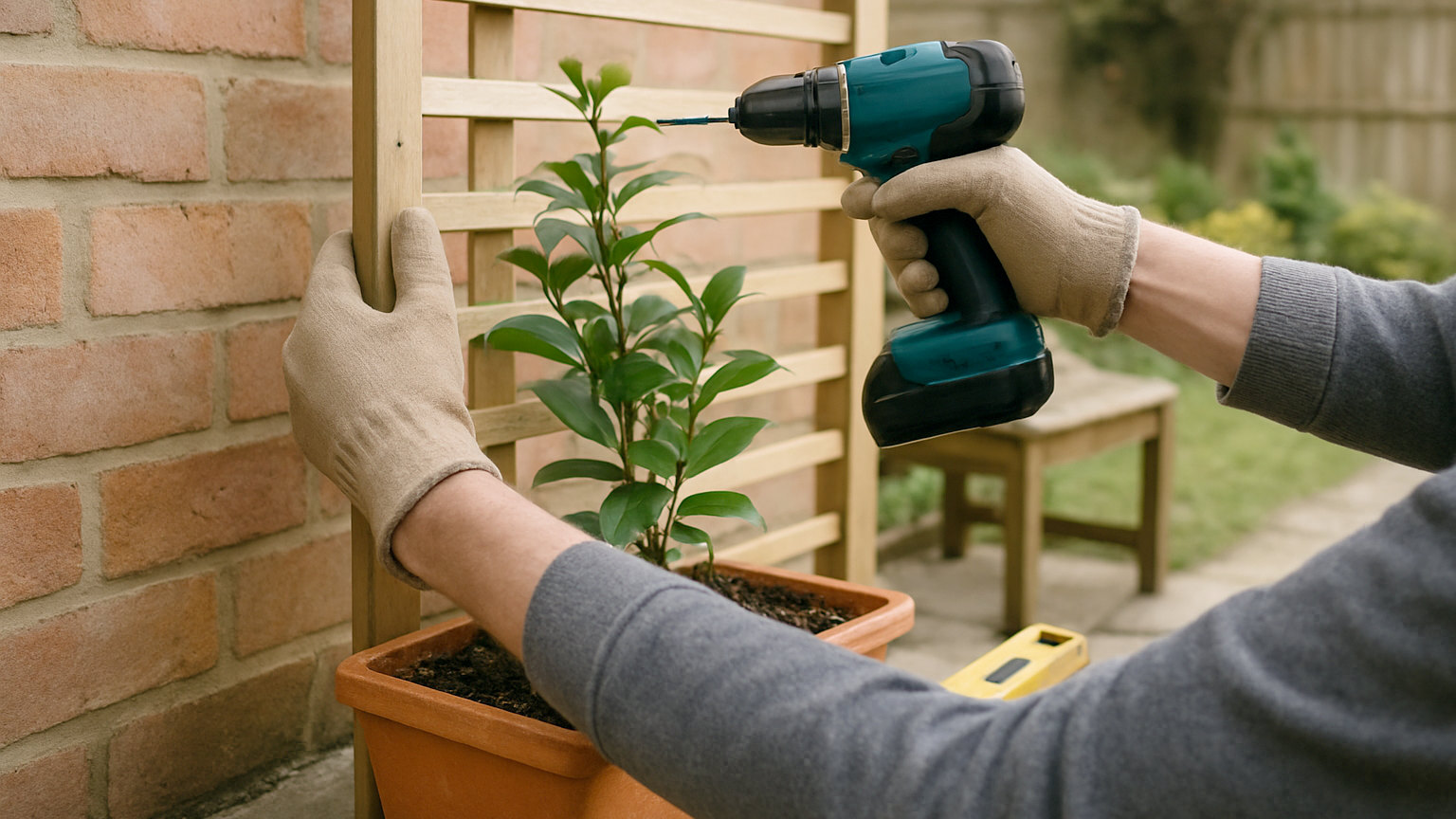
Overlooking is the commonest complaint about small and urban gardens, and the instinctive response, raising the boundary, is usually the least effective and most contentious approach.
Screen where you sit, not at the boundary
Screening close to you blocks a far wider angle of view than the same screen at the boundary.
A trellis panel two metres from a seat obscures much more than a fence at the end of the garden, and it needs far less height to do it.
Think about the specific sightline from the window that overlooks you to the spot where you sit, and interrupt it at the point closest to you.
A pergola, an arbour, a parasol or an overhead beam with a climber blocks a downward view from an upstairs window, which no boundary fence can do.
Height rules
Under permitted development in England, a fence, wall or gate can generally be up to two metres high, reduced to one metre where it adjoins a highway used by vehicles or a footpath alongside it.
Anything higher usually needs planning permission, and different rules apply to listed buildings, and in conservation areas.
Rules differ in Scotland, Wales and Northern Ireland, so check with the local authority.
Evergreen hedges over two metres can be the subject of a High Hedges complaint under anti-social behaviour legislation, where they affect a neighbour's reasonable enjoyment of their property.
Trellis on top of a fence counts towards the total height, whatever is sometimes claimed.
A tree is not subject to the fence rules, which is one reason planting is often the better route.
Planting for privacy
Trees screen better than fences because they operate above fence height, where the overlooking actually is.
A well-placed small tree such as amelanchier, crab apple, birch or a multi-stemmed specimen breaks a sightline without blocking light.
Position it on the line between the overlooking window and where you sit, closer to you rather than to the boundary.
Pleached trees, with clear stems and a raised block of foliage, screen at first-floor level while leaving ground level open. Hornbeam, lime and photinia are all used this way.
Bamboo, tall grasses and large shrubs screen at ground level, and clumping bamboo is far safer than running types.
Structures
Trellis with climbers, slatted screens, woven willow or hazel hurdles, and reed screening all provide immediate cover.
Slatted or trellis screens filter views rather than blocking them entirely, which looks better and casts less shade than a solid panel.
A pergola over a seating area with a vine, wisteria or climbing rose is the most effective response to being overlooked from above.
Freestanding screens within the garden can be placed exactly where they are needed, unlike boundary structures.
Light and wind
Solid screening casts shade and creates turbulence, which damages plants on the sheltered side.
A permeable screen slows wind and filters light, and gives better shelter over a greater distance than a solid barrier.
Check where a screen's shadow will fall in winter as well as summer.
Neighbours
Talk to them before erecting anything substantial. Boundary disputes are expensive, unpleasant and must be disclosed when selling.
Establish who owns the boundary before altering it, and remember you cannot attach anything to a fence you do not own without permission.
Blocking a neighbour's light with a large structure or hedge can create a genuine grievance and a complaint.
Accepting some of it
Complete privacy in a small urban garden is rarely achievable, and the effort to obtain it can produce a dark enclosed space.
Screening the one seat where you spend most time is usually enough, and better than trying to screen everything.
Noise
Screening does very little for noise, whatever is claimed for it. A fence or hedge reduces the perception of noise rather than the level.
Moving water is more effective, since the sound masks traffic noise, and a small recirculating feature is enough.
Dense planting and a solid wall or a close-boarded fence with no gaps help marginally more than an open screen, since gaps let sound through directly.
Screening from above
Where the overlooking comes from an upstairs window or a block of flats, nothing at ground level helps.
The answer is overhead: a pergola, an arbour, a parasol, a tree canopy or a sail. All of them work where a taller fence would not.


