
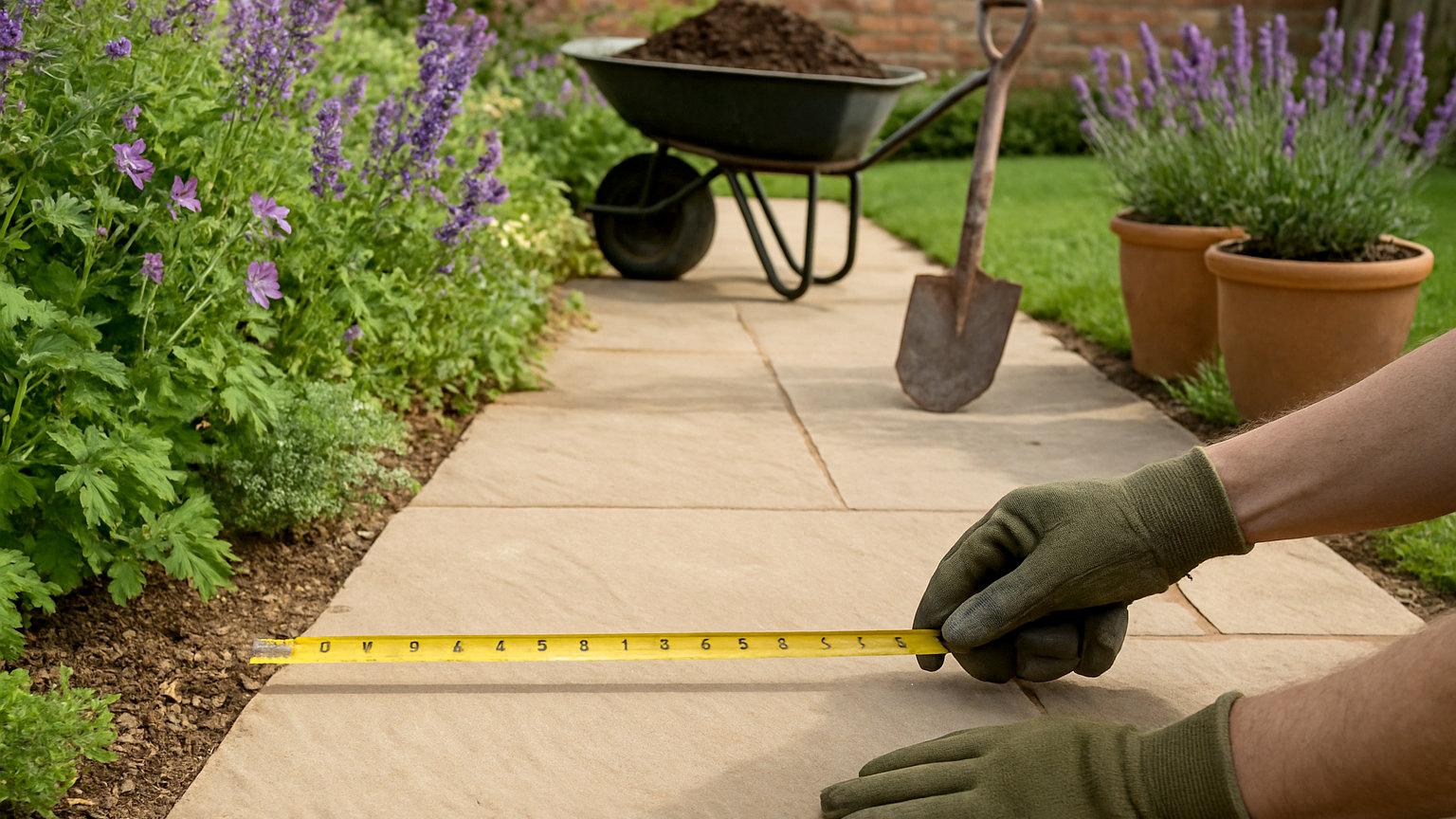
The commonest fault in an amateur garden design is that everything is slightly too small. Borders too narrow, paths too thin, terraces that will not take a table, plants that never fill the space they were given.
Borders
A border needs to be at least a metre and a half deep to hold a proper planting, and two to three metres is better where space allows.
A border sixty centimetres deep can hold one row of plants and always looks thin. It also dries out faster and needs more attention.
Deeper borders let you layer planting front to back, which is what produces the effect people are actually after.
In a small garden, fewer deeper borders read far better than a thin strip round the entire perimeter.
Paths
A main path should be at least a metre and a half wide, which allows two people to walk side by side and a wheelbarrow to pass planting without catching it.
A secondary path can be nine hundred millimetres to a metre and a quarter.
Anything under about seven hundred millimetres is a route rather than a path, and will feel cramped in use.
Allow for plants flopping over the edges, which reduces the effective width by as much as a third by midsummer.
Terraces and seating areas
The area people most often underestimate.
A table for four with chairs pulled out needs about three metres by three metres. Six people need three and a half by three and a half or more.
Mark it out on the ground with the actual furniture before committing. A terrace that looks generous on paper is frequently too small in practice.
Add space for movement around the table, not just for the chairs.
Steps
Garden steps should be shallower and deeper than indoor ones: a riser of about a hundred and fifty millimetres and a tread of at least three hundred and fifty.
All the risers in a flight must be equal, since an odd one causes trips.
Wide steps read far better than narrow ones and can double as informal seating.
Plants and the house
Scale plants against the building rather than against each other.
A two-storey house needs something substantial nearby to relate to it. Small shrubs dotted along the base of a tall wall look lost.
Conversely a large tree close to a small bungalow overwhelms it and creates practical problems with light and roots.
Check the eventual height and spread of everything and plant at that spacing, accepting two sparse seasons rather than a congested border in five years.
The rule of thirds
Dividing a space into thirds rather than halves generally produces a more comfortable composition.
A lawn occupying two thirds with a third given to planting reads better than an even split.
Placing a focal point a third of the way along a view is usually stronger than centring it, unless the design is deliberately formal and symmetrical, where the centre is the point.
Fewer, larger elements
Three large pots read as a deliberate group. Nine small ones read as clutter.
One generous bed of five plant varieties repeated looks considered. Twenty varieties in the same space looks like a collection.
Simplifying a fussy outline into one clean shape makes a garden look larger and better organised, and reduces the maintenance.
Test it before building
Mark everything out on the ground: hosepipe for curves, canes and string for structures, sand lines for paths.
Leave it for a few days and look at it from the house and from an upstairs window.
Walk the routes. If you find yourself cutting a corner, the path is in the wrong place.
This costs nothing and prevents the expensive mistakes.
Other useful dimensions
A bench needs about eighteen hundred millimetres of clear space in front of it to sit comfortably.
A gate should be at least nine hundred millimetres wide, and wider if a barrow or a bin must pass.
Allow at least six hundred millimetres between a path and a wall for planting, or the plants will be squeezed.
A pergola should be at least two metres two hundred to the underside of the beams, since climbers hang down considerably once established.


