
Almost every garden design sits somewhere between two poles. Understanding which you are aiming at makes every subsequent decision easier, and the commonest fault is drifting between them without deciding.
Formal
Based on symmetry, straight lines, geometry and repetition.
Characteristics: axial paths, symmetrical layouts about a central line, clipped hedges and topiary, geometric beds, matched pairs of pots or trees, a strong central focal point, and restrained planting where structure matters more than variety.
Formal gardens work well with period houses, regular plot shapes, and small spaces where geometry brings order.
They read well in winter, since the structure carries the design when nothing is flowering.
The maintenance is regular rather than heavy: clipping on a schedule, and keeping lines crisp. A formal garden that has grown shaggy loses its point entirely.
Informal
Based on curves, asymmetry and apparent naturalness.
Characteristics: sweeping bed shapes, meandering paths, irregular groupings, mixed planting with many species, self-seeding allowed, and a looser relationship between house and garden.
Cottage gardens, wildlife gardens, woodland gardens and naturalistic prairie planting all sit here.
Informal styles suit irregular plots, rural settings and gardeners who enjoy plants more than structure.
They can look thin in winter without deliberate evergreen structure, and they need editing rather than clipping: dividing, thinning and removing self-sown plants that have taken over.
Which suits your garden
Look at the house first. A formal Georgian frontage suits symmetry; a rambling cottage does not.
Look at the plot. A regular rectangle takes formality easily. An awkward triangle usually reads better handled informally.
Look at the setting. A garden with countryside beyond gains from informality that connects to it. An enclosed urban plot often benefits from geometry.
Be honest about maintenance. Formal requires regular clipping on time; informal requires plant knowledge and editing. Neither is low maintenance.
Combining them
The most successful approach in many gardens is formal structure with informal planting.
Clipped hedges, straight paths and geometric bed shapes provide the bones, and loose exuberant planting fills them.
This gives year-round structure with seasonal generosity, and it forgives a great deal, since a strong framework holds together even when the planting is untidy.
The reverse, informal structure with rigidly formal planting, rarely works.
The usual mistake
Drifting between styles without deciding: a wiggly border on one side and a straight one on the other, a symmetrical terrace leading to an asymmetric lawn, curves that are neither obviously deliberate nor obviously natural.
The result reads as indecision rather than as a style.
If you use curves, make them generous and confident. Weak shallow curves look like mistakes; strong sweeping ones look intended.
If you use straight lines, make them genuinely straight and align them with something: the house, a boundary, a focal point.
Transitions
Where a garden moves from formal near the house to informal further away, which is a traditional and effective arrangement, make the transition deliberate.
Use a hedge, an arch, a change of level or a change of surface to mark the point where one becomes the other.
Consistency in materials
Whatever the style, limiting the palette of materials holds a garden together.
Two or three surfaces at most, and preferably ones that relate to the house.
A garden with brick, four kinds of paving, gravel, decking and railway sleepers looks unresolved regardless of the planting.
Testing the idea
Collect images of gardens you like and look for what they have in common. The pattern usually reveals which pole you are drawn to.
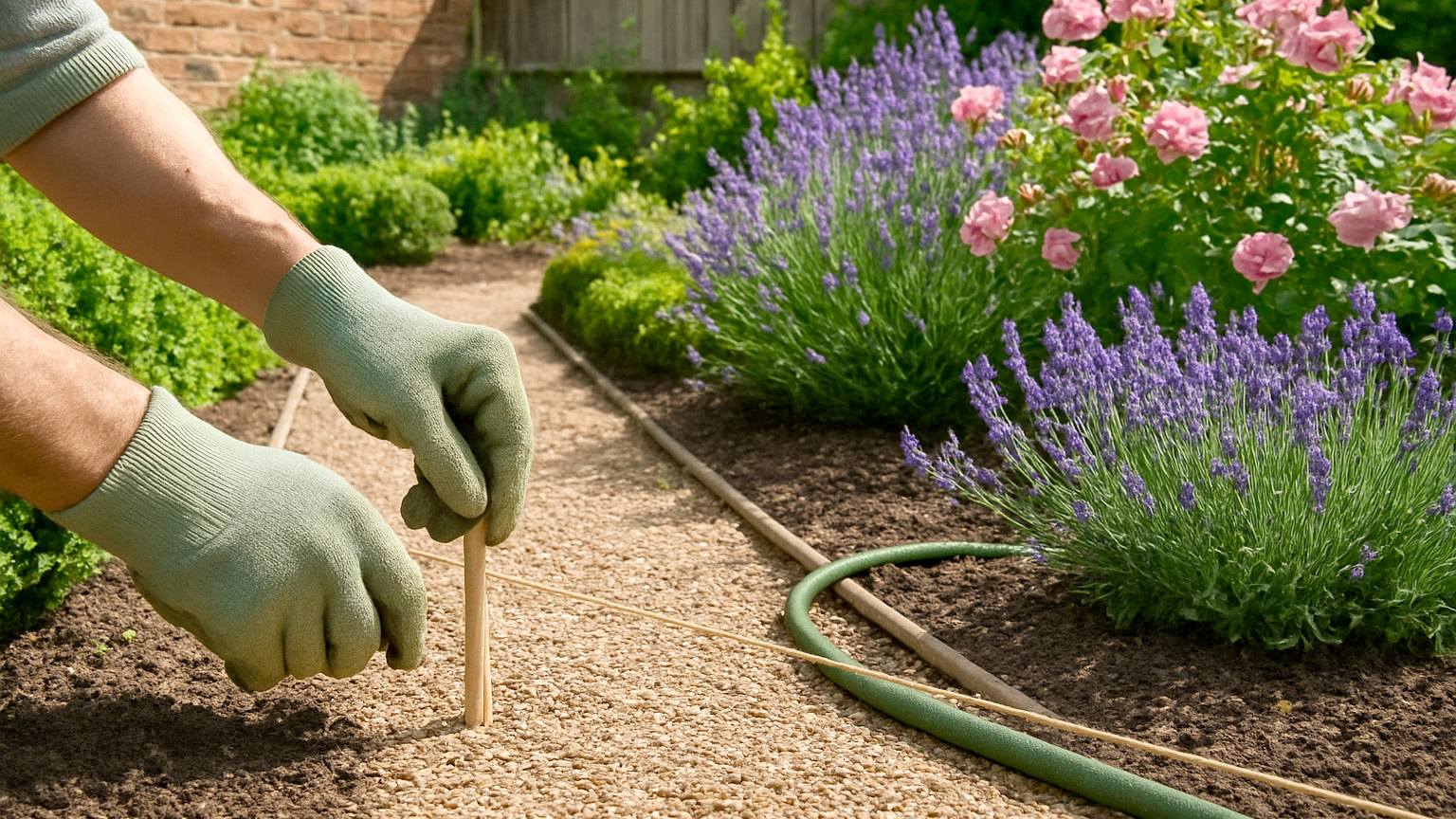
Then mark the layout out on the ground with hosepipe, canes and sand, and look at it from the house and from an upstairs window before committing to anything.
Other recognised styles
Mediterranean planting on gravel, Japanese-influenced gardens using restraint and evergreen structure, prairie or naturalistic perennial planting, and productive kitchen gardens all have their own conventions.
Each works best when followed with some consistency rather than borrowed piecemeal from several at once.
Whatever the style, the test is whether the garden looks deliberate. A visitor should be able to tell what you were aiming at without being told.
Working with what you have
An existing garden usually has a style already, however unintentional, and working with it is easier than imposing something else.
Established hedges, mature trees and existing paths are expensive to change and often worth building the design around instead.


