
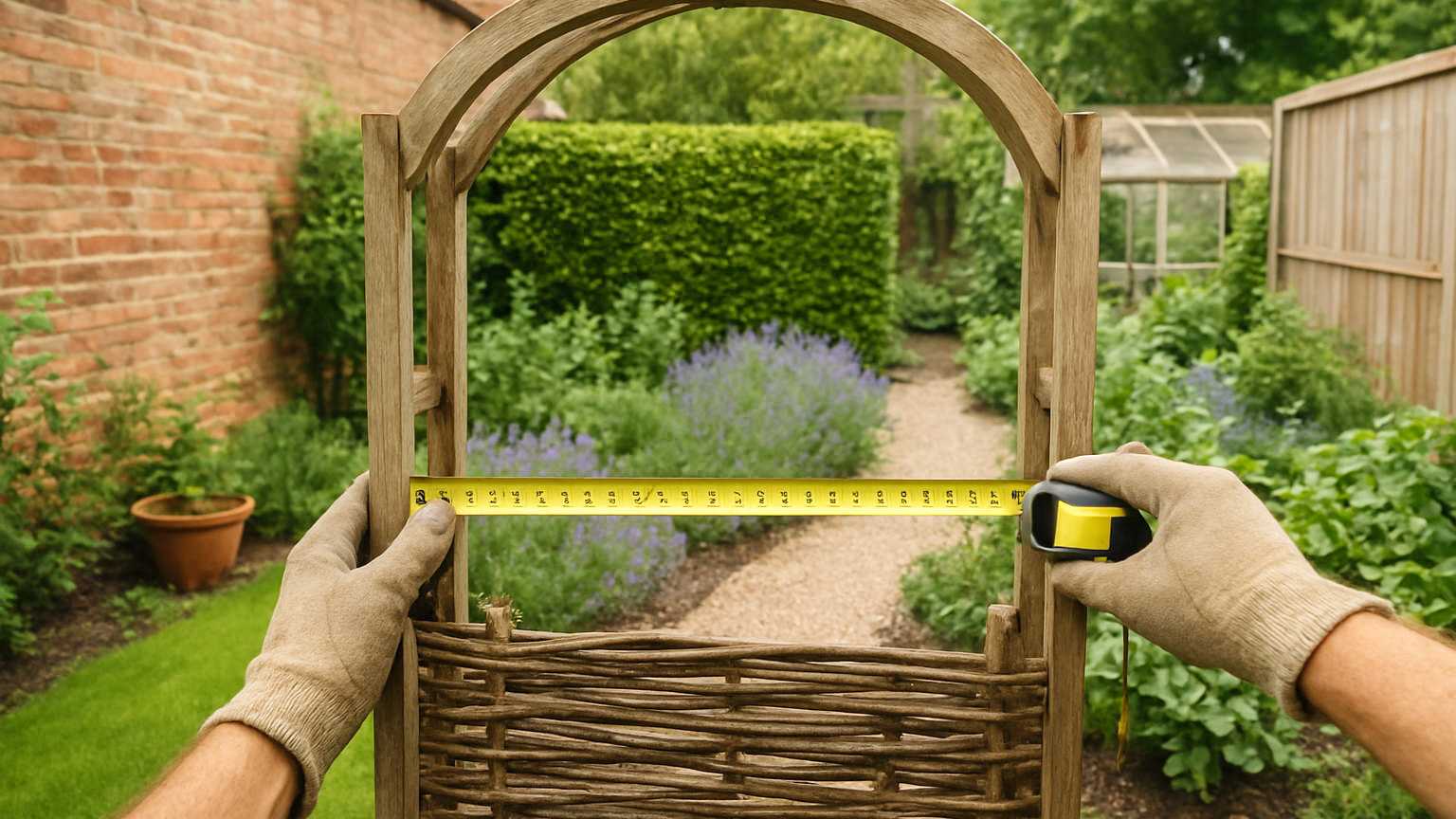
A garden taken in at a single glance is understood immediately and then exhausted. Dividing it so that parts are hidden makes the whole feel larger and gives a reason to walk through it.
Why it works
A long rectangular garden viewed from the house reads as a corridor, and the eye reaches the back fence at once.
Interrupt that view and the garden becomes a sequence of spaces rather than a single one. What is hidden implies more than what is shown.
This is counterintuitive in a small garden, where the instinct is to keep everything open to avoid making it feel cramped. In practice division nearly always makes a small space feel bigger.
Ways to divide
Hedges are the traditional method: yew, beech, hornbeam or a native mix. They take time and give the best result.
Trellis and screens divide immediately and can be planted with climbers. Slatted screens filter views rather than blocking them, which is often better.
Planting, using a group of shrubs or tall perennials, divides without any structure at all and is the cheapest method.
A change of level, even one step, separates two areas clearly.
A change of surface from paving to gravel to grass signals a different space without any vertical element.
An arch or a gateway marks the transition between areas and is worth adding wherever a path passes through a division.
Pergolas and overhead structures divide by enclosing rather than blocking.
You do not need full height
A division does not have to be solid or tall to work.
A waist-high hedge, a group of grasses, or a low wall separates areas while keeping the garden light and open.
Screening at eye level when seated is enough to create separation around a terrace.
In a very small garden, a screen at head height that you can see over when standing but not when sitting divides the space without shading it.
Leave a way through
Every division needs an opening, and the position of the opening matters more than the division itself.
Place it off-centre so the next space is not fully revealed from the first.
Make it deliberate: an arch, a gap between two clipped shapes, a change in the path surface.
A view through the opening to something worth walking towards makes the invitation work.
Giving each area a purpose
Division works best when each space does something.
A terrace for sitting near the house, a lawn beyond, a productive area with vegetables and compost at the far end, and a quiet corner with a bench.
Utility areas benefit most from screening: bins, compost heaps, sheds, water butts and washing lines can all be tucked behind a division and forgotten.
Long narrow gardens
The situation where division helps most.
Dividing across the width, into two or three sections, breaks the corridor effect entirely.
Setting the path off-centre, or making it zigzag between sections, slows the journey and disguises the shape.
Wide planting on alternate sides has the same effect at less cost.
Wide shallow gardens
Divide along the length instead, creating a sequence of spaces across the width, which lengthens the journey through them.
Practical considerations
Check that divisions do not cast shade where you need light, and that a hedge will not compete with planting alongside it.
Keep access clear for barrows, bins and materials.
Mark divisions out with canes and string first and live with them for a week before building anything.
How many divisions
Two or three areas is plenty in a typical garden. More than that in a small plot produces a series of cramped compartments rather than a sequence of spaces.
Each area should be big enough to do something in. A space too small to stand in comfortably is a gap rather than a room.
What it costs
Very little, if the divisions are planting. A group of shrubs or a run of tall grasses divides a garden for the price of a few plants.
Hedges cost more in time than in money, particularly if bought as bare-root whips in winter, which are a fraction of the price of container-grown plants.
Trellis and screens cost most and work immediately, which is the trade.


