
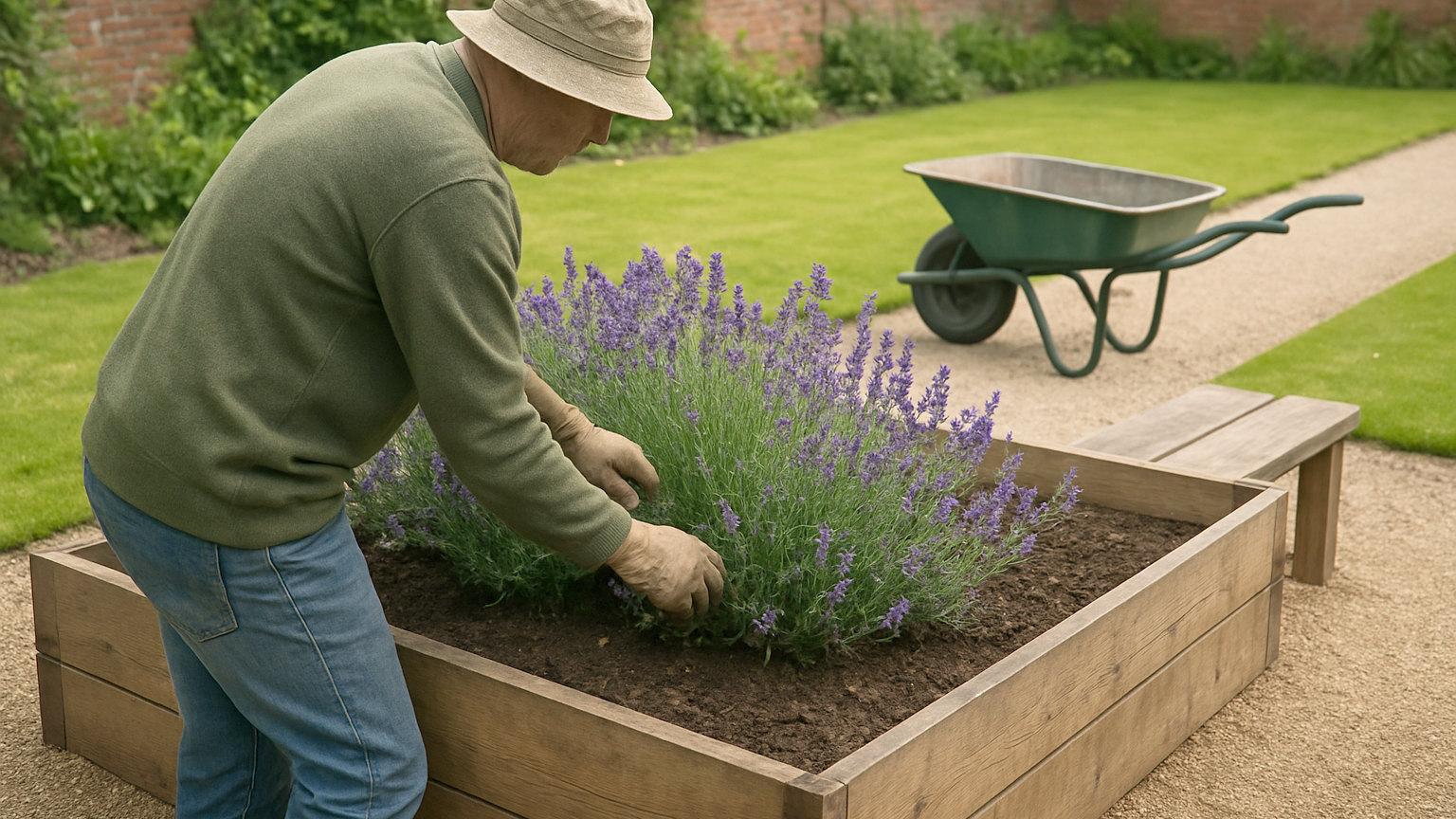
An accessible garden is easier for everyone to use, not only for people with a specific need. The dimensions are straightforward and much cheaper to build in than to retrofit.
Paths
A path used by a wheelchair should be at least twelve hundred millimetres wide, and fifteen hundred allows two people to pass or a chair to turn comfortably.
Nine hundred millimetres is a workable minimum for a single chair on a short run.
Allow passing places and turning spaces of at least fifteen hundred millimetres square on longer paths.
Remember that planting flops over edges and reduces the effective width by a third by midsummer, so build in generously or keep edges clear.
Surfaces
Firm, level and non-slip. Bonded gravel, resin-bound surfacing, smooth paving with narrow joints, or well-laid concrete all work.
Loose gravel is difficult for wheels and for anyone unsteady, and is best avoided on main routes.
Avoid smooth polished stone, which becomes slippery when wet, and keep surfaces clear of moss and algae.
Falls of about one in eighty across the path shed water without being noticeable.
Gradients and steps
A ramp should be no steeper than one in twenty where possible, and one in twelve is the usual maximum for a short run.
Include level landings at intervals on longer slopes.
Where steps are unavoidable, make risers equal and no more than a hundred and fifty millimetres, with treads of at least three hundred and fifty.
Fit handrails on both sides at around nine hundred millimetres, and mark the step edges in a contrasting colour or material, which helps anyone with limited vision.
Raised beds
The most useful adaptation for anyone who cannot kneel or bend.
For a seated gardener, a bed height of about six hundred to seven hundred and fifty millimetres works well. For someone standing but unable to bend, seven hundred and fifty to nine hundred.
Reach is the limiting factor. From a seated position, comfortable reach is about six hundred millimetres, so a bed accessible from one side should be no deeper than that, and one metre two hundred if reachable from both sides.
A knee recess underneath, or a bed on legs, lets a wheelchair user get close rather than reaching over.
Table-height planters and vertical growing systems bring plants to a comfortable height in a small space.
Seating
Provide seats at intervals, so anyone who tires can rest without turning back.
Seats with arms and a back are far easier to get out of than a bench without.
Seat height of around four hundred and fifty millimetres suits most people.
Leave a level space beside benches so a wheelchair user can sit alongside rather than in the path.
Taps, tools and storage
Fit an outside tap at a reachable height with a lever handle rather than a turning one.
Provide water points around the garden rather than one at the house, to avoid carrying.
Long-handled and lightweight tools reduce bending and effort considerably. Tools with soft ergonomic grips help anyone with weak hands or arthritis.
Store tools where they can be reached without stretching or lifting.
Sensory planting
Scent, texture and sound matter more where sight is limited.
Plant aromatic foliage beside paths and seats where it will be brushed: rosemary, lavender, thyme, choisya, mint.
Include plants with distinct textures, grasses that move and rustle, and strongly scented flowers near doors and seating.
Strong colour contrast helps with orientation, including between path and planting.
Lighting
Light steps, changes of level and route junctions rather than the whole garden.
Any permanent outdoor wiring should be installed by a qualified electrician and protected by a residual current device.
Reducing the work
Dense planting, generous mulching, irrigation on a timer and choosing plants suited to the conditions all reduce the physical demands, which matters as much as the dimensions.
Small changes in an existing garden
Not everything requires rebuilding. A firm level route to one seat, a raised bed or two, a bench halfway down the garden, a second tap and a set of long-handled tools transform how usable a garden is.
Widening one path and removing a single step often makes more difference than a full redesign.
Thinking ahead
Building accessibility in from the start costs very little and is far cheaper than retrofitting. Needs change, and a garden designed to be usable at eighty is no less pleasant at forty.


