
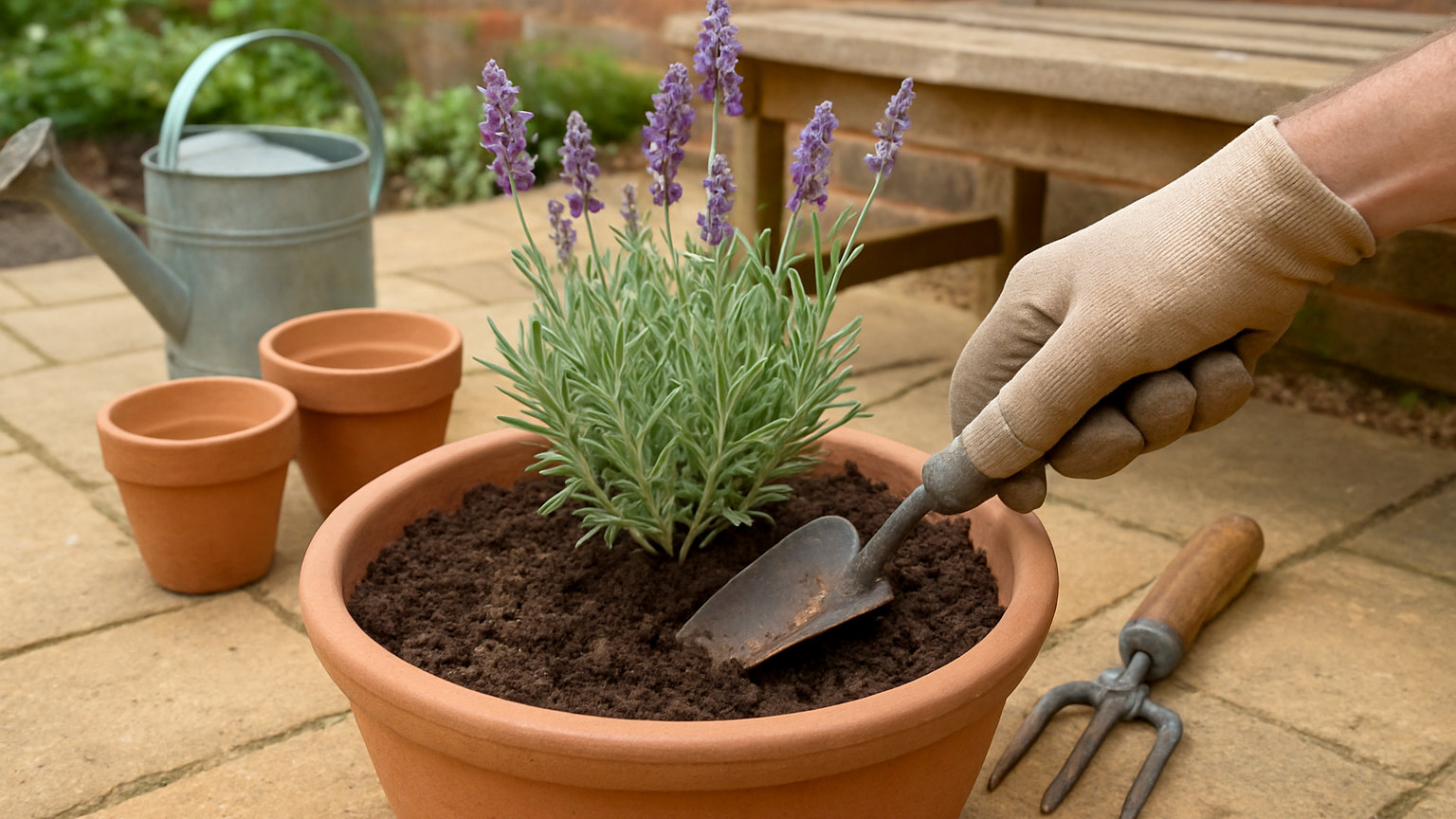
The difference between a terrace that looks like part of a garden and one that looks like a car park is almost entirely the planting around and within it.
Break up the edges
A hard straight line where paving meets lawn or border reads as abrupt.
Let planting flop over the edges. Hardy geraniums, nepeta, alchemilla, erigeron, lavender and low grasses all spill forward and soften the transition.
Plants growing over paving is the intention rather than untidiness, and it makes a new terrace look settled within a season.
Allow for it when sizing the terrace, since planting reduces the usable area by a surprising amount.
Planting pockets within the paving
Leaving out one or two slabs and planting into the gap breaks up a large expanse and costs nothing.
The pocket needs proper depth, so excavate the sub-base out of that area and fill with decent soil rather than planting into fifty millimetres over compacted hardcore.
Suitable plants are those that tolerate reflected heat and free drainage: thyme, sedum, erigeron, dianthus, small grasses, sempervivum.
A single larger pocket with a small tree or a substantial shrub has more impact than several small ones.
Between the joints
Low creeping plants in wide joints soften paving and release scent when trodden on.
Thyme, chamomile, mind-your-own-business, acaena and mossy saxifrage all tolerate occasional treading.
They need free drainage and sun, and they make the surface slippery when wet, so keep them away from main routes and steps.
This works with wide-jointed paving laid on a permeable base, not with mortar-pointed slabs.
Scent near seating
The place where scented planting earns most.
Plant aromatic foliage where it will be brushed against: rosemary, lavender, thyme, choisya, mint, myrtle. Foliage scent is available for eight months rather than three weeks.
Add evening-scented flowers, since a terrace is used at that time of day: nicotiana, night-scented stock, jasmine, honeysuckle.
Scented climbers overhead on a pergola scent the air you sit in.
Height and enclosure
A terrace surrounded by nothing but paving and lawn feels exposed.
Planting at head height on one or two sides creates enclosure without blocking the view or the light.
A small tree, a large shrub or tall grasses on the side away from the main view gives shelter, privacy and something to look at.
Containers
Almost every terrace ends up with pots, and they work best in groups of odd numbers with varying heights rather than dotted evenly about.
Use the largest containers practical, since small pots dry out within hours in summer and against a hot wall.
Group them together, which raises humidity and shades the pots.
Consider irrigation on a timer if there are more than a few, since daily watering is the reason terrace containers fail.
Allow for the floor area they take, which is always more than expected.
What to avoid near a terrace
Anything thorny beside a seat or a route: berberis, pyracantha and roses at arm height.
Plants that drop heavily onto furniture: some limes drop sticky honeydew, and fruiting trees drop fruit that stains and attracts wasps.
Anything that attracts wasps to an eating area in late summer.
Very vigorous plants immediately against paving, whose roots lift slabs and whose growth needs constant cutting back.
Plants with irritant sap where people sit, particularly euphorbia.
The reflected heat
Paving stores and radiates heat, and the ground at the edge of a terrace is drier and warmer than the open garden.
This suits Mediterranean planting and stresses anything wanting moisture, so choose accordingly and water new planting thoroughly for the first two seasons.
Winter
A terrace is looked at from indoors far more than it is used, so plant for what can be seen in February.
Evergreen structure, a clipped shape in a pot, coloured stems and something scented by the door all earn their place in the months when nobody sits outside.
Wildlife
Terrace planting supports as much as anything else in a garden. Scented flowers near seating attract pollinators you can watch, and a shallow water dish with stones in it lets bees drink safely.
Avoid lighting the planting all night, which disrupts moths and other night-flying insects that use the garden after dark.
Leaving seedheads standing through winter gives the terrace something to look at and feeds birds at the same time.


