
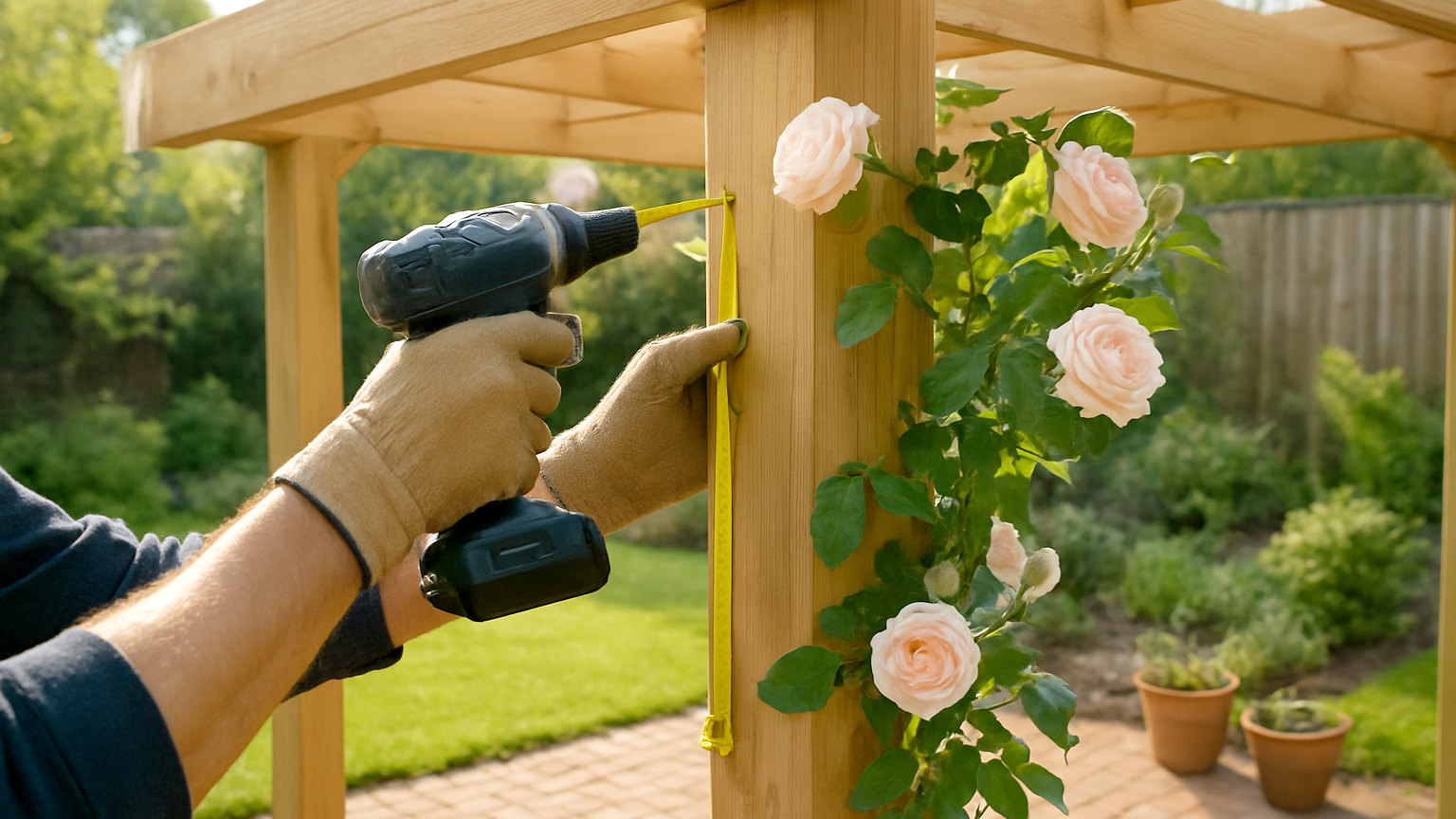
An overhead structure does two things nothing else does: it screens a terrace from windows above, and it creates a sense of enclosure that makes a seating area feel like a room rather than an expanse of paving.
Height
Allow at least two metres two hundred to the underside of the beams, and two and a half is better.
Climbers hang down considerably once established, and wisteria in particular drops flowers and growth well below the structure.
A pergola built at two metres feels oppressive within three years of planting.
Height also affects proportion. A low structure over a wide terrace looks squat; the two dimensions should relate.
Structure and sizes
Posts of at least a hundred by a hundred millimetres for a domestic pergola, and larger for anything wide or exposed.
Set posts in metal post supports bolted to a foundation, or in concrete, keeping the timber clear of the ground so it does not rot at the base.
Beams and rafters need to be substantial enough to carry a mature climber, which is heavier than people expect, and to resist wind.
Brace the structure, since a pergola is essentially a set of posts and beams and will rack sideways without triangulation or rigid connections.
Use timber treated for the exposure and stainless or properly rated fixings, and treat every cut end.
Fixing to a house
Where a pergola is attached to a building, fix a wall plate securely into masonry with appropriate fixings, not into mortar joints alone.
Keep the fixing clear of the damp-proof course and do not create a detail that traps water against the wall.
A free-standing structure close to the wall avoids all of this and is often the simpler answer.
Materials
Softwood is cheapest and needs treating every few years.
Oak is expensive, extremely durable, and weathers to silver. Green oak moves as it dries, which is part of its character.
Metal gives slender sections and a lighter appearance, and powder-coated steel or aluminium needs little maintenance.
Consider access for treating timber once climbers are established, since a mature wisteria makes maintenance very difficult.
Sails, awnings and canopies
Different solutions to the same problem.
Shade sails are cheap and effective, need proper anchor points capable of taking considerable tension, and should be taken down in winter and in high wind.
Retractable awnings give shade on demand and retract in bad weather, and need a sound wall fixing and periodic maintenance.
Louvred roofs adjust for sun and rain, are expensive and give year-round usability.
Parasols are the simplest, cost least and blow over. Use a heavy base and take them down in wind.
Planting a pergola
Wisteria is the classic and needs the strongest structure and twice-yearly pruning.
Grape vines give shade in summer and let light through in winter when the leaves fall, which is exactly what is wanted.
Climbing roses, honeysuckle, clematis and jasmine all suit, and scented climbers over a seating area are worth prioritising.
Annual climbers cover a new structure in one season while permanent planting establishes.
Plant at least forty-five centimetres out from the posts, leaning inwards, since the ground at the base of a structure is dry.
Light and shade
Consider what the structure does in winter as well as summer.
A deciduous climber shades in summer and lets low winter sun through, which is usually the right answer near a house.
An evergreen or a solid roof creates permanent shade, which may darken a room behind it.
Permission
A pergola is generally permitted development within the limits on height and position that apply to garden structures.
Check with the local authority for listed buildings, conservation areas, and anything tall or close to a boundary.
Building it
Set out the posts accurately and check the diagonals, since errors in the base appear in every beam above.
Assemble as much as possible at ground level and get help lifting beams into position, which is where accidents happen.
Work from a proper platform rather than a domestic stepladder on soft ground.
Proportion
A pergola should relate to the area it covers and to the house. Posts that are too slender look flimsy and will not carry a mature climber; beams that are too heavy overwhelm a small terrace.
Err towards more substantial timber than seems necessary, since a pergola always looks lighter once it is built than it did on paper.


