
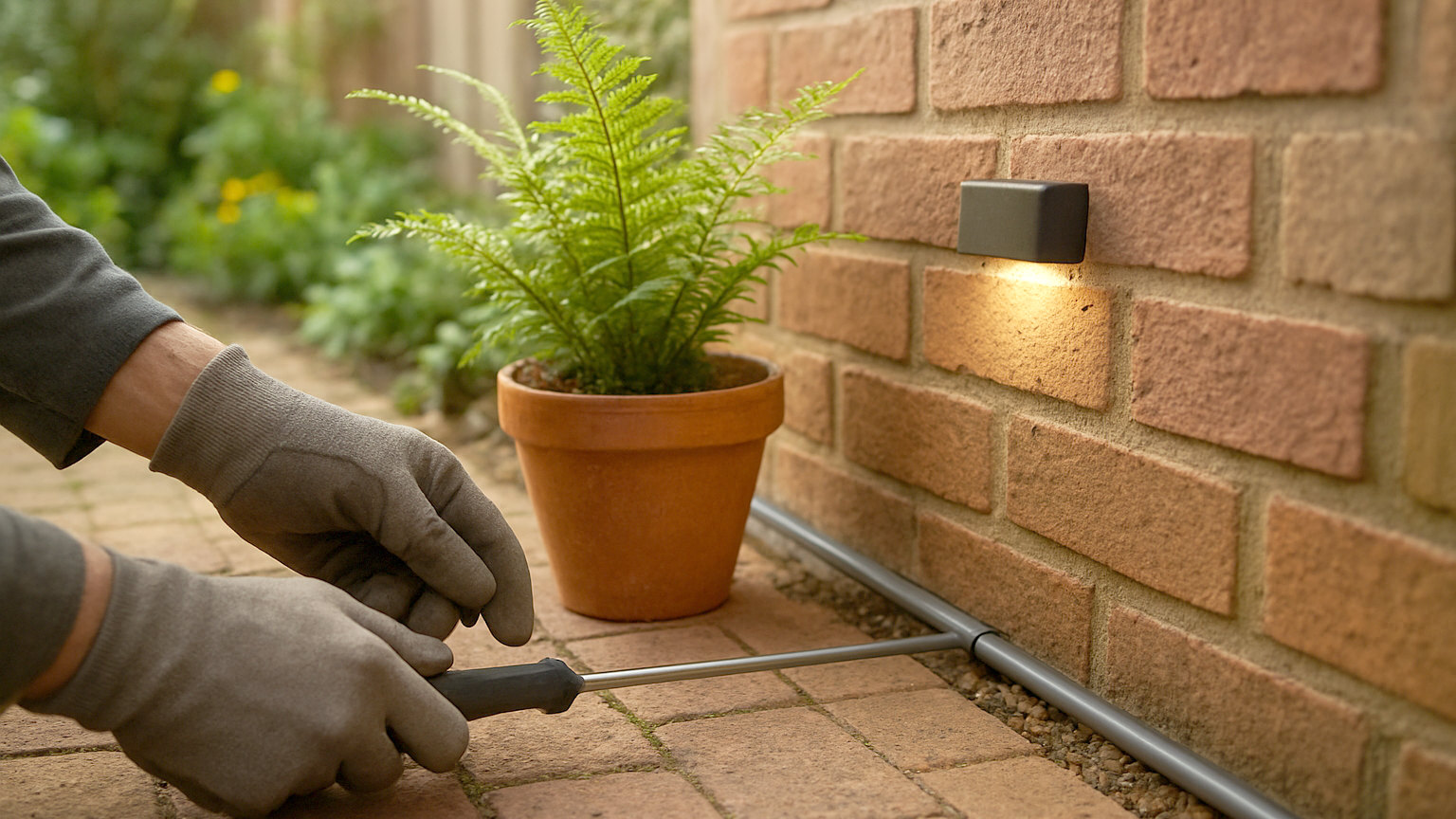
Lighting extends the use of a terrace into the evening and through winter, when the garden is dark by the time most people are home. The commonest fault is too much of it.
Light what needs lighting
Steps, level changes, the edges of a terrace and the route to the door, for safety.
The table or seating area, at a low level.
One or two features that are worth looking at from indoors: a specimen tree, a clipped shape, a wall, a pot.
That is usually enough. A garden lit throughout looks like a car park and gives nothing to look at, since the effect depends on contrast between lit and unlit.
Avoid glare
The single most common mistake.
A visible bright source dazzles and destroys night vision, so the surroundings disappear.
Conceal the fitting and light the object rather than the eye. Recessed, shielded and downward-directed fittings all achieve this.
Never point a light towards where people sit or towards a window, your own or a neighbour's.
Use warm colour temperatures, around two thousand seven hundred kelvin, which flatter planting and feel comfortable. Cold white light looks clinical outdoors.
Use the lowest output that achieves the effect. Outdoor lighting almost always needs less power than people expect, since the eye adapts to darkness.
Techniques
Uplighting a tree or a clipped shape from below is dramatic and works particularly well in winter on bare branches.
Downlighting from within a tree or a structure gives a natural dappled effect.
Grazing a wall or a textured surface at a shallow angle reveals the texture.
Step and riser lights light the tread rather than the eye.
Silhouetting a plant against a lit wall shows its shape.
Portable lanterns, candles and rechargeable table lamps give atmosphere with no installation at all, and for many terraces are all that is needed.
Electrical safety
Permanent outdoor electrical installation is notifiable work and must be carried out by a qualified electrician, or notified to building control.
All outdoor circuits must be protected by a residual current device.
Fittings and connections must be rated for external use, with an appropriate IP rating for their position, and cables must be armoured or otherwise protected and buried at an adequate depth with marker tape above them.
Do not run domestic extension leads outside as a permanent arrangement.
Low voltage systems
The practical choice for most domestic gardens.
A transformer converts mains to twelve volts, and the low-voltage cable can be run more simply and is far safer to work with.
Plug-and-play systems are widely available and can be installed without an electrician, provided the transformer is fed from a properly installed outdoor socket.
They limit the length of cable runs and the number of fittings, so plan the layout before buying.
Solar
Cheap, requires no wiring, and output is modest and unreliable in a British winter, which is exactly when garden lighting is most useful.
Reasonable for marking a path or for decorative effect; not adequate for lighting steps for safety.
Wildlife and neighbours
Artificial light at night has genuine effects on wildlife. It disrupts moths and other night-flying insects, affects bats, which avoid lit areas and lose foraging habitat, and disturbs the behaviour of birds and other animals.
Use the minimum light needed, direct it downwards, and avoid lighting hedges, trees and boundaries where wildlife moves.
Put lighting on timers or sensors rather than leaving it on all night.
Avoid light spilling into neighbouring windows or gardens, which is a common source of complaint and can amount to a nuisance.
Controls
Separate switching for different circuits lets you light the route without lighting the whole garden.
Timers, dimmers and sensors reduce running time and improve the effect.
Planning it
Run the cabling before laying paving or planting, since retrofitting means lifting surfaces.
Test the positions before committing by standing a torch or a temporary fitting where each light will go and looking at the result after dark, from the terrace and from indoors.
It is far easier to move a torch than a buried cable.
Maintenance
Clean lenses annually, since dirt and algae reduce output considerably.
Check that planting has not grown over fittings, and that no cable has been exposed or damaged by digging.
Adjust aim seasonally, since the shape of what you are lighting changes through the year.


