
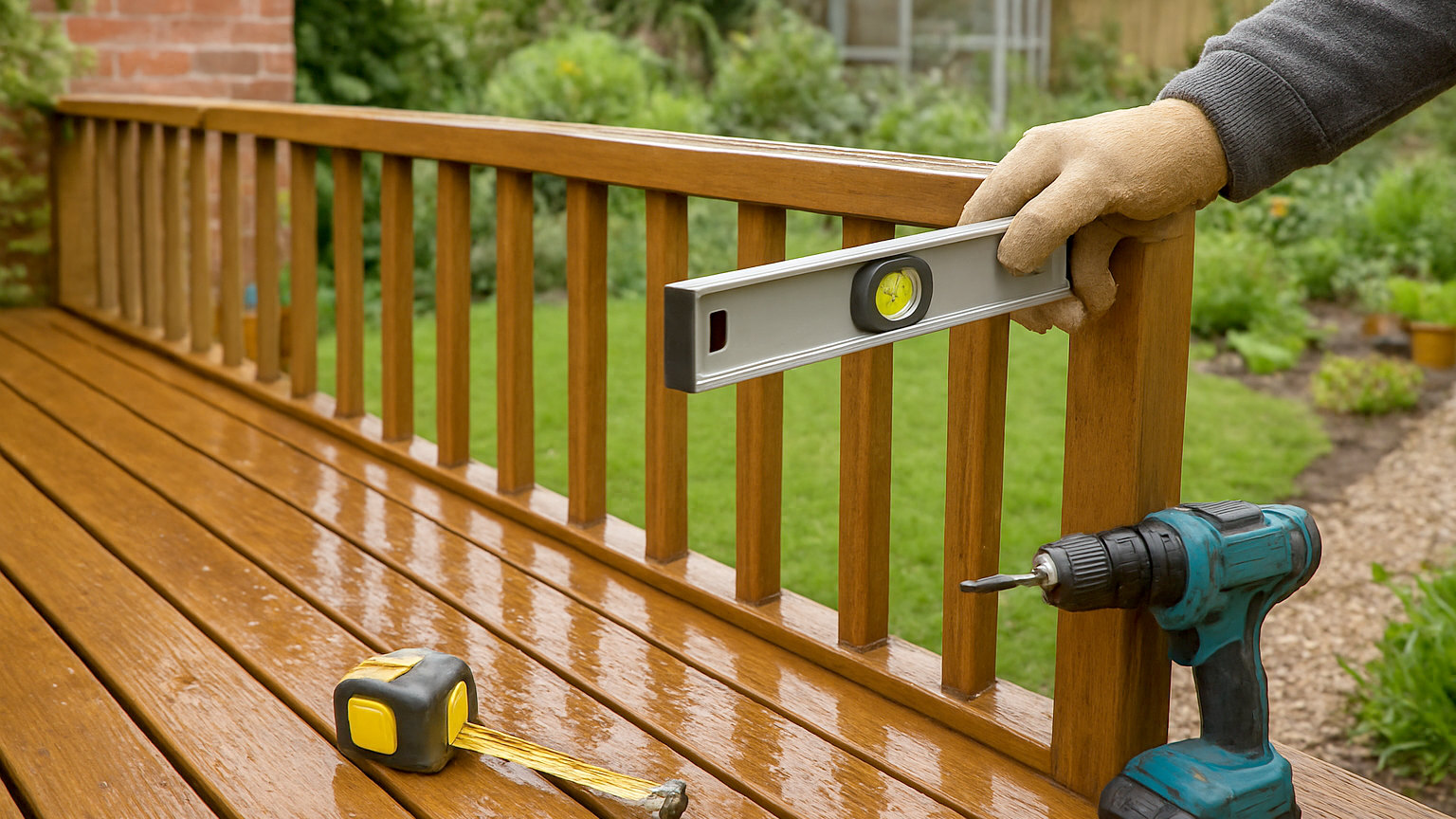
Decks present two safety issues that paving does not: a surface that becomes genuinely slippery when wet, and, where raised, a fall risk that needs proper guarding.
Slip resistance
Algae is what makes decking slippery, not the timber itself. A clean dry deck grips reasonably well; the same deck with a green film on it is hazardous.
Shaded, damp and north-facing decks are worst, and the problem is at its peak in autumn and winter.
Clean the surface at least twice a year, in autumn before the wet months and again in spring, using a deck cleaner or a proprietary algae remover.
Brush regularly and clear leaves promptly, since a layer of wet leaves is both slippery in itself and feeds the algae.
Improve light and airflow by cutting back overhanging planting where you can.
Grooved boards
Sold as anti-slip and the evidence is mixed. The grooves trap dirt and water, and many decking specialists now recommend laying grooved boards smooth side up.
Anti-slip strips or inserts, bonded into the board surface, are genuinely effective and are worth fitting on steps and on any route used in the dark.
Anti-slip paints and coatings work and need reapplying every year or two.
Balustrades on raised decks
Where a deck is raised enough that a fall would cause injury, a guard is needed.
For domestic situations the usual guard height is around eleven hundred millimetres above the deck surface, and this is a matter for building regulations rather than preference where the drop is significant.
Infill gaps should not allow a hundred millimetre sphere to pass through, which is the standard intended to prevent a small child's head becoming trapped or a child falling through.
Avoid horizontal rails arranged like a ladder, which children climb. Vertical balusters are safer.
The guard must be structurally fixed to resist someone leaning or falling against it, which means bolting posts to the frame rather than screwing them to the deck boards.
Take proper advice on anything substantially raised, since this is a structural matter.
Steps
Where most deck falls happen.
Make all risers equal in a flight, since an odd one causes trips.
Garden steps want shallower risers and deeper treads than indoor ones: around a hundred and fifty millimetres rise and at least three hundred and fifty tread.
Fit a handrail on anything more than a couple of steps.
Fit anti-slip strips to every tread and light them.
Lighting
Light steps, edges and level changes rather than the whole deck.
Recessed deck lights, riser lights and low-level lighting all work.
Any permanent outdoor electrical work must be carried out by a qualified electrician, protected by a residual current device, and using fittings rated for external use.
Low-voltage systems are the simpler option for a domestic deck.
Inspecting the structure
Check the deck annually, ideally in spring.
Look for soft spots, which indicate rot. Probe suspect areas with a screwdriver: sound timber resists, rotten timber gives way.
Check where posts meet the ground, where the frame meets the house, and any point where water sits. These fail first.
Check fixings for corrosion and boards for splits, protruding screws and movement.
Check the balustrade by pushing it firmly. Any movement needs investigating immediately.
Clear debris from beneath the deck, since trapped damp material rots the frame from below.
Other hazards
Protruding screw heads, which catch bare feet.
Splinters on older softwood, which can be sanded.
Gaps wide enough to trap a heel or a small foot.
A deck used with a barbecue or a fire pit needs particular care, since embers damage timber and composite alike, and a heatproof base is essential.
Never use a fire pit or a barbecue directly on decking without a proper heat shield, and keep both well clear of any fence or building.
Children and pets
Check that gaps between boards and in the balustrade are too small to trap small fingers or paws.
Make sure the space beneath a raised deck is not accessible to a child, since it is dark, enclosed and difficult to get out of.
After a hard winter
Check the deck each spring before it comes back into use, since frost, rain and standing water do most of their damage between November and March.
Clean the surface, check the fixings and the balustrade, and deal with any soft timber before the summer rather than after someone has fallen.


