
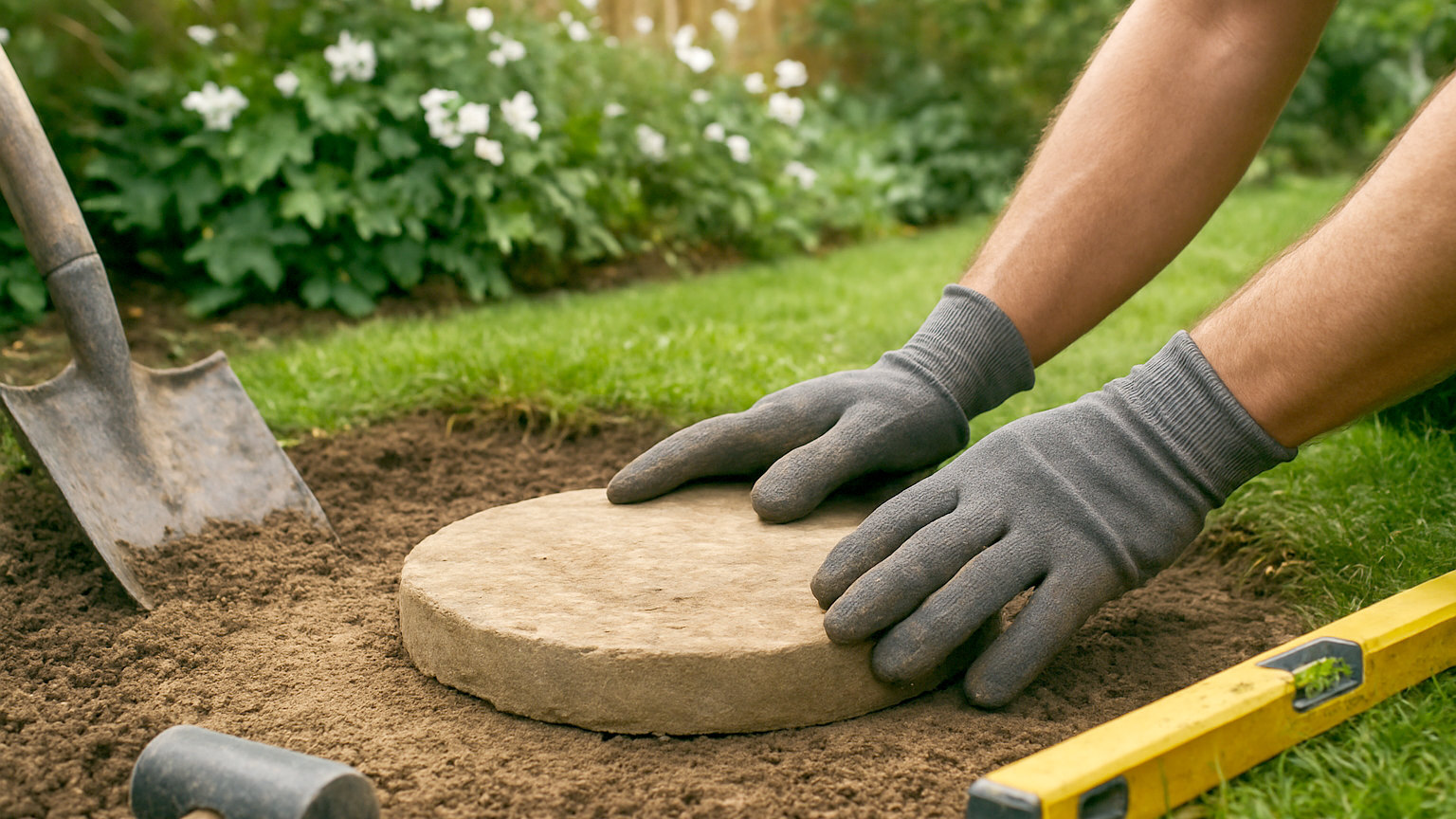
Stepping stones are the cheapest way to make a route usable without building a path. They break up an expanse of lawn or gravel, suit informal planting, and let the surface close over between them.
Spacing to a natural stride
Walk the route first and mark where your feet land. This is the whole technique and it takes two minutes.
Centres of around six hundred millimetres suit most adults walking at a normal pace, though it varies with stride length.
Lay the stones out loose first, walk it several times, and adjust before setting anything.
Stones spaced by eye rather than by walking produce a path that makes people break stride, which is uncomfortable and quickly wears the ground beside it.
On a slope or a curve, space them closer, since strides shorten.
Size and material
Large enough to take a whole foot comfortably, which means at least about four hundred millimetres across.
Small stones look mean and are easy to miss in the dark.
Use slabs, natural stone, log rounds, or thick sawn timber. Whatever you choose should be substantial enough not to tip.
Round or irregular shapes suit informal settings; squares and rectangles suit a more ordered layout.
Setting them in a lawn
Set the stones flush with or slightly below the grass surface, never proud.
A stone standing above the lawn stops the mower, damages the blade, and is a trip hazard.
Cut round the stone with a spade or a half-moon iron, lift the turf, and excavate deep enough for a bedding layer.
Lay on a bed of sharp sand or a semi-dry mortar mix, at least fifty millimetres, on a firmed base.
Tap down to the correct level, checking each stone does not rock.
Check them each spring, since they settle and lift with frost.
In gravel
Simpler, since the gravel accommodates small differences in level.
Still bed them properly on a compacted base rather than laying them on loose gravel, where they will rock and sink.
In planting
Stepping stones through a border let you reach the back for maintenance without compacting the soil.
Set them on a firm bed and allow planting to grow over the edges, which is the intended effect.
Planting between stones
Low creeping plants in the gaps soften the route and are one of the pleasures of this kind of path.
Thyme, chamomile, creeping mint, mind-your-own-business and acaena all tolerate occasional treading. Thyme releases scent when walked on.
These need free drainage and sun. In shade, moss will colonise the gaps unaided and looks well.
Plants between stones make the surface slippery when wet, which matters on a route used in the dark.
Safety and use
Stepping stones are not an accessible route. They cannot be used with a wheelchair or a walking frame, and they are awkward with a barrow or in poor light.
Where a route needs to be usable by everyone, or in all weathers, build a proper path and use stepping stones for secondary routes.
Keep them clear of algae, which makes any smooth surface slippery.
Informal paths generally
Other low-cost informal surfaces suit the same situations.
A mown path through longer grass costs nothing and reads as entirely deliberate.
Bark or woodchip suits woodland and productive areas.
Gravel over a compacted base with a firm edge works almost anywhere, provided the depth is kept modest so it is comfortable to walk on.
Where the route already is
If a worn line already crosses the lawn, put the stepping stones there rather than where you think they ought to go. People walk the shortest sensible route regardless of what the design intends.
Cost
Very low, since a handful of slabs covers a route that would take many square metres of continuous paving.
Reclamation yards and salvage sites are good sources of individual interesting stones, and irregularity suits this use rather than working against it.
Maintenance
Trim the grass around each stone when edging the lawn, since growth creeps over the edges and hides them.
Lift and re-bed any stone that has begun to rock, which is a job of ten minutes and prevents a fall.
Brush off algae in autumn and spring, particularly on a shaded route.


