
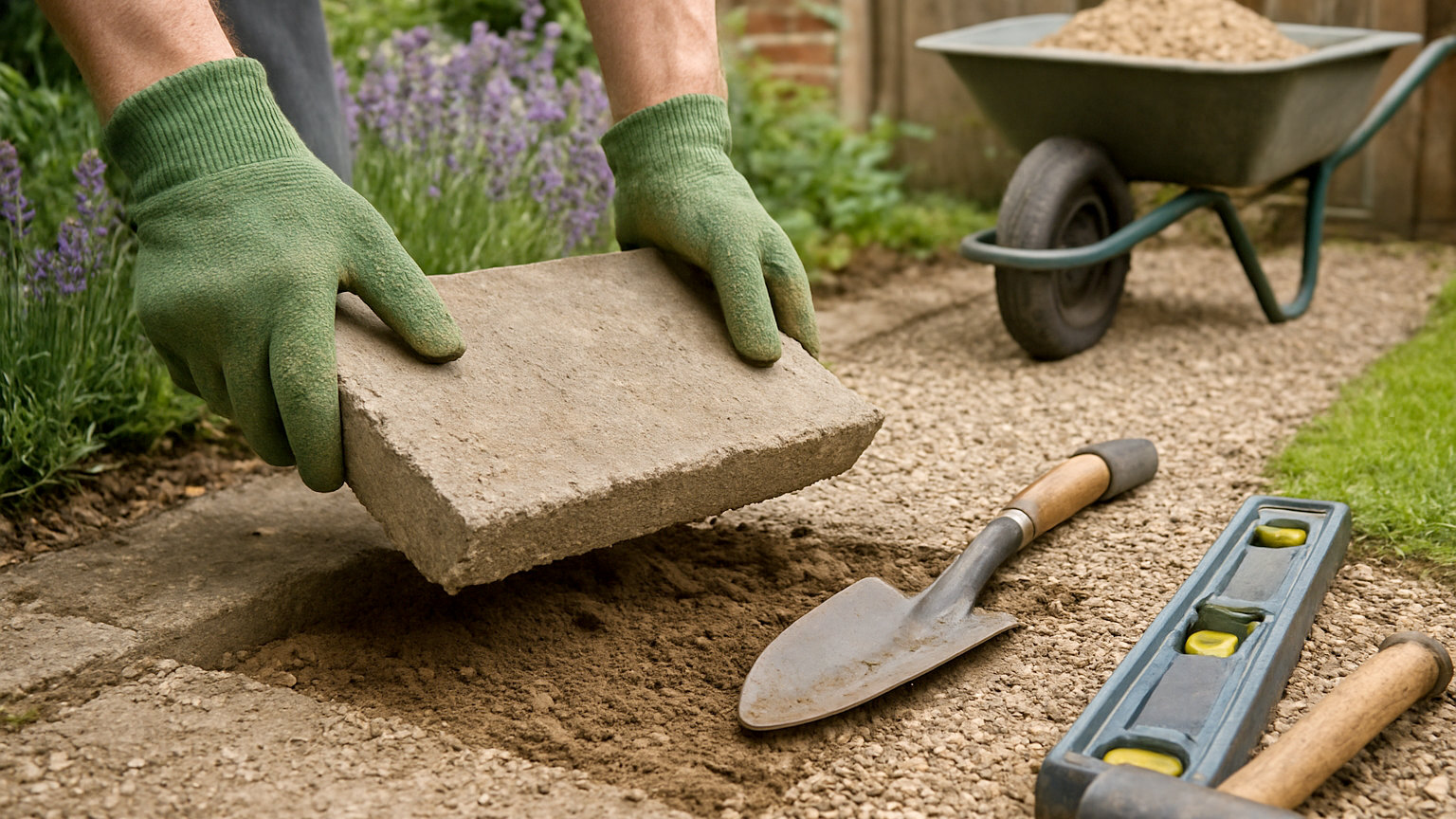
Paving problems are nearly always symptoms of the layers beneath. Lifting a slab, adding a bit of sand and putting it back is the usual response and it means the same slab will move again within a year.
Diagnose first
A single rocking slab usually means it was spot-bedded on dabs of mortar, or the bed has washed out beneath it.
A sunken patch means the sub-base was inadequately compacted, was too thin, or soft material was left in place beneath it.
Cracked slabs in the middle indicate a void beneath, again usually from spot bedding, or a load the construction was not built for.
Spreading and opening joints in block paving mean the edge restraint has failed or was never properly haunched.
Water pooling means an inadequate or reversed fall, which is a construction fault requiring the area to be relaid.
Crumbling joints usually mean the pointing was dry-brushed rather than properly worked in.
Lifting a slab
Rake out the pointing around it completely with a plugging chisel or a joint raker.
Work a bolster or a spade under one edge and lever gently, using a block of wood as a fulcrum so you do not chip the neighbouring slab.
Slabs are heavy and awkward. Get help with anything large, and lift with your knees.
Set the slab aside on edge rather than flat, where it is less likely to be broken.
Correcting the bed
Remove all the old bedding material and look at what is underneath.
If the sub-base is sound and firm, lay a fresh full bed of mortar and re-bed the slab, priming the back if it is natural stone or porcelain.
If the sub-base is soft, loose or too thin, that is the actual problem. Dig it out, add fresh Type 1, and compact it properly in layers before re-bedding.
Never pack under a slab with fragments of stone or brick, which creates point loads and cracks it.
Check the finished level against the surrounding slabs with a straight edge before the mortar sets.
Sunken areas
Where several slabs have dropped together, the whole area needs lifting.
Take up the paving, excavate the failed sub-base, and rebuild it properly: Type 1 compacted in layers of no more than a hundred millimetres, to at least a hundred millimetres deep for pedestrian use.
This is more work than it looks and it is the only lasting repair.
Replacing a cracked slab
Break the damaged slab out with a bolster and a lump hammer, wearing eye protection and gloves, working from the centre outwards so the neighbours are not disturbed.
Clear the bed completely and re-bed a replacement on full mortar.
Matching is the difficulty. Colours vary between batches and new stone will not match weathered stone, which is why keeping spares from the original delivery matters.
Where no match is available, consider taking a slab from an inconspicuous position and putting the new one there.
Block paving repairs
Far easier, which is one of the material's advantages.
Lift individual blocks with a block extractor, or with two screwdrivers.
Correct the bed, replace the blocks, brush kiln-dried sand into the joints and compact.
The same blocks go back, so the repair is invisible.
Repointing
Rake out the failed material completely, down to sound depth, and clear the dust.
Wet the joints, then point with a stiff mortar worked firmly in, or use a proprietary brush-in compound following the instructions.
Filling over crumbling mortar repeats the failure within a year.
Cutting safely
Cutting stone and concrete produces respirable silica dust, which causes permanent lung damage. Use water suppression, a properly fitted respirator, eye and ear protection, and cut outdoors.
When to relay entirely
Where the falls are wrong, where much of the area is sinking, or where the construction was clearly inadequate, piecemeal repair wastes effort.
Lifting and relaying properly is more work at the outset and cheaper than repairing the same area every year for a decade.
Reusing the material
Slabs lifted carefully can generally be relaid. Clean the old mortar off the backs with a bolster before re-bedding, since lumps of set mortar prevent the slab sitting properly.
Broken pieces are useful for edging, stepping stones or hardcore.


