
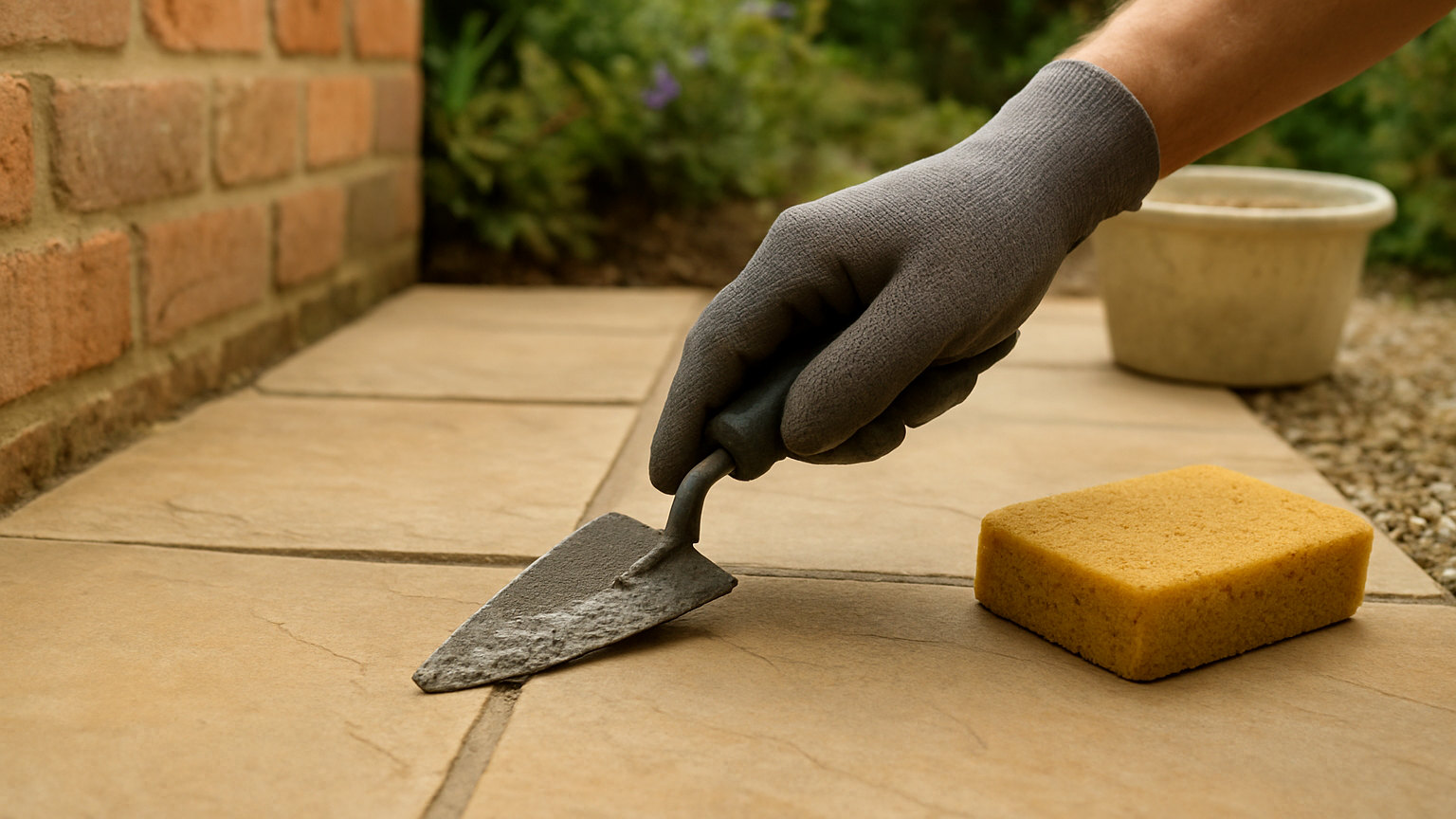
Joints are the part of paving that fails first. They crack, wash out, grow weeds and stain the stone around them, and most of that traces back to how they were filled.
Why dry-brushing usually fails
The traditional shortcut is to brush a dry mix of sand and cement into the joints and wait for rain or dampness to set it.
It rarely works well. The mix does not hydrate evenly, so the resulting mortar is weak and crumbles within a few years.
Worse, dry cement dust left on the surface of the stone reacts with moisture and produces a haze that is extremely difficult to remove from natural stone, particularly riven sandstone.
It is quick, and it is the reason a great many patios have both failing joints and permanently stained slabs.
Wet mortar pointing
The traditional method done properly.
Mix a fairly stiff mortar of sharp sand and cement, typically around three or four parts sand to one of cement, with a plasticiser.
Wet the joints first so the slabs do not draw water out of the mix.
Work the mortar into the joint with a pointing trowel or a pointing bar, pressing firmly so there are no voids, and finish slightly recessed below the surface.
It is slow, and the results last.
Keep mortar off the face of the stone and wipe any splashes immediately with a damp sponge, changing the water frequently. Cement staining is far easier to prevent than to remove.
Brush-in jointing compounds
Proprietary resin or polymer-based compounds, brushed into wet joints and left to cure.
They are considerably quicker than hand pointing, flexible rather than brittle, resistant to weeds and to washing out, and generally less likely to stain if used correctly.
They cost more per square metre and the saving in labour usually justifies it.
Follow the instructions precisely. Most require the paving to be thoroughly wetted, the joints to be a minimum width and depth, and the work to be done within a temperature range and with no rain forecast.
Check the product suits your stone, since some are unsuitable for certain porous materials.
Remove all residue from the surface before it cures, which is the point where things go wrong.
Kiln-dried sand
Used for block paving and setts laid flexibly, not for slabs on mortar.
Brushed into narrow joints and vibrated in, repeatedly, until the joints are completely full.
It must be genuinely dry to flow into the joints, which is why kiln-dried sand is specified.
Top up after a few weeks and again periodically, since it settles and washes out.
Joint width and depth
Consistent joints are what make paving look properly laid.
Natural stone typically takes eight to fifteen millimetres, porcelain and precise concrete rather less.
Joints need adequate depth for whatever fills them, usually at least twenty millimetres for mortar or compound. Shallow joints fail quickly.
Rake out any bedding mortar that has squeezed up into the joints before pointing.
Weather
Do not point in frost, when frost is forecast, or in heavy rain.
Avoid strong sunshine on the work, which dries mortar before it cures. Shade the area or work in the cooler part of the day.
Weeds in joints
Weeds in paving joints germinate in windblown debris that collects on top, not from below.
Brushing the surface regularly is the most effective control. Sound well-filled joints leave nowhere for seed to lodge.
Boiling water, a hand weeder or a joint-scraping tool all deal with them without chemicals.
Repointing
Rake out the failed material completely with a plugging chisel or a joint raker, down to sound depth.
Clean out the dust, wet the joints and repoint as above.
Filling over crumbling mortar simply repeats the failure within a year or two.
How long joints should last
Properly worked wet mortar or a good jointing compound should last many years without attention.
Joints failing within two or three years indicate the method rather than the weather, and repointing badly a second time achieves nothing.
Movement joints
Large areas of rigid paving need provision for thermal movement, and cracks appearing in long straight runs of jointing usually indicate none was made.
Flexible jointing compounds accommodate more movement than rigid mortar, which is one of the reasons they have become popular.


