
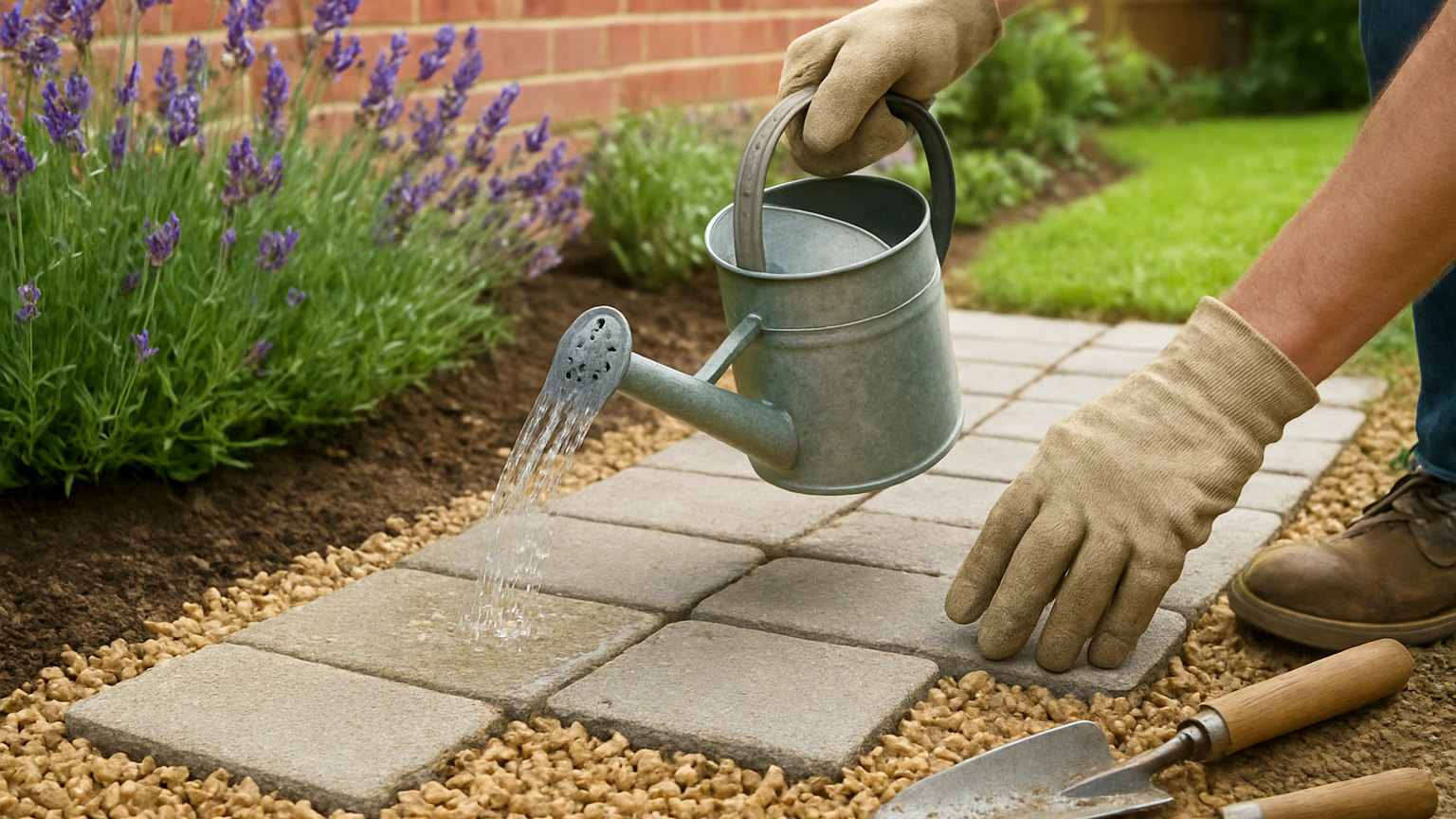
Permeable surfacing lets rainwater soak through into the ground beneath rather than running off it. It solves drainage problems at source, and in front gardens it determines whether planning permission is needed.
The front garden rule
In England, paving more than five square metres of a front garden with an impermeable surface generally requires planning permission.
Permission is not needed if the surface is permeable, such as gravel, permeable block paving or porous asphalt.
Nor is it needed if rainwater from an impermeable surface is directed to a lawn or a border where it can soak away naturally.
The rule exists because run-off from paved front gardens has contributed significantly to surface water flooding, and because it removes soakage and planting from urban areas.
Rules differ in Scotland, Wales and Northern Ireland, and the local planning authority will confirm the position.
How the construction differs
This is the part most often got wrong.
A permeable surface laid over a conventional sub-base achieves nothing, because standard Type 1 contains fines and compacts to something close to impermeable.
Permeable construction uses a clean angular material without fines, so that voids remain between the particles for water to pass through and be stored.
The layers are typically a clean angular sub-base, a thinner laying course of clean grit, then the surface.
The sub-base is usually deeper than conventional construction, since it acts as a reservoir holding water while it soaks away.
Options
Gravel is the simplest and cheapest permeable surface. It needs a firm compacted base, an edge restraint on every side, and a modest depth of around fifty millimetres so it is comfortable to walk on. Deeper gravel is hard work underfoot.
Cellular grids filled with gravel or grass stabilise the surface, prevent rutting and make gravel usable for parking and for wheelchairs.
Permeable block paving uses blocks with spacer nibs creating wide joints filled with fine grit, through which water passes. It looks like conventional block paving and performs entirely differently.
Porous asphalt and resin-bound surfacing allow water through the material itself and give a smooth firm surface, which suits accessibility.
Reinforced grass using cellular grids gives a green surface that takes occasional vehicle use.
Where it will not work
Heavy clay, where water cannot soak away below the sub-base.
A high water table.
Close to a building, where soaking water could affect foundations. Keep permeable surfaces a sensible distance from walls.
On a steep slope, where water runs across the surface before it can infiltrate.
In those cases, a permeable surface can still be used with a tanked construction and a controlled outlet, which is a design matter rather than a simple build.
Maintenance
The one genuine drawback. Permeable surfaces silt up over time as fine material accumulates in the voids.
Brush regularly, keep leaves and soil off the surface, and top up jointing grit on permeable blocks.
A silted permeable surface stops being permeable and needs cleaning to restore it, which for block paving means brushing or vacuuming out the joints and refilling.
Why it is worth doing anyway
Beyond the planning position, permeable surfacing reduces run-off and local flood risk, avoids the cost and complication of drainage runs and soakaways, keeps water in the ground where trees and planting can use it, and filters pollutants.
It is generally the better technical solution as well as the simpler planning one.
Dropped kerbs
Creating vehicle access across a footway requires permission from the highway authority, which is separate from planning permission and involves a specified construction carried out by an approved contractor.
Applying for a dropped kerb is done through the local council, and the work is charged to the householder.
Combining approaches
A drive need not be entirely permeable. Wheel strips of paving with gravel or reinforced grass between them reduce the impermeable area considerably and look better than a solid expanse.
Directing run-off from a conventional surface into a planted rain garden or a border achieves the same result and adds planting rather than removing it.
Keeping some of the garden
Front gardens have been substantially lost to parking over recent decades, with real consequences for flooding, wildlife and street appearance.
Paving only the area actually needed for the vehicle, and keeping the rest planted, usually costs less and looks considerably better.


