
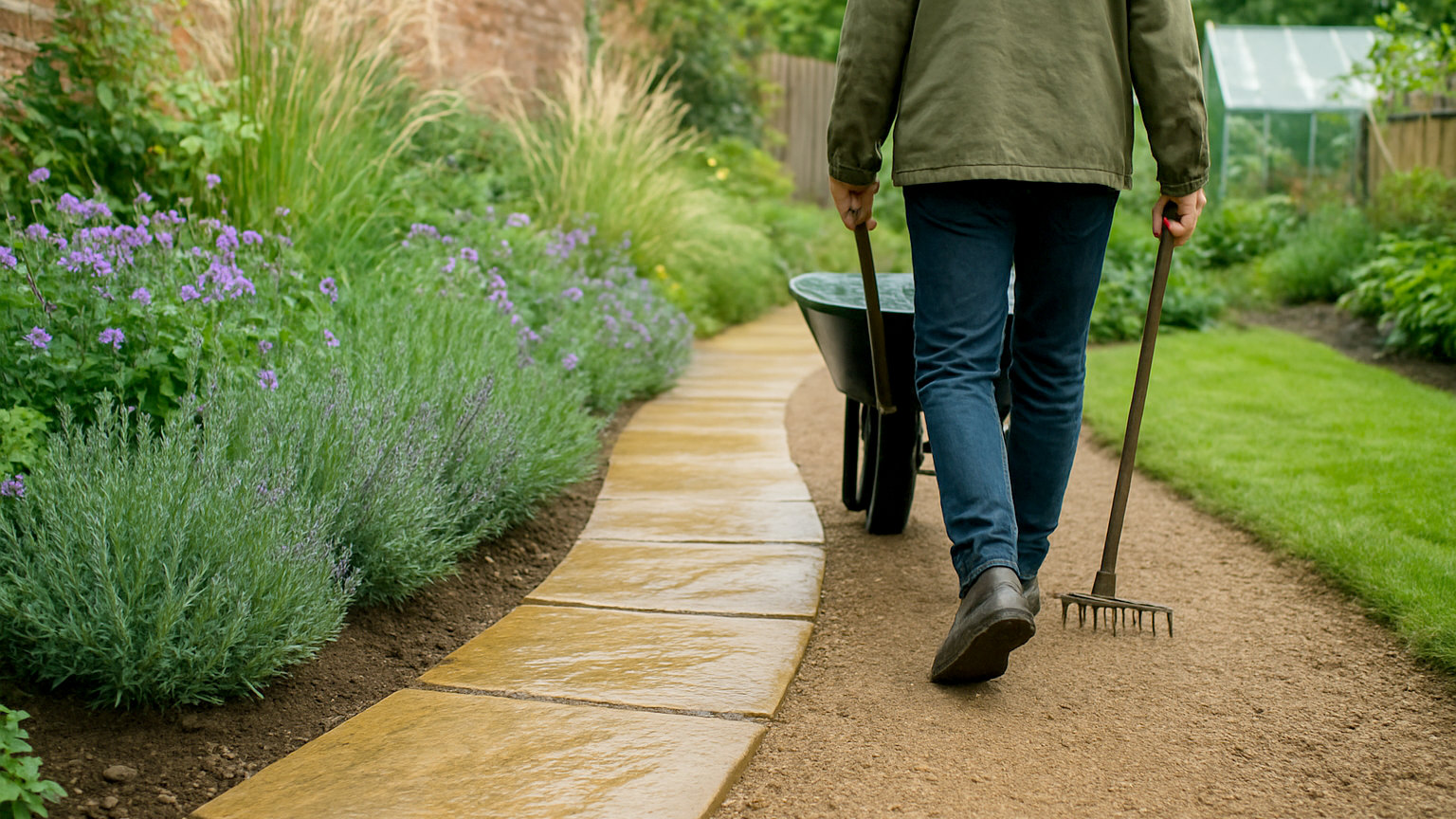
A path has one job, which is to get people where they are going in reasonable comfort. Get the route or the width wrong and people simply walk beside it, leaving a worn strip through the border as evidence.
Follow the desire lines
Desire lines are the routes people naturally take, and they are stubborn. Before designing anything, watch where the family actually walks: to the shed, to the bins, to the washing line, round to the side gate.
A path that follows those lines gets used. One that takes an elegant curve past the border because it looks better on paper gets cut across at the corner within a month.
Curves are fine provided there is a reason for them, such as going round a tree or a bed. A curve for its own sake across an open lawn is the one people short-cut.
The widths that work
- 1.2 metres - a main path, two people side by side, comfortable for a wheelbarrow
- 900mm - a good secondary path, one person comfortably, a barrow with care
- 750mm - the practical minimum for a wheelbarrow route
- 600mm - an occasional or purely functional path, one person
- 1.5 metres - what wheelchair access wants, with turning space at either end
Remember that planting flops over the edges through summer, so a path effectively loses fifteen or twenty centimetres each side by July. Allow for it, or keep the planting back with a mowing strip or a hard edge.
Gravel
The cheapest option and easy to lay in curves. Angular chippings around ten to twenty millimetres stay put; rounded pea shingle does not. Self-binding gravel compacts to a firmer surface and takes a barrow better.
Drains freely, which suits a garden. Needs edging to contain it, occasional raking, and it is noisy, which some people like as a security feature and others find tiring.
Paving slabs
The most solid and most expensive per square metre. Concrete slabs are cheapest and have improved considerably in appearance. Natural stone, typically sandstone or limestone, looks better and costs more.
Needs a proper compacted sub-base and a mortar bed, and a fall so water runs off. Slabs laid on sand alone will rock and sink within a couple of seasons.
Check slip resistance before buying. Smooth stone and some porcelain are treacherous when wet, and a path in shade will grow algae whatever it is made of. Riven or textured surfaces are safer, and this matters most on any route used at night or by anyone unsteady.
Brick and setts
Small units suit curves and narrow paths, and they read well against a brick house. Use proper clay pavers rather than house bricks, which are not frost resistant and will spall and crumble.
Laying takes considerably longer than slabs because of the number of units, and the pattern affects the look substantially. Herringbone is the strongest bond and best where there is any vehicle traffic.
Bark and woodchip
Cheap, soft underfoot, quick to lay and entirely appropriate for an informal path through a wooded area or a vegetable garden. Lay over membrane to a depth of fifty to seventy-five millimetres.
It decomposes and needs topping up every couple of years, and it can be slippery when very wet. Not suitable as a main route or anywhere it will get muddy.
Stepping stones
Good across a lawn or through planting where a full path would be too dominant. Set them so the spacing matches a natural stride, around six hundred millimetres centre to centre, and check it by walking the line before fixing anything.
In a lawn, bed each stone so the surface sits just below the grass, allowing a mower to pass over without catching. Stones proud of the lawn are a trip hazard and a nuisance to mow around.
Mixing materials
Combining two materials, such as brick edging with a gravel infill, or stone slabs with cobble joints, often looks better than a single surface and can reduce the cost. Keep it to two materials at most, and repeat them elsewhere in the garden so the path reads as part of a scheme.
Practical considerations
Permeable surfaces are preferable to sealed ones, since water soaking into the ground rather than running off reduces flooding and helps the garden.
Think about lighting on any route used after dark, and about how a surface will behave in frost. Consider drainage before construction rather than after, since water running off a new patio has to go somewhere.


