
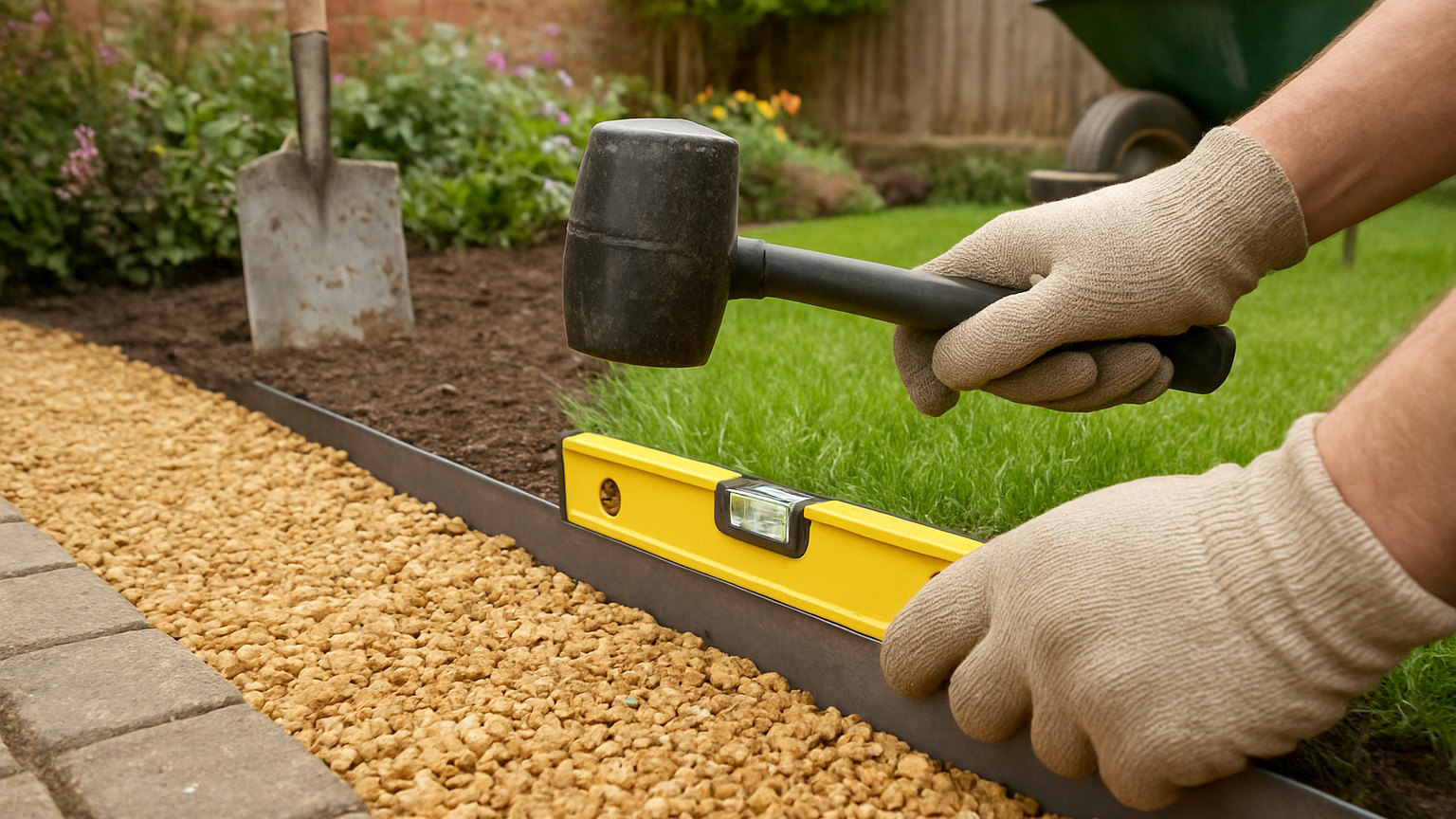
The edge of a path does more work than it appears to. It contains loose material, restrains flexible paving, defines the line, and separates the surface from whatever is beside it.
What needs an edge and why
Block paving and setts must have a restraint on every edge. Without one the blocks spread sideways under load, joints open, the interlock is lost and the surface fails. This is structural rather than decorative.
Gravel and bark migrate into lawns and borders within a season without containment.
Slabs on a mortar bed do not strictly need a restraint, and an edge still improves the appearance and protects the outer slabs.
Lawn edges benefit from a mowing strip, which removes the edging job entirely.
Installing a restraint properly
The method matters more than the material.
Excavate a trench alongside the path, deeper than the edging unit.
Bed the edging on a concrete foundation of at least a hundred millimetres, checking the line with a string and the level as you go.
Haunch it, which means placing concrete against the back of the edging, sloping down and away, to hold it against sideways pressure.
Haunching is the part usually omitted, and an unhaunched edge tips outwards within a couple of years.
Let the concrete set before laying the surface against it.
Materials
Concrete edging kerbs are cheap, strong and utilitarian. Fine where they will be hidden by planting.
Bricks on edge are the traditional garden solution and look well with almost anything. Use frost-resistant clay pavers rather than house bricks.
Setts laid as a course give a strong edge and suit curves, since small units follow a radius easily.
Timber gravel boards are cheap and quick, and suit informal and productive areas. Use timber rated for ground contact and expect to replace it eventually.
Metal edging strip in steel or aluminium gives a very clean nearly invisible line and follows curves well. It is not a structural restraint for block paving.
Plastic edging is cheap and tends to lift and distort over time.
Log roll suits woodland and children's areas and rots within some years.
Curves
Small units follow curves; large ones do not.
Setts, bricks and metal strip all take a radius easily. Long concrete kerbs do not, and forcing them produces a faceted line rather than a curve.
Set out a curve with a hosepipe or a string and a pin, and check it from the house before fixing anything.
Mowing strips
A row of bricks or paving set flush with the lawn surface along a border or path edge.
The mower runs over it and cuts the grass right to the edge, which removes the separate edging job permanently.
It also stops border plants flopping onto the grass and killing it, and stops the lawn creeping into the bed.
Set it slightly below the grass surface rather than proud, or the mower will scalp against it.
Bed the units on mortar so they do not move.
It is a day's work and saves an hour a month for the next twenty years.
Height and level
Where a path meets a lawn, keep the edging at or just below grass level.
Where it meets a border, the edging can stand slightly proud to retain soil and mulch.
Where it meets another hard surface, match the levels precisely, since a small step is a trip hazard.
Edging as a design element
A crisp edge is one of the things that most distinguishes a well-maintained garden.
Using the same edging material throughout a garden ties the whole layout together, and it is a cheap way to create unity.
Contrasting edging, such as a brick edge to a gravel path, defines the line and looks deliberate.
Maintenance
Check edges annually, particularly after frost, and re-bed anything that has moved.
Keep gravel and bark topped up to the edging level, since a surface that has dropped below the edge looks neglected and holds water.
Trimming alongside
An edging that stands proud of a lawn creates a strip of grass the mower cannot reach, which then needs strimming every week.
Setting the edging flush or slightly below the grass avoids the job entirely, which over twenty years is a considerable saving of time.


