
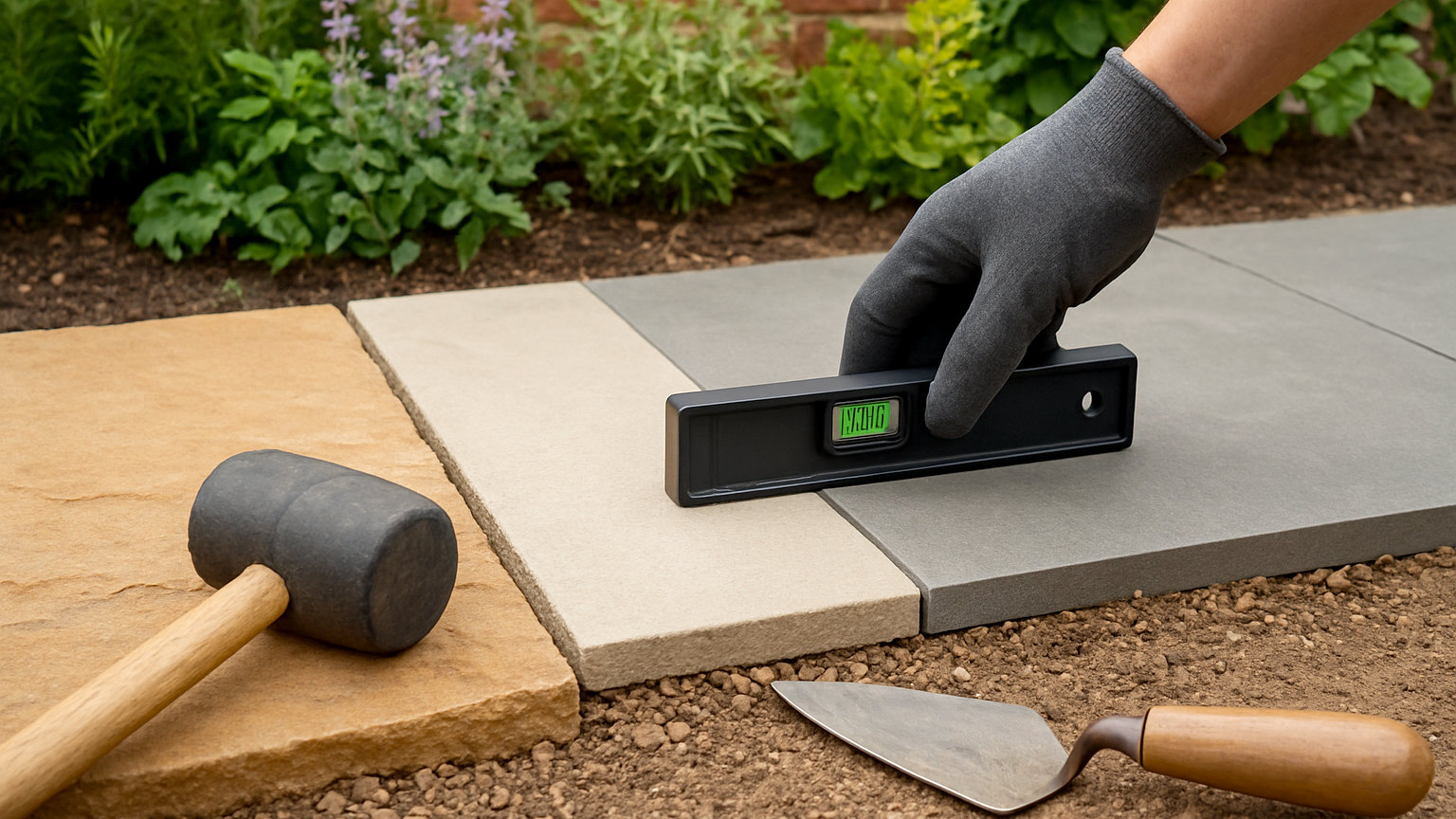
Most paving decisions come down to three families of material. They differ in appearance, cost, how they weather and how demanding they are to lay.
Natural stone
Quarried stone, cut into slabs. The most varied in appearance, since no two pieces are identical, and it weathers attractively over decades.
Sandstone is the most widely used, much of it imported from India. It is warm in colour, riven or sawn, relatively easy to cut and comparatively porous, which means it stains and supports algae in shaded damp positions.
Limestone gives a smoother, more uniform surface in greys and blues. It is damaged by acid, so acidic cleaners and some patio cleaners must be avoided entirely.
Granite is extremely hard and durable, resistant to staining and difficult to cut. Setts and small units are the usual domestic form.
Slate is dark and dramatic, and can be slippery when wet.
York stone is the traditional English paving, expensive and unmatched in appearance, and reclaimed pieces vary in thickness which complicates laying.
Natural stone varies in thickness within a pack, particularly riven material, so each slab is bedded individually to level.
Concrete
Manufactured slabs, from plain utilitarian units to convincing reproductions of natural stone.
Consistent in size and thickness, which makes laying quicker and easier than natural stone.
Considerably cheaper, and the quality range is wide. Cheap concrete slabs fade, and the surface layer can wear or spall in frost.
Better wet-cast and textured products age reasonably well and are a sensible choice where budget matters.
They tend to weather less gracefully than natural stone, becoming duller rather than developing character.
Porcelain
Fired ceramic tiles for outdoor use, and now very widely specified.
The advantages are real: almost no porosity, so it does not stain, does not support algae readily, does not fade, and needs no sealing. It stays looking new for many years and cleans easily.
Colours and finishes are consistent, including convincing stone and timber effects.
The disadvantages are about installation. Porcelain must be laid on a full mortar bed with a slurry primer on the back of every slab, since it will not bond to mortar otherwise.
Cutting requires a diamond blade and care, since edges chip.
It is unforgiving of poor workmanship, because the tight consistent joints show every error.
Some people find the uniformity looks less natural than stone, which is a matter of taste.
Slip resistance
Worth checking, and frequently ignored.
Manufacturers quote slip ratings, commonly an R value or a pendulum test value. Higher figures indicate better grip.
Smooth polished surfaces of any material become slippery when wet. Textured, riven and sawn-and-brushed finishes grip better.
Slip resistance matters most on steps, slopes, and any route used in the dark or by anyone unsteady.
Algae and moss reduce grip on any surface, so shaded paving needs cleaning more often whatever it is made of.
Cost
Roughly, concrete is cheapest, porcelain and mid-range natural stone sit in a similar bracket, and premium natural stone costs most.
Installation costs matter as much as material cost. Porcelain and irregular natural stone both take longer to lay well.
Sealing
Porcelain does not need it.
Natural stone can be sealed to reduce staining, particularly sandstone near a seating area. Sealing changes the appearance, needs redoing periodically, and must be applied to clean dry stone.
Sourcing
Ask about the origin of imported stone and whether the supplier can demonstrate responsible sourcing, since working conditions in some quarrying regions have been the subject of serious concern.
Order all the material at once, since batches vary in colour.
Order about ten per cent more than the calculated area to allow for cuts, breakages and future repairs, and keep the surplus somewhere dry.
Which to choose
Natural stone for character and for a garden where the paving should look as though it has always been there.
Porcelain where a clean modern appearance and minimal maintenance matter most, and where the laying will be done well.
Concrete where budget is the constraint, choosing the best quality the budget allows rather than the largest area of the cheapest product.
A smaller terrace in a good material laid well is a better outcome than a large one in a poor material laid badly.


