
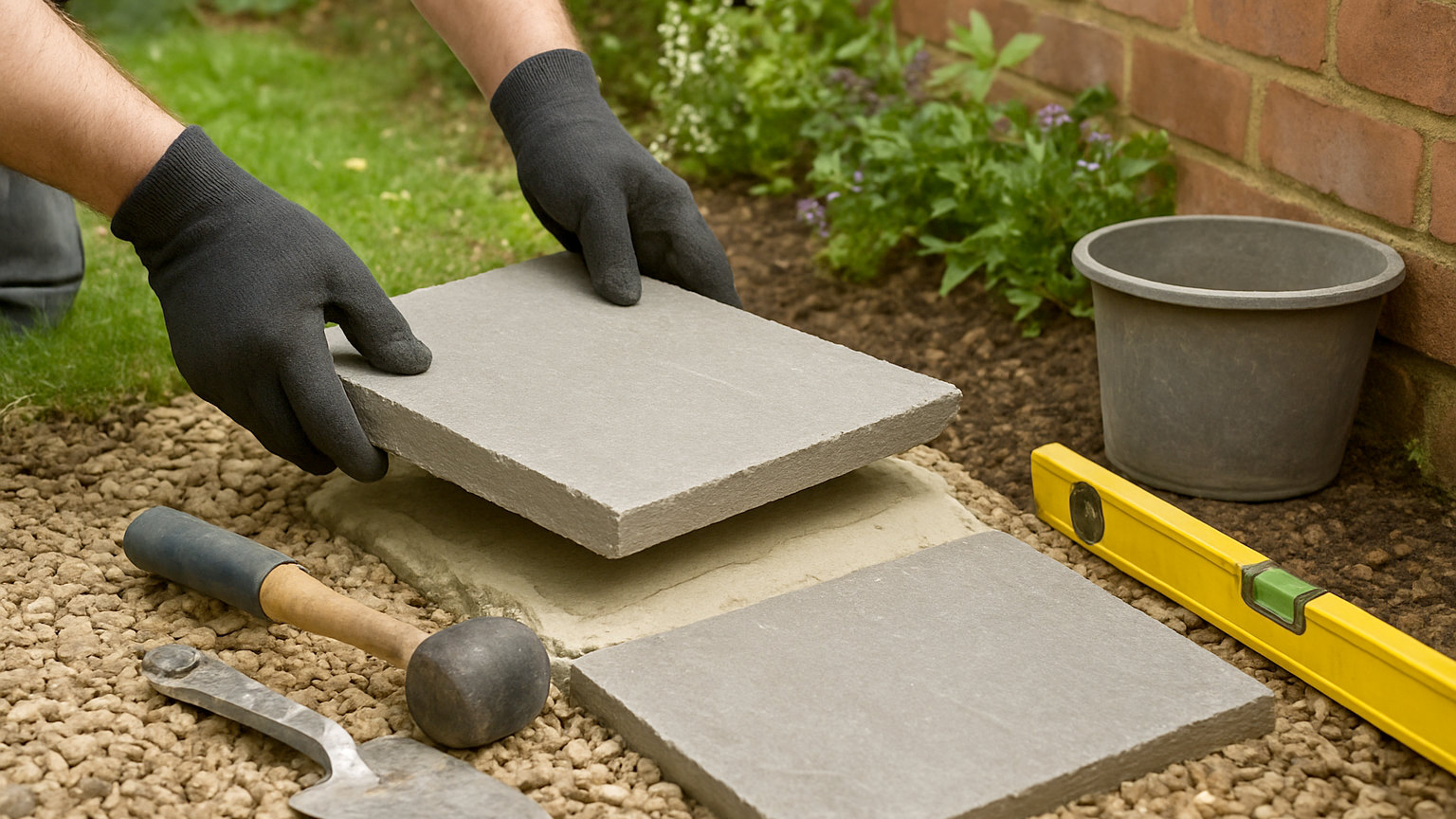
Laying slabs is straightforward and there is one shortcut that causes most patio failures, and it is still widely used.
Full bed, not spot bedding
Lay every slab on a continuous full bed of mortar with no voids beneath.
Spot bedding, using five dabs of mortar under each slab, leaves hollow spaces. Water collects in them, freezes and expands, and the slab cracks. The unsupported centre also cracks under load, and the slab rocks as the dabs settle unevenly.
It is quicker and it is the single commonest cause of a patio failing within a few years.
The mortar bed should be twenty-five to forty millimetres thick after the slab is bedded down.
Mortar mix
A dry-ish mix of sharp sand and cement, usually around five or six parts sand to one of cement, sometimes quoted as four to one for heavier duty.
Use sharp sand rather than building sand, which is too fine and produces a weak bed.
Mix it damp enough to hold together when squeezed but not wet and sloppy. A wet mix squeezes out and does not support the slab.
Mix only what you can lay before it starts to go off, which in warm weather is not long.
Prime the backs of natural stone
Natural stone, and porcelain in particular, does not bond reliably to mortar on its own.
Brush a slurry primer, usually an SBR bonding agent mixed with cement to a paint consistency, onto the back of each slab immediately before laying.
This is essential for porcelain, which has very low porosity and will otherwise simply lift off the bed, and strongly advisable for sandstone and limestone.
Lay the slab while the slurry is still wet.
Setting out
Establish the levels first with pegs and a string line, including the fall of about one in eighty away from any building.
Start from a fixed straight edge, usually the house or a path, and work outwards.
Lay the perimeter or a key row first and work from it, checking constantly with a spirit level along and across.
Dry-lay the pattern first for random or mixed-size paving, so you can adjust before any mortar is mixed.
Bedding each slab
Spread the mortar slightly proud of the finished level and lay the slab onto it.
Tap it down with a rubber mallet, working from the centre outwards, until it sits at the correct level.
Check with a level in both directions and against the neighbouring slabs.
If a slab is too low, lift it and add mortar. Do not tap it further down once the bed has been compressed, and never pack underneath with fragments of stone.
Joints
Use spacers or a consistent gauge, typically eight to fifteen millimetres for natural stone and narrower for porcelain and precise concrete slabs.
Consistent joints are what make paving look properly laid. Uneven ones are the most visible sign of amateur work.
Keep mortar out of the joints as you go, since cement staining on the face of natural stone is very difficult to remove.
Wipe any splashes off immediately with a damp sponge.
Curing
Keep off the paving for at least twenty-four hours, and longer in cold weather.
Do not lay in frost or when frost is forecast within a few days, since mortar that freezes before curing is permanently weakened.
Protect fresh work from heavy rain, which washes cement out of the bed.
Point the joints once the bed has set, usually the following day.
Cutting
Cutting stone and concrete produces respirable crystalline silica dust, which causes permanent lung damage.
Always cut with water suppression on the saw, wear a properly fitted respirator rated for fine dust, and use eye and ear protection.
Cut outdoors, and never dry-cut in an enclosed space.
Plan the layout to minimise cuts, and put any cut edges where they are least visible.
Working conditions
Do not lay in frost, when frost is forecast, or in very hot weather when mortar dries before it can be worked.
Slabs are heavy. Large natural stone units frequently need two people, and lifting with a straight back is how people injure themselves on this job.
Use a slab lifter or a sack truck for moving material, and stack slabs on edge rather than flat.


