
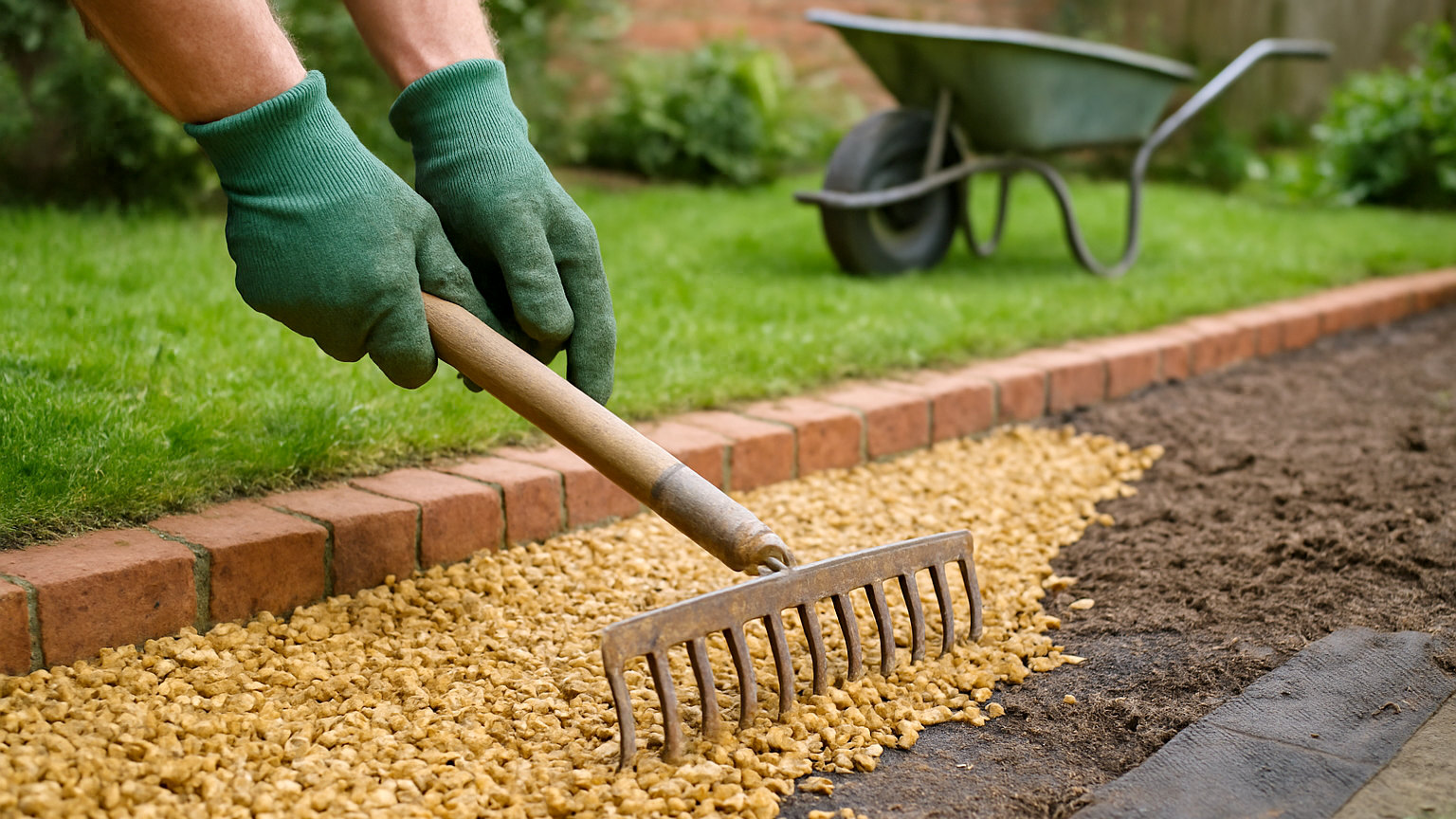
Gravel is the cheapest hard surface in a garden and among the easiest to lay well. It is also frequently laid badly, which is why so many gravel paths turn into muddy channels with the stone spread across the lawn.
Choose the right gravel
Angular gravel, not rounded pea shingle. This is the decision that matters most. Angular chippings lock together underfoot and stay put. Rounded pea shingle behaves like ball bearings, migrates constantly, and is unpleasant to walk on.
A size of around ten to twenty millimetres is right for a path. Smaller gets carried into the house on shoes; larger is uncomfortable to walk on and hard to push a wheelbarrow over.
Self-binding gravel, sometimes sold as hoggin or path gravel, contains fine material that compacts into a firm surface. It is the best choice for a path that needs to take a wheelbarrow or a wheelchair.
Width
A main path wants to be one metre twenty, which allows two people to walk side by side or a wheelbarrow to pass comfortably. A secondary path can be ninety centimetres, and a purely occasional route six hundred millimetres.
Bear in mind that planting spills over the edges, so a path effectively narrows once the border grows. Add a little to allow for it.
Excavating
Mark the line with string or a hosepipe, and dig out to a depth of about a hundred and fifty millimetres for a foot path, or two hundred where a wheelbarrow will be used regularly.
Keep the base even and firm, and remove any soft spots. Slope the excavation very slightly to one side so water drains rather than sitting, though gravel is permeable enough that this matters less than with paving.
Edging
Edging is not optional. Without it, gravel spreads sideways into the borders and lawn and the path gradually disappears.
Options include treated timber boards pegged with stakes, metal edging strip, brick laid on edge in mortar, or proprietary plastic edging. Set the edging so its top sits about twenty-five millimetres above the finished gravel level, which contains the stone.
Fix it firmly, since edging that moves is worse than none.
The sub-base
Fill the excavation with about a hundred millimetres of compacted MOT Type 1 hardcore, which is the crushed material used under roads and available from any builders' merchant.
Lay it in two layers rather than one, compacting each with a plate compactor or a hand tamper. This is the step that decides whether the path stays firm or develops soft muddy patches, and it cannot be skipped on anything other than an ornamental path over dry ground.
Membrane
Lay a permeable geotextile membrane over the compacted sub-base, before the gravel. It stops the gravel working down into the hardcore over time and suppresses weeds coming up.
Use a proper woven landscape membrane rather than plastic sheeting, which stops drainage and creates a bog. Overlap joints generously and turn the edges up against the edging.
Be aware that membrane does not prevent weeds forever. Wind-blown soil and leaves accumulate on top of the gravel and weeds germinate in that layer, so occasional weeding is still needed.
The gravel
Spread the gravel to a depth of about twenty-five to forty millimetres. That is thinner than most people expect, and it is deliberate.
Deep gravel is difficult to walk on, since the foot sinks and slides. A shallow layer over a firm sub-base is far more comfortable and uses considerably less material.
Rake it level and leave it. It settles and locks together with use.
Gravel over an existing surface
Gravel can be laid over existing concrete or a firm compacted surface, which saves the excavation entirely. Check the surface drains, or drill holes through it, since gravel over sealed concrete simply holds water. Fit edging to contain the stone and lay a thinner layer, around twenty-five millimetres.
Gravel stabilisation grids, honeycomb panels filled with stone, are worth considering where a barrow or a bicycle will use the path regularly, as they stop rutting entirely.
Keeping it right
Rake occasionally to redistribute where it thins, and top up every few years. Hoe or hand-weed anything that germinates in the surface layer, ideally when small, and clear fallen leaves each autumn since leaf mould in gravel is what weeds root into.
A stiff brush along the edges keeps the line crisp and pushes stray gravel back where it belongs.


