
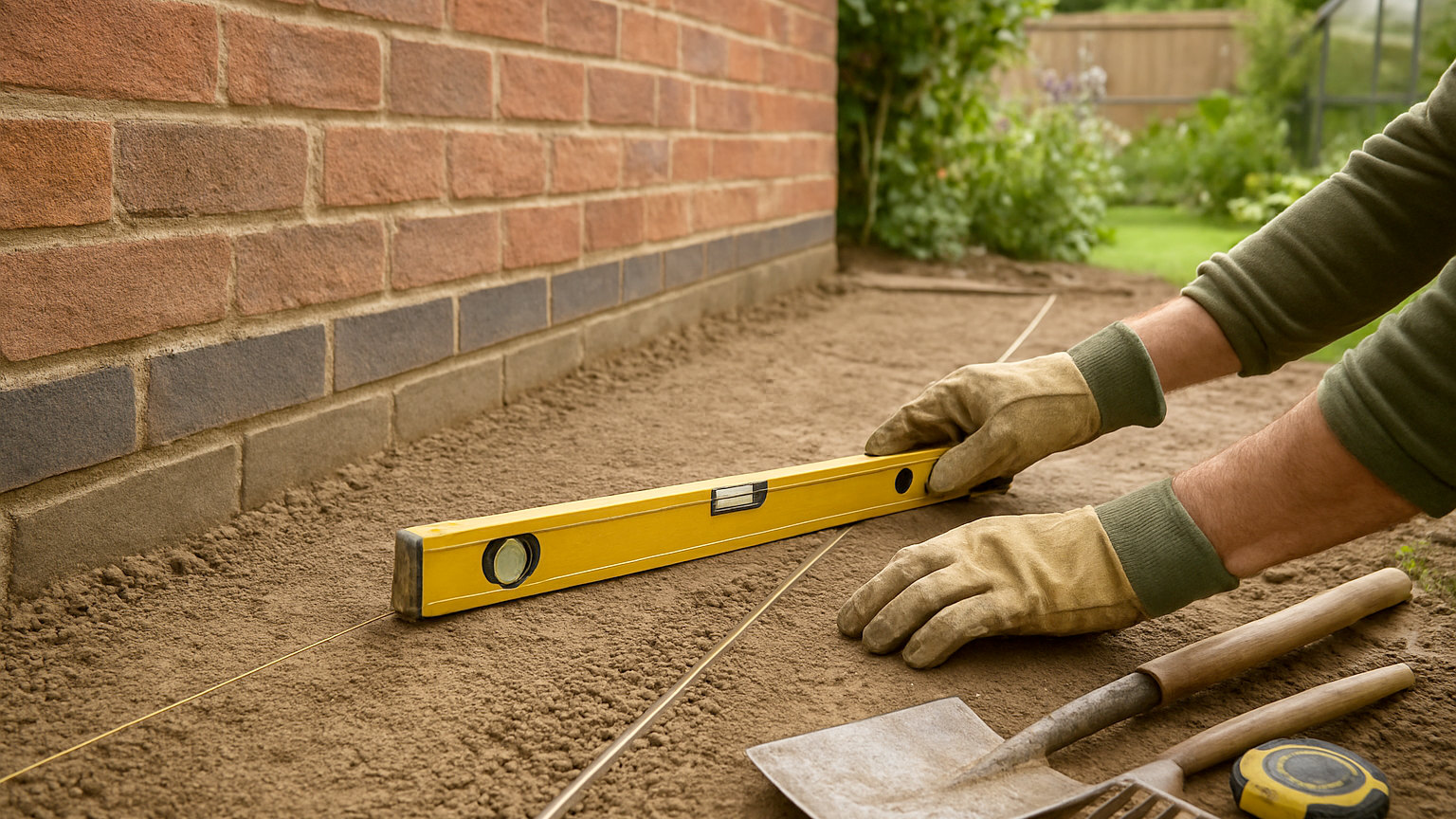
Water is what damages paving and buildings, and where it goes is decided before the first slab is laid. Correcting a fall afterwards means taking the paving up.
How much fall
A gradient of about one in eighty is the usual figure for paving, and one in sixty for a smoother surface where water might otherwise sit.
That means roughly twelve millimetres of drop per metre at one in eighty.
It is enough to shed water and shallow enough to be imperceptible underfoot and to a table.
Insufficient fall leaves puddles, which encourage algae, freeze in winter and stain the surface.
Excessive fall is uncomfortable and makes furniture rock.
Which way
Always away from the house. This is not negotiable.
Where a terrace sits between the house and a wall or a bank, the water must be collected rather than simply directed, usually with a drainage channel.
Consider where the water is going once it leaves the paving. Running it onto a lawn or a border is usually acceptable for a small area; running it onto a neighbour's land or towards a building is not.
The damp-proof course
The single most important level in the job.
Finished paving must sit at least a hundred and fifty millimetres below the damp-proof course of a house.
Paving laid over or too close to the damp course bridges it, allowing moisture into the wall above, which causes damp inside and is expensive to correct.
The damp course is usually visible as a distinct horizontal line in the mortar two or three brick courses above ground level.
Where a surface must be higher, use a drainage channel with an open gap against the wall so the paving does not touch it, and drain the channel properly.
Drainage channels
A linear channel with a grating, set flush with the paving, collecting water along its length.
Use one across the head of a terrace against a house, at the foot of a slope, or wherever water would otherwise collect.
The channel needs a fall along its length and a proper outlet. A channel that discharges nowhere simply moves the puddle.
Set the grating slightly below the paving level so water runs into it.
Where the water goes
Options in rough order of preference: to a lawn or border where it can soak away, to a soakaway, or to a surface water drain.
Do not connect surface water to a foul drain. This overloads the sewerage system and is generally not permitted.
A soakaway must be sized for the area it serves, sited well away from buildings, and not used where the ground is heavy clay or the water table is high, since it will not work.
Connecting to an existing surface water drain may need approval, and the drain must have capacity.
Permeable surfaces
Gravel, permeable block paving and porous surfacing let water soak through rather than running off, which removes much of the drainage problem.
These need a different construction, with a clean angular sub-base without fines so water can pass through.
Standard Type 1 sub-base is not permeable, so laying a permeable surface over it achieves nothing.
Front gardens
Paving more than five square metres of a front garden with an impermeable surface generally requires planning permission in England.
Permission is not needed where the surface is permeable, or where rainwater is directed to a lawn or a border to soak away.
This rule exists because run-off from paved front gardens contributes to surface water flooding.
Building it in
Set the fall in the sub-base rather than correcting it in the mortar bed, since a thick wedge of mortar under one edge is a weak point.
Use pegs and a string line, or a laser level, and check as you build each layer.
Test it before pointing by pouring a bucket of water across the surface and watching where it goes.
Correcting a fall afterwards means lifting the paving, so this check is worth doing at the point when it can still be fixed.
Ground levels generally
Water follows the ground. Consider the whole area rather than the paving alone: where the lawn falls, where the borders sit, and whether a new terrace will collect water from a slope above it.
A French drain or a swale above a terrace intercepts water from a bank before it reaches the paving.


