
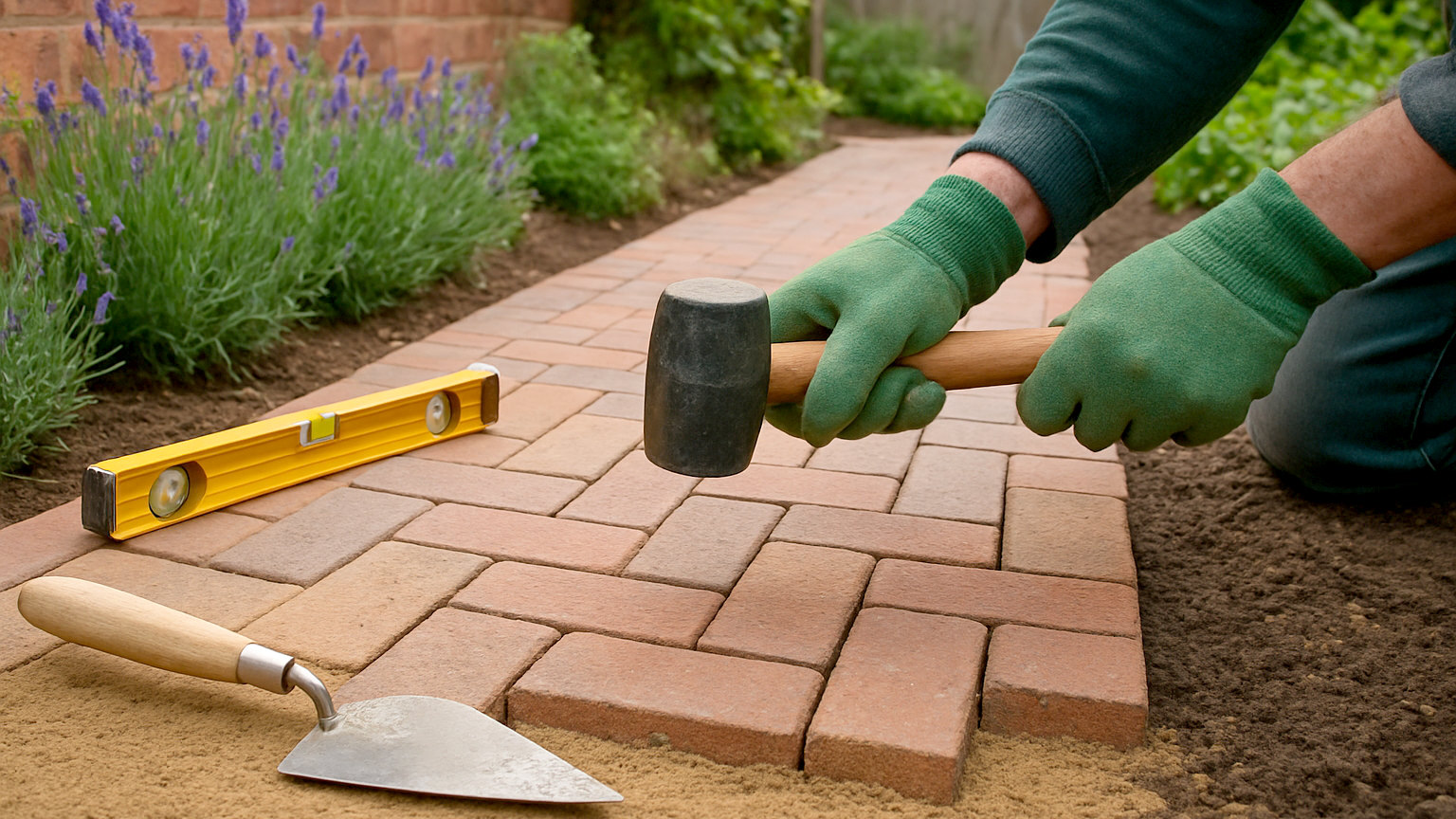
Brick makes one of the most attractive path surfaces there is, particularly in a period or cottage garden, and it suits small spaces because the unit size keeps the scale right.
Use the right brick
Ordinary house bricks are not suitable for paving. Most are not rated for exposure to saturation and frost, and they spall, crumble and break up within a few winters.
Use clay pavers, which are made specifically for the purpose, or engineering bricks, or reclaimed bricks that are known to be frost resistant.
Clay pavers are typically thinner than building bricks and are designed to be laid flat.
Where using reclaimed bricks, check they are frost resistant and be aware that the mix will vary in colour and dimension, which is part of the appeal and complicates laying.
Clay pavers keep their colour permanently, since the colour is fired in rather than applied.
Two ways to lay them
Flexible construction, on a sand bed with sand-filled joints, is the same system as block paving. It flexes rather than cracking, individual units can be lifted and relaid, and it needs edge restraints on every side.
Rigid construction, on a mortar bed with mortar joints, suits paths where a very firm surface is wanted and where the pattern includes cut pieces. It is less forgiving of ground movement and cracks if the base settles.
For a garden path, flexible laying is usually the better choice.
Sub-base
A hundred millimetres of compacted Type 1 for a path, compacted in layers.
Then either thirty to forty millimetres of screeded sharp sand for flexible laying, or a full mortar bed of twenty-five to forty millimetres for rigid.
Build in a fall of about one in eighty to shed water.
Edge restraints
Essential for flexible laying and worth having in any case.
A course of bricks laid on edge, bedded and haunched in concrete, is the traditional and best-looking solution.
Timber, metal edging or a concrete kerb also work, and the brick edge suits the material.
Patterns
Herringbone gives the strongest interlock and looks well in both period and modern settings.
Basketweave is traditional and decorative, with less interlock, so it suits paths rather than drives.
Stretcher bond, laid running along the path, emphasises its length and is the simplest.
Stack bond and soldier courses are used for edges and detail rather than large areas.
Laying the bricks across the path rather than along it makes a narrow path feel wider.
Dry-lay a section first to check the pattern and work out the setting-out, since brick patterns are unforgiving of accumulated error.
Jointing
For flexible laying, brush kiln-dried sand into the joints, vibrate or tamp, and repeat until full. Top up after a few weeks.
For rigid laying, point with a mortar mix, taking care to keep it off the brick faces, since cement staining on brick is very difficult to remove.
Jointing compounds resist weeds and washing out and are worth considering on a flexible path.
Bricks on edge
Laying bricks on their narrow edge rather than flat uses considerably more bricks and produces a much stronger and more durable surface, with a finer texture.
It is the traditional method for a garden path and worth the extra material for a short run.
Practical points
Brick paths become slippery with algae in shade, so they need brushing and occasional cleaning. Avoid a pressure washer at high setting, which erodes both brick face and jointing.
Allow for the fact that a brick path takes considerably longer to lay than slabs of the same area, since there are far more units.
Order ten per cent more than the calculated quantity for cuts, breakages and future repairs, and keep the surplus somewhere dry.
Combining brick with other materials
Brick works particularly well as an edging or a detail with other surfaces: a brick edge to a gravel path, a brick border around slabs, or brick used to form a pattern within paving.
This is a good way to get the character of brick at a fraction of the cost and the labour of a whole brick path.
Reclaimed bricks
Attractive and variable, and the key question is frost resistance, since many old house bricks were never intended for paving.
Test a few by soaking and freezing if you can, or restrict reclaimed bricks to sheltered positions and use clay pavers where exposure is severe.


