
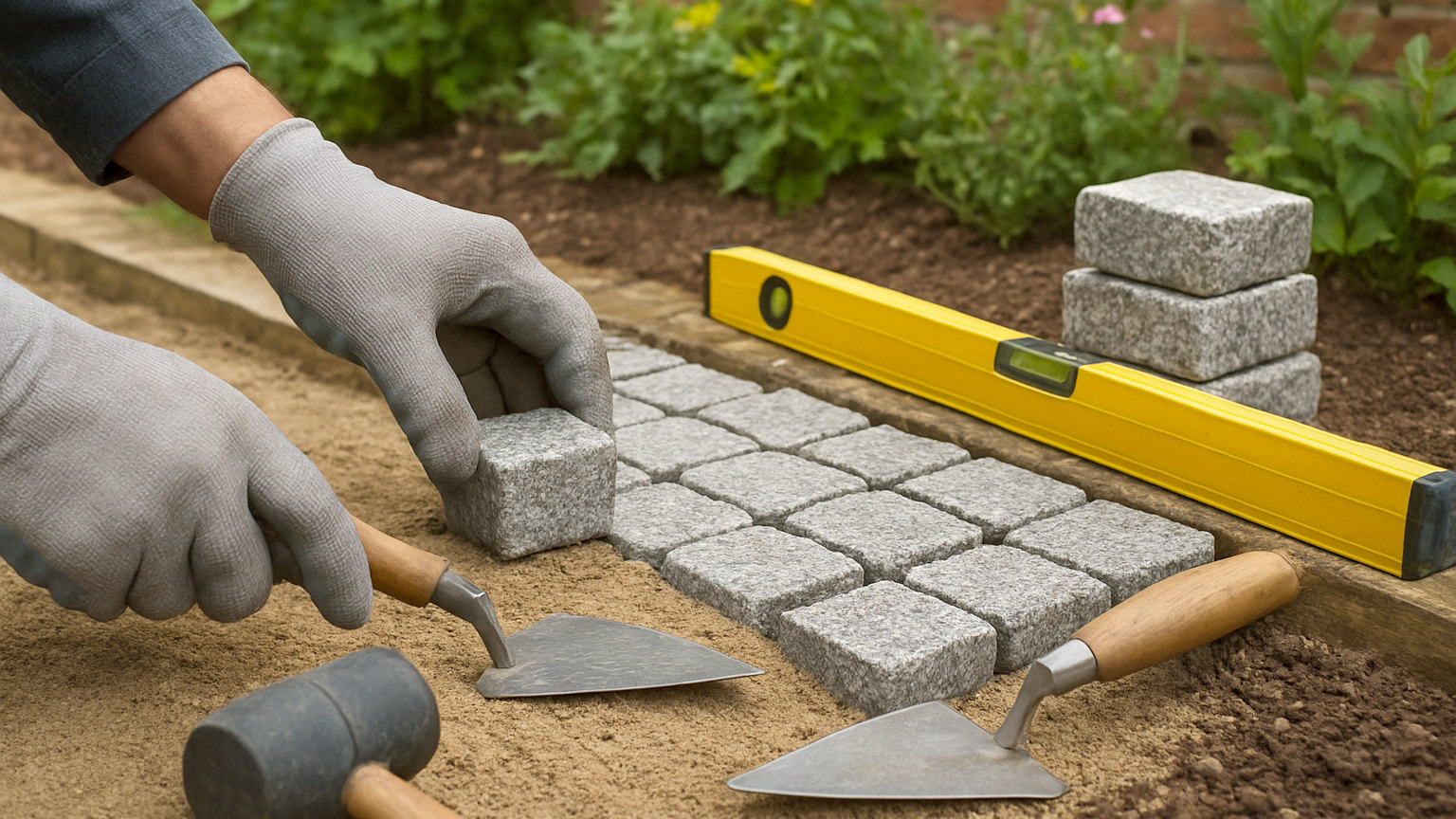
Block paving and setts work on a different principle from slabs. Instead of a rigid bed, the units are laid on sand and rely on interlock, which allows the surface to flex under load rather than cracking.
How the system works
A compacted sub-base, a thin bed of sharp sand, the blocks laid tight against each other, then vibrated down and the joints filled with fine sand.
The filled joints are structural. They transfer load between blocks and create the interlock that makes the surface behave as a whole rather than as loose pieces.
This is why joints must be filled completely and kept filled.
Edge restraints are essential
Without a restraint on every edge, block paving spreads sideways and fails. This is not optional.
Use kerbs, edging blocks or a course of blocks laid on edge, bedded on concrete with a haunching of concrete behind them.
Install the restraints before laying the field of blocks, and let the concrete set.
Every edge needs one, including where paving meets a lawn or a border.
Sub-base
A hundred millimetres of compacted Type 1 for pedestrian areas, a hundred and fifty or more for a drive, compacted in layers of no more than a hundred millimetres.
Build the fall into the sub-base, at about one in eighty away from the house.
Laying course
Thirty to forty millimetres of sharp sand, screeded level and left uncompacted.
Screed it just ahead of laying, and do not walk on the screeded sand. Work from the laid blocks, not from the bed.
The blocks are bedded down later by the plate compactor, which is why the sand is left loose.
Patterns
Herringbone at forty-five or ninety degrees gives the strongest interlock and is the pattern for drives.
Stretcher bond, like brickwork, is simpler and adequate for paths and patios.
Basketweave is decorative and has the least interlock, so it suits light-use areas only.
Setts are often laid in curved or fan patterns, which look well and take longer.
Lay blocks tight against each other with a joint of only two to five millimetres.
Vibrating and jointing
Once the blocks are laid and the cuts made, run a plate compactor with a protective mat over the whole area to bed everything down.
Brush kiln-dried sand into the joints and vibrate again, repeating until the joints are completely full.
Kiln-dried sand is used because it is dry enough to flow into narrow joints. Damp sand will not.
Top up the joints after a few weeks, since they settle.
Jointing compounds and polymeric sands cost more, resist weeds and washing out, and are worth considering.
Cutting
Plan the layout to minimise small awkward cuts, and never use a cut piece smaller than about a third of a block, which will work loose.
Cutting concrete and stone produces respirable silica dust, which causes permanent lung damage. Use water suppression on the saw, a properly fitted respirator, eye and ear protection, and cut outdoors.
A block splitter avoids the dust entirely for straight cuts and is worth hiring.
Common problems
Sinking in patches means the sub-base was inadequately compacted or too thin, or soft material was left in place. It has to be lifted and relaid.
Spreading and gaps at the edges mean the edge restraint has failed or was never installed properly.
Weeds in the joints grow in windblown debris that accumulates on top rather than from below. Keep the surface brushed, top up the jointing sand, and consider a jointing compound.
Sand washing out in heavy rain leaves joints empty and the interlock lost. Top them up promptly.
Repairs
The genuine advantage of block paving. Individual blocks can be lifted with a block extractor, the bed corrected, and the same blocks relaid invisibly.
Keep some spare blocks from the original batch, since colours change between production runs and a repair with new blocks always shows.
Setts
Small units of natural stone, usually granite, laid in the same way as concrete blocks but with wider joints, frequently mortared.
They suit period settings, curved paths and edging details, and they are considerably more expensive and slower to lay than concrete blocks.
Reclaimed setts vary in size, which adds character and complicates the setting out.


