
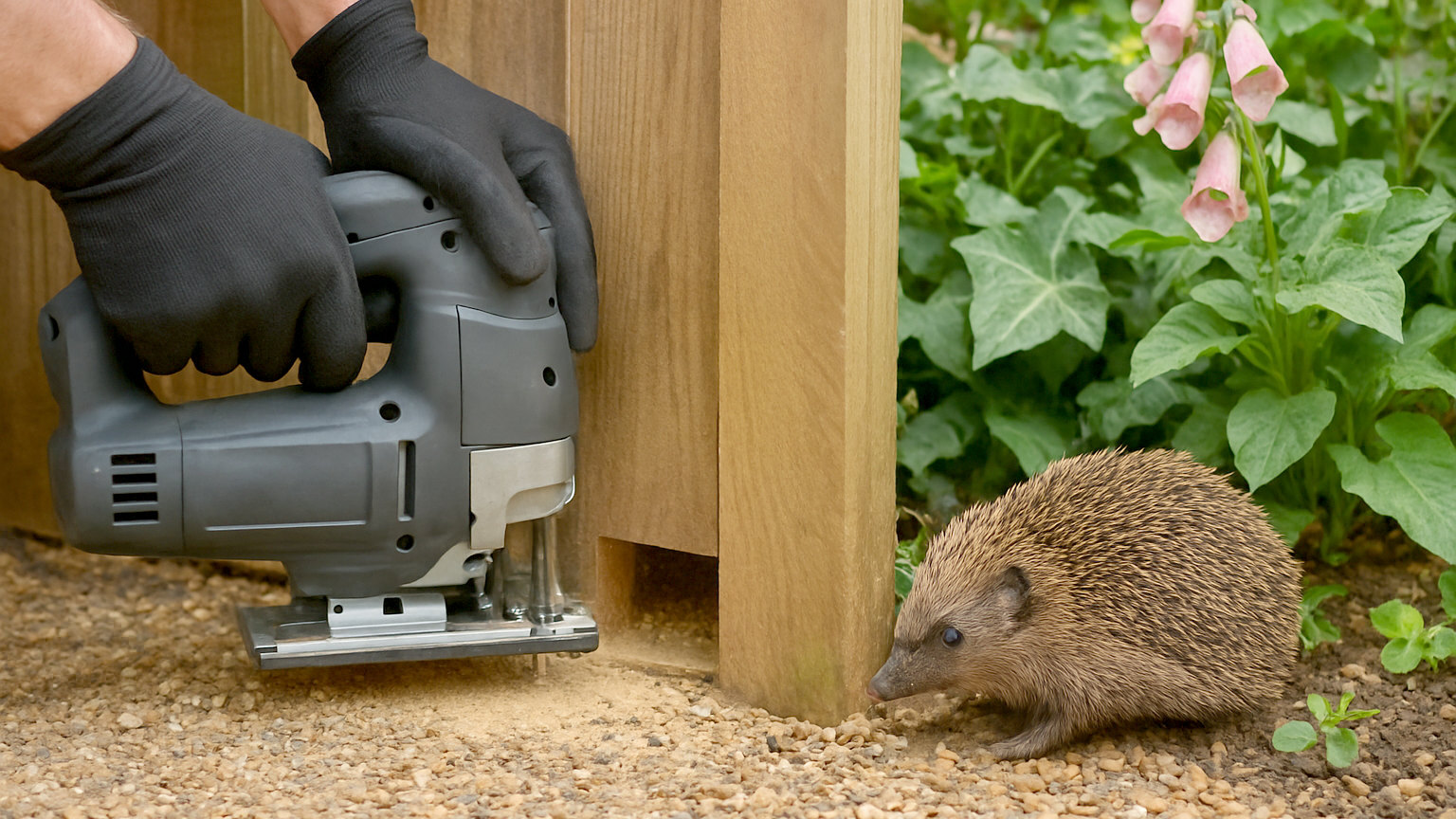
Gardens collectively cover a substantial area and could function as connected habitat. Continuous solid fencing has largely prevented that, and reversing it costs almost nothing.
Hedgehog gaps
A gap of about thirteen centimetres square at the base of a fence lets hedgehogs pass and is too small for most pets.
Hedgehogs travel a kilometre or more in a night and need access to many gardens to find enough food and a mate. A single unbroken fence line around a garden makes it useless to them.
Cut a hole in a gravel board, leave a gap beneath a panel, or remove a brick from a wall.
The value multiplies with the number of neighbours who do it, so it is worth asking along the row. Several organisations run schemes to encourage exactly this.
Mark the gap so it is not blocked accidentally.
Hedges do most
A mixed native hedge is the single most valuable boundary a garden can have.
It provides nest sites, cover from predators, shelter in winter, nectar in spring, berries in autumn, and food plants for a very large number of insect species.
Hawthorn, blackthorn, hazel, field maple, dog rose, guelder rose and holly between them support far more than any fence.
It is also permeable at the base, so animals move through it freely.
Cut once a year in winter, and leave the berries rather than trimming in autumn.
Planting a fence
Where a fence must stay, planting it transforms its value.
Ivy is exceptional: it flowers in autumn when almost nothing else does, feeding late bees and hoverflies, berries in late winter when birds are shortest of food, and provides dense evergreen nesting and roosting cover.
Honeysuckle feeds night-flying moths and provides cover. Climbing roses give hips. Clematis and pyracantha both offer food and shelter.
Fix trellis on battens so there is an air gap behind, which suits both the plants and the fence.
Dead hedges
Two rows of stakes with prunings, brash and woody material packed between them.
Costs nothing, uses material that would otherwise be disposed of, provides outstanding habitat for insects, small mammals and nesting birds, and acts as an informal boundary or division.
Top it up as it settles, which it does continuously.
Nesting season
It is an offence to intentionally damage or destroy an active bird's nest.
Avoid cutting hedges and dense boundary planting between March and August, and check thoroughly before any work in that period.
If you find a nest, leave that section entirely alone until the birds have fledged.
Other measures
Leave the base of a boundary undisturbed. A strip of long grass, leaf litter and a log pile along a fence line is where a great deal lives.
Fit bird boxes and insect habitat on fences and walls, facing between north and east and away from the prevailing weather.
Avoid lighting boundaries at night, since bats and moths avoid lit areas and lose foraging habitat.
Plant climbers rather than painting a bare fence.
Avoid netting close to the ground where it can trap hedgehogs, and check any netting daily.
What to avoid
Continuous concrete gravel boards with no gaps, which seal a garden completely.
Herbicide use along a boundary strip, which removes the habitat at the base.
Over-tidy management. A boundary that is entirely neat supports very little.
Talking to neighbours
Boundary wildlife measures only work at scale, and a gap in one fence achieves little if the next garden is sealed.
It is one of the easier conversations to have with neighbours, since it costs them nothing and most people are willing once they know why.
Why it matters
Hedgehog numbers have declined sharply, and fragmentation of gardens by continuous fencing is one of the identified causes.
Gardens together cover more ground than all the national nature reserves in Britain, and connecting them costs a hole in a gravel board.
It is among the cheapest and most effective things an individual garden can do for wildlife.
Other animals
Frogs, toads and newts also travel between gardens and are blocked by continuous barriers.
Slow worms and grass snakes use the base of boundaries as corridors, which is another reason to leave that strip rough rather than mown or sprayed.


