
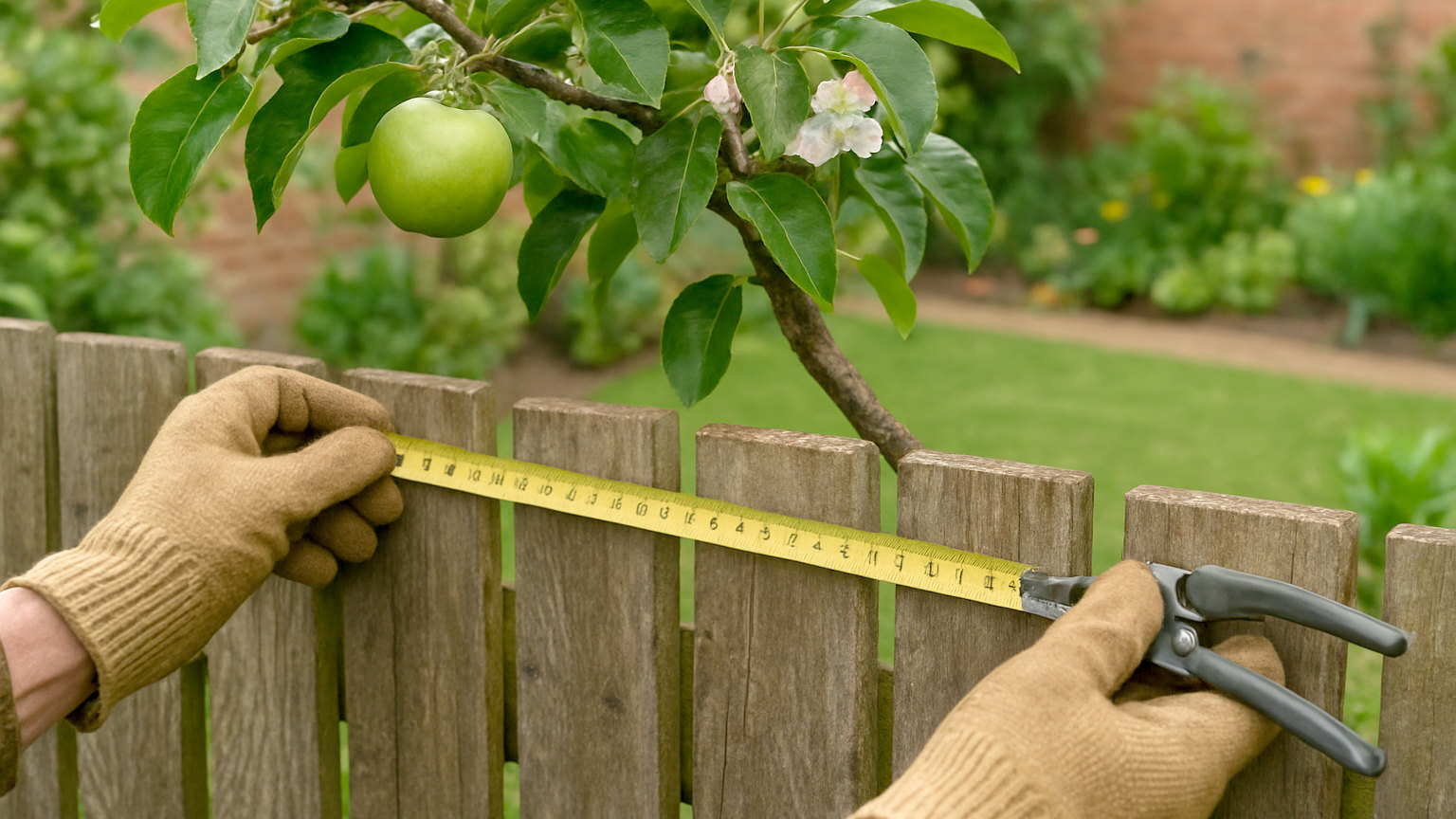
There is a widely repeated rule that you own the fence on the left as you look from the house, or on the right depending on who is telling you. It has no basis in law whatsoever. Boundary responsibility is determined by the deeds, and quite often by nothing at all.
How to find out
Start with your title documents. Obtain the title plan and register from HM Land Registry, which costs a few pounds online, or check the deeds if the property is unregistered.
Look for T-marks on the title plan. A T drawn on one side of a boundary line indicates that the owner of the land on that side is responsible for maintaining it. An H shape, effectively two Ts back to back, indicates a shared or party boundary.
Read any conveyance covenants too, which may impose an obligation to maintain a particular boundary.
Frequently the deeds say nothing at all. This is extremely common, particularly on older properties, and it means there is no legal owner of the boundary and no obligation on anyone to maintain or replace anything. In that situation, agreement with the neighbour is the only practical route.
What responsibility actually means
Being responsible for a boundary means you may maintain and replace it. It does not oblige you to, unless a covenant says so. Nobody can force a neighbour to repair a fence they own simply because it looks bad.
Equally, you cannot attach anything to a fence you do not own, paint it, or alter it, without permission. That includes trellis, hanging baskets and climbing plant supports, which is worth knowing before fixing anything.
You also cannot enter a neighbour's land to carry out work without their agreement. The Access to Neighbouring Land Act allows an application to court for access to carry out essential repairs, but that is a last resort rather than a starting point.
Overhanging branches
If branches from next door overhang your boundary, you are generally entitled to cut them back to the boundary line. Several conditions apply.
- You may only cut what is on your side, and cannot lean over or enter their garden to do it
- The cuttings, and any fruit, legally remain the neighbour's property, so you should offer them back rather than disposing of them or keeping them
- You must not cut so much that the tree dies or becomes unstable, or you may be liable
- Check first whether the tree has a Tree Preservation Order or is in a conservation area, in which case consent from the local authority is needed before any work
Roots follow much the same principle, and the same caution about destabilising the tree applies.
High hedges
Evergreen or semi-evergreen hedges over two metres that block light can be dealt with under the High Hedges provisions of the Anti-social Behaviour Act 2003 in England and Wales, with similar arrangements in Scotland.
The council will only consider a complaint after you have made genuine attempts to resolve it directly, and there is usually a fee. It applies to hedges of two or more evergreen trees, not to a single tree or a deciduous hedge.
Fence heights and rules
Generally a fence may be up to two metres high as permitted development, reducing to one metre where it adjoins a highway used by vehicles. Listed buildings, conservation areas and covenants can restrict this further.
Trellis on top counts towards the total height, which surprises people adding it to an existing two-metre fence.
Keeping it civil
Boundary disputes are among the most expensive and least satisfying legal matters there are, routinely costing far more than the land in question is worth, and they must be disclosed when selling.
Talk to the neighbour first, in person, before doing anything. Agree in writing, even informally by email, what has been decided about a shared fence or a shared cost. Take photographs before work starts.
If a genuine dispute arises, Citizens Advice, RICS boundary mediation and the Land Registry's guidance are all better first stops than a solicitor's letter.
This is general information
Boundary law is fact-specific and the position differs across the United Kingdom. Nothing here is legal advice, and for anything contentious or valuable, take advice from a solicitor before acting.


