
Trellis and slatted screens do something a solid fence cannot: they interrupt a view without eliminating it, and they let light and air through while still creating separation.
Filter rather than block
A screen of around fifty per cent openness reads as a division from a distance while remaining light and airy close to.
It casts far less shade than a solid panel, which matters on the sunny side of a small garden.
It also filters wind rather than blocking it, giving better shelter over a greater distance than a solid barrier, which creates damaging turbulence on the sheltered side.
Something half-glimpsed through a screen is more interesting than either a full view or a blank surface.
Fixing to a wall or fence
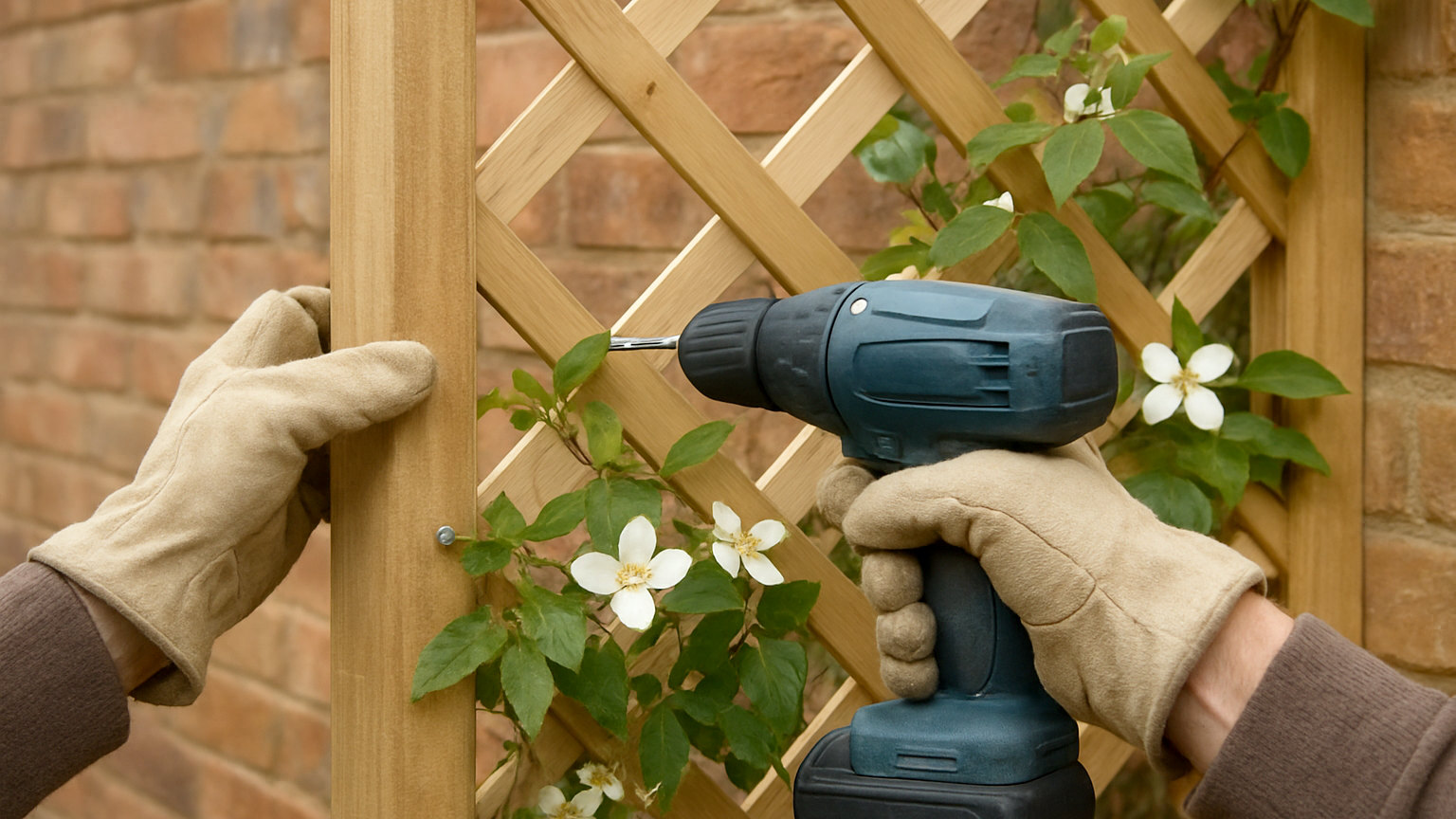
Mount trellis on battens rather than flat against the surface.
The gap of at least twenty-five millimetres lets air circulate behind the plant, which substantially reduces mildew on roses, honeysuckle and clematis, and gives twining stems room to grip.
Fix the battens into masonry with appropriate plugs, or into fence posts rather than the panels, which are not designed to carry weight.
Consider hinging the bottom edge so the whole panel, with the plant attached, can be lowered away from the wall for painting, repointing or fence treatment. This is a small amount of extra work at installation and saves an impossible job later.
Height rules
Trellis added on top of a fence counts towards the total height.
A one metre eight hundred fence with three hundred millimetres of trellis is a two metre one hundred structure, which generally exceeds the permitted development limit of two metres, or one metre where the boundary adjoins a highway.
Trellis used within the garden, rather than on a boundary, is not subject to those limits.
You cannot fix trellis to a fence you do not own without the owner's permission.
Free-standing screens
Frequently more useful than boundary screening.
A screen placed close to where you sit blocks a far wider angle of view than the same screen at the boundary, and needs much less height to do it.
Free-standing screens can be positioned exactly where they are needed, used to divide a garden into areas, or set to hide a shed, a compost heap or bins.
They need proper posts, concreted in, since a screen catches wind like a sail. This is where most free-standing screens fail.
Materials
Timber trellis is cheapest, and quality varies enormously. Heavy square-section trellis lasts many years; thin diamond lattice sags and breaks within a few.
Slatted screens in horizontal or vertical battens look contemporary and are stronger. Horizontal slats are climbable, which matters near a boundary.
Metal gives slender sections and needs no treating if powder coated.
Woven willow and hazel suit informal settings and last five to ten years.
Reed and bamboo screening is cheap, quick and short lived.
Planting
Trellis is designed for climbers, and the type matters.
Clematis climbs by twisting its leaf stalks around thin supports and cannot grip a broad batten, so check the section thickness if that is what you intend to grow.
Twining climbers such as honeysuckle need something they can wrap around.
Roses and other scramblers cannot attach themselves at all and must be tied in.
Train stems horizontally where you can, since a stem trained sideways flowers along its whole length while an upright one flowers only at the top.
Allow for the weight and wind load of a mature climber when specifying the fixings.
Maintenance
Treat timber trellis before planting anything on it, since access afterwards becomes impossible.
Check fixings annually, particularly after gales, and loosen any plant ties that are cutting in.
Where screens work best
Around a seating area, close to where you sit, where a modest screen blocks a wide angle of view.
Dividing a garden into areas, where a screen separates without darkening.
Hiding utility: bins, compost, oil tanks and sheds.
On top of a low wall, where the solid base gives stability and the screen gives height and lightness.
Quality matters
Cheap diamond lattice trellis sags, twists and breaks within a few years, particularly once a climber is on it.
Heavier square-section trellis with a proper frame costs more and lasts many times longer, which matters when the alternative is dismantling an established climber to replace it.


