
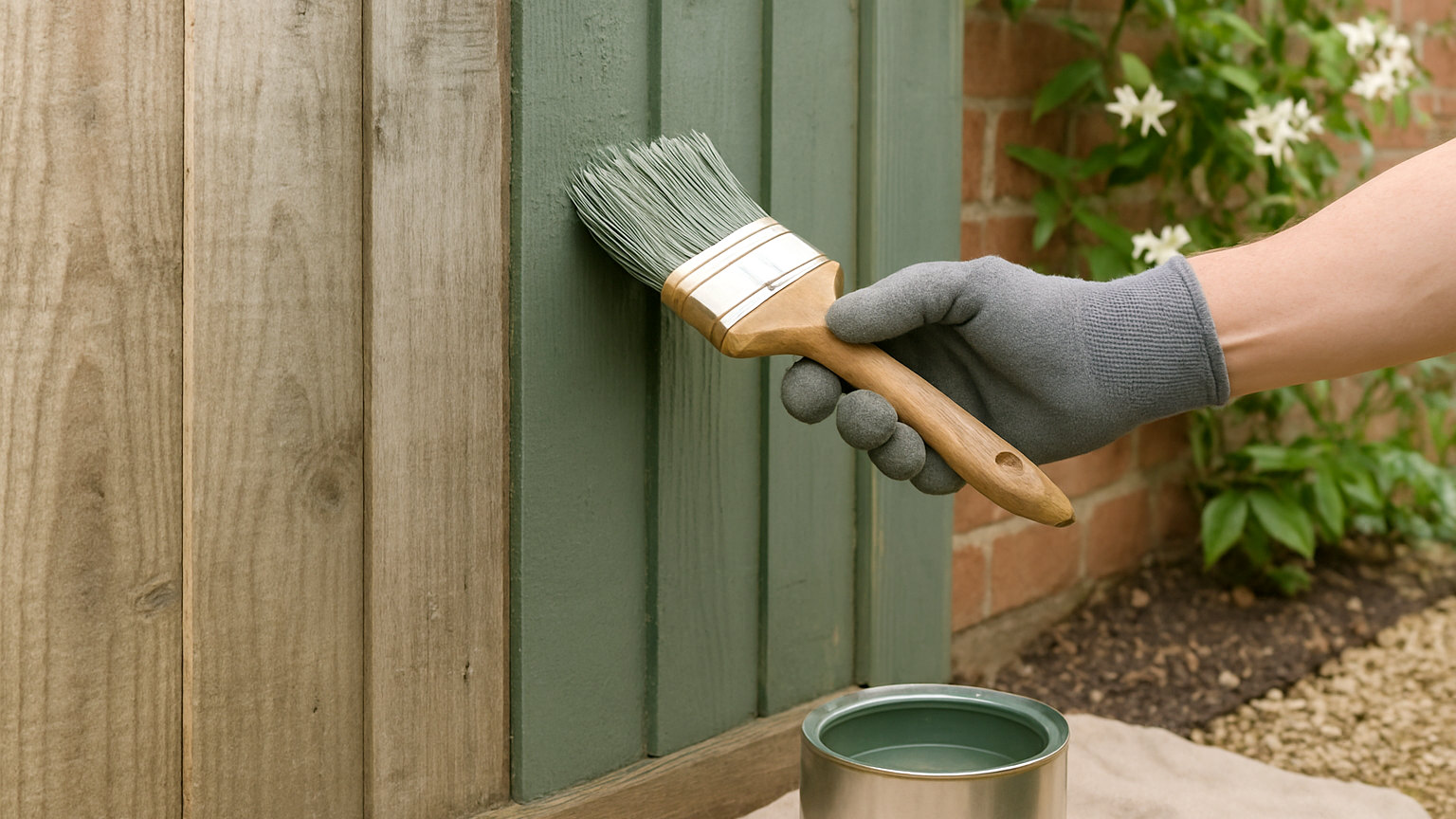
Pressure treatment protects timber from rot from within. It does not stop the surface weathering, greying and absorbing water, which is what a surface coating addresses.
The options
Preservative or timber treatment soaks into the wood, protecting against rot and insects with little colour change. It weathers away and needs reapplying every two to three years.
Stain adds colour while letting the grain show, penetrates the surface, and weathers gradually rather than peeling. Recoating is straightforward, and it is the usual choice for a garden fence.
Paint and opaque coatings cover the timber entirely and give the strongest colour. They sit on the surface, and as they age they crack and peel, which means scraping and sanding before recoating. The highest-maintenance option and the one that most transforms a garden.
Some modern fence paints are formulated to be more flexible and to fade rather than peel, which reduces the problem.
When to do it
Dry settled weather with no rain forecast for at least a couple of days.
The timber must be dry. Applying anything to damp wood seals moisture in and causes the coating to fail.
Avoid strong direct sun, which dries the coating before it can penetrate, and avoid cold weather, which prevents it curing.
Spring and early autumn are usually best.
New pressure-treated timber often needs to weather for several months before it will accept a coating, since it is still wet from treatment. Check the manufacturer's guidance.
Preparation
Brush off dirt, cobwebs and loose material.
Remove algae and green growth with a fence cleaner, and let it dry completely.
Scrape and sand any flaking paint back to a sound edge.
Repair or replace damaged boards first, since coating a rotten board achieves nothing.
Cut back planting to give access, which is easier before the growing season.
Applying it
A sprayer is far quicker over a large area and produces considerable overspray.
A brush gives the best penetration into joints and end grain and takes far longer.
A roller is a reasonable compromise on flat panels, with a brush for the edges.
Work along the grain, and do not spread the product too thinly. Follow the coverage rate on the tin.
Pay particular attention to end grain, the tops of posts and the bottom of boards, which absorb far more water than the faces and are where rot starts.
Two thinner coats are better than one thick one.
Protecting what is nearby
Cover plants with dust sheets or polythene before spraying, and be aware that overspray travels further than expected.
Do not spray on a windy day.
Protect paving, decking and lawn, since fence stain marks all three.
Water plants beneath the fence before and after, which dilutes anything that reaches them.
Access and the neighbour's side
You may treat your own side. You have no right to enter a neighbour's garden to treat the other side without their agreement.
Ask, since most people will agree and it doubles the life of the fence.
Where planting will eventually cover a fence, treat it thoroughly before planting, since access afterwards becomes impossible.
Consider hinged trellis panels that can be lowered with the climber attached.
How often
Preservative and stain: every two to three years.
Paint: every three to five, with preparation.
Test by splashing water on the fence. Beading means the coating is working; soaking in means it is time.
Safety
Wear gloves, eye protection and a mask when spraying. Follow the label, which is a legal document. Keep children and pets away until dry, and dispose of surplus through a household hazardous waste facility rather than pouring it down a drain.
Colour
A dark fence recedes and makes a small garden feel larger, and planting reads strongly against it.
Orange-brown fence stain is the default and rarely flatters planting. Dark grey, near-black and deep green all work considerably better as a backdrop.
Painting a fence is one of the cheapest ways to transform a small garden, and it can be done in a weekend.
Use the same colour throughout rather than different treatments on different boundaries, which unifies the garden and makes it feel larger.
Test a sample on a small area first, since fence colours look very different outdoors and across a large surface.


