
Most fence failures are the same failure: a post has rotted at ground level, where the timber is permanently damp and oxygen is available. The rest of the fence is usually sound.
Diagnose first
Push the fence firmly. If the panel moves but the post stays put, the panel or its fixings have failed. If the post moves at ground level, the post has gone.
Probe the post at ground level with a screwdriver. Sound timber resists; rotten timber gives way.
Check whether the concrete is still sound or whether the post has simply worked loose within it.
Repairing a snapped post
Digging out an old concreted post is hard work, and there are two ways to avoid it.
A concrete repair spur is a short concrete post bolted to the sound upper part of the timber post and set into the ground alongside the old concrete. It is the standard repair, it is strong, and it lasts.
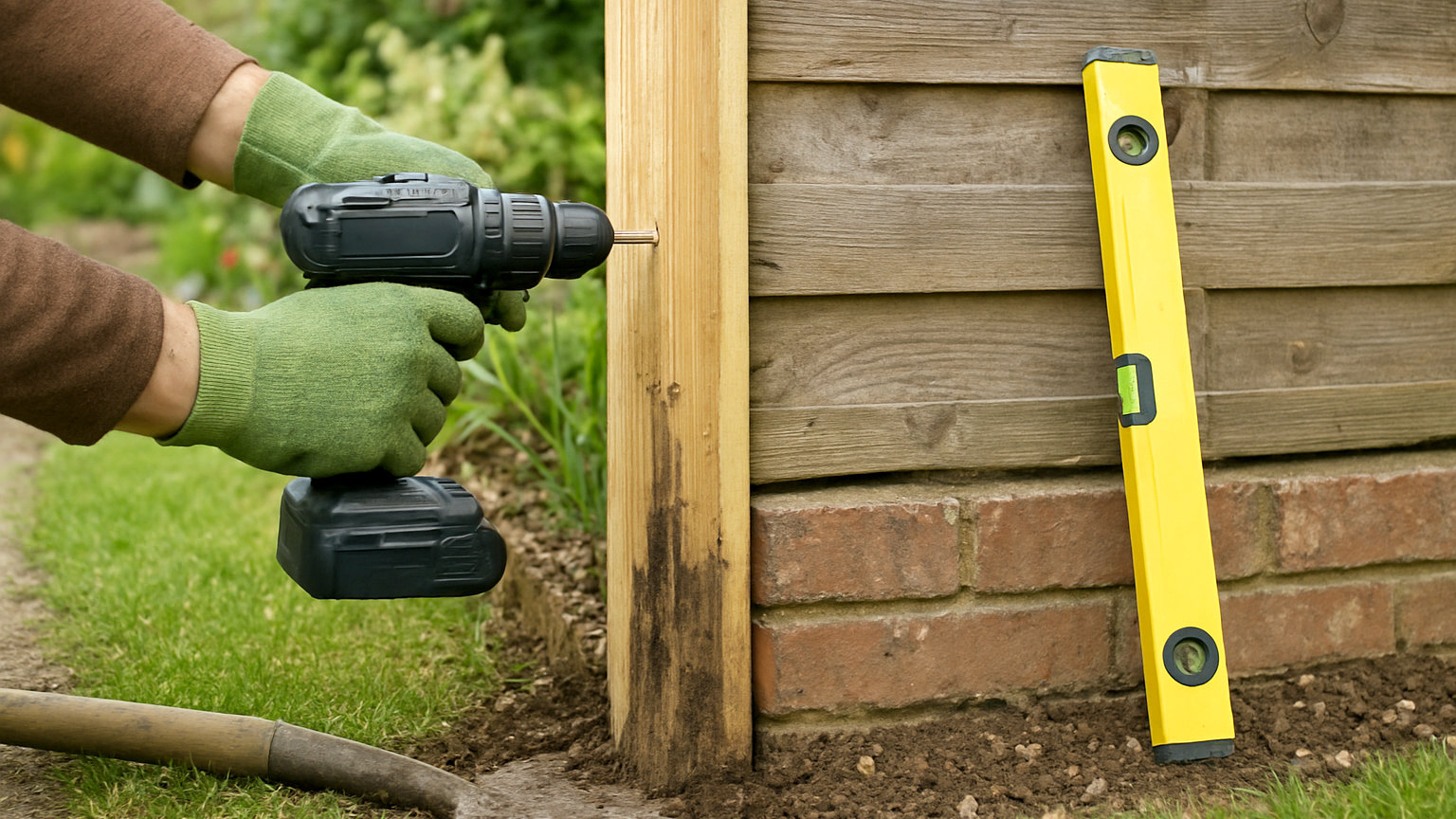
Dig alongside the existing footing, bolt the spur to the post through pre-drilled holes, check the fence is plumb, and concrete the spur in.
A metal repair spike or post support can be driven or concreted in beside the failed post and the post bolted to it, which works for lighter fences.
Either way the fence is repaired without disturbing the panels or the neighbouring posts.
Replacing a post entirely
Where the post has failed completely or the repair would be visible, the old one has to come out.
Remove the panels either side and unbolt or unscrew anything fixed to the post.
Dig around the concrete footing and lever it out, or break it up with a bolster and lump hammer, wearing eye protection.
A car jack and a strong beam can be used to lift a stubborn footing out of the hole.
Set the new post as for a new fence: hardcore in the base, plumb, concreted, with the concrete sloped away from the timber.
Replacing a panel
The easiest repair, and one reason panel fencing remains popular.
Remove the fixing clips or unscrew the panel, lift it out, and drop the replacement in.
Measure the actual gap between posts before buying, since panel sizes vary and posts are rarely exactly where they should be.
Where the gap is slightly narrow, trim the panel frame rather than forcing it.
A new panel will not match weathered ones until it has aged, and treating the whole fence afterwards helps.
Close-board repairs
Individual feather-edge boards can be prised off and replaced in minutes.
A broken arris rail is repaired with a metal rail bracket screwed over the break, or a new rail fitted with brackets at each end. Neither requires dismantling the fence.
A rotted gravel board is replaced by easing the bottom of the boards up slightly and sliding the new one in.
Wind damage
Check the whole run after a gale, not just the obvious failure.
Posts that have loosened but not broken can sometimes be re-firmed by removing soil, adding concrete around the existing footing and bracing until it sets.
Consider whether the fence is simply too solid for an exposed site, since a permeable fence takes far less wind load.
Preventing the next failure
Fit gravel boards, which keep timber clear of the ground.
Keep soil, mulch and vegetation away from the base of posts and boards.
Slope the concrete away from posts so water runs off.
Fit post caps and a capping rail to protect end grain.
Treat the fence every few years.
Whose fence is it
Establish ownership before repairing or replacing a boundary fence, since altering a neighbour's fence without permission causes disputes.
You may not attach anything to a fence you do not own, and disputes must be disclosed when selling a property.
When to replace rather than repair
Where several posts have failed, where the rails are rotten throughout, or where panels are breaking up generally, piecemeal repair wastes effort.
A fence that has needed attention three years running is at the end of its life, and replacing it is cheaper than another season of patching.
It is also the moment to reconsider the type, since a boundary being replaced anyway can become close-board on concrete posts, or a hedge.


