
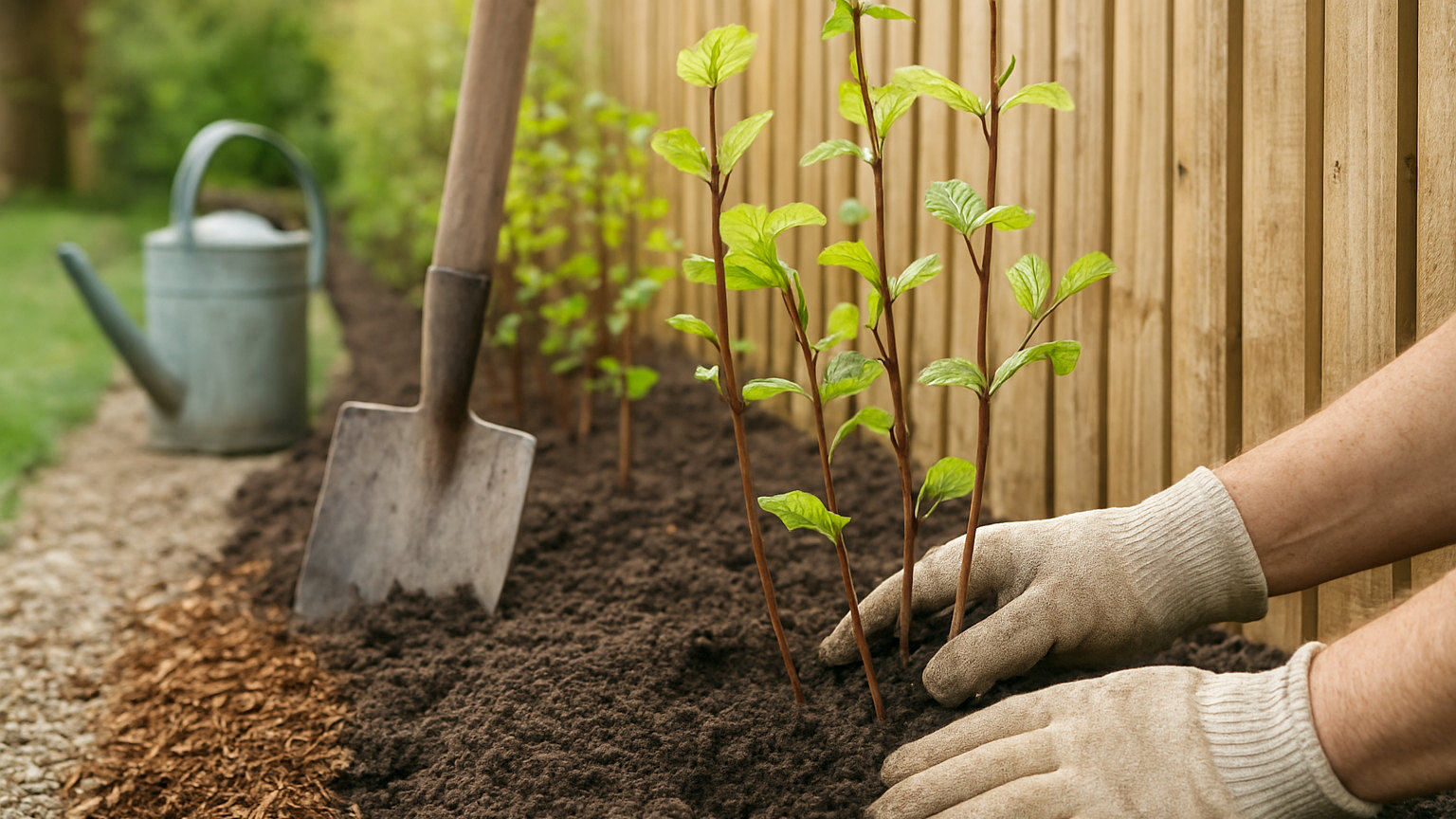
A hedge is the cheapest boundary to plant, the longest lived, and the best for wildlife and shelter. It also takes several years to do anything and occupies more ground than a fence.
Cost
Bare-root whips planted between November and March cost a fraction of container-grown plants, and a metre of native hedging bought this way costs less than a single potted shrub.
Compared with fencing, a hedge is dramatically cheaper to install and requires ongoing cutting rather than eventual replacement.
Over thirty years a hedge costs a small fraction of what two rounds of fencing would.
What it needs that a fence does not
Space. A mature hedge occupies at least six hundred millimetres of width and frequently a metre or more, plus a strip either side that nothing else will grow in.
In a narrow garden this is a real cost.
Time. Three to five years before it functions as a barrier, and longer for a dense stock-proof hedge.
Annual cutting, which for a long boundary is a genuine commitment.
Establishment care: watering through the first two summers and keeping the base weed free, which is what most failed hedges lacked.
Planting
Plant bare root between November and March while dormant, as soon as the plants arrive.
Prepare a strip at least six hundred millimetres wide rather than digging individual holes, clearing all perennial weeds first.
Plant three per metre in a single row, or five per metre in a staggered double row for a thicker and more stock-proof result.
Keep the roots covered at all times, since they die within minutes of drying out.
Cut whips back by about a third after planting, which feels wrong and produces a hedge that is dense at the base rather than bare and leggy.
The first three years
Water thoroughly through the first two summers, which is what most people skip.
Keep a weed-free strip either side, since grass competing at the base slows establishment more than anything.
Mulch generously each spring.
Trim the sides lightly from the first year to encourage density, and let the height build gradually rather than allowing it to run up and then cutting it back.
Choosing
Yew for a formal evergreen boundary. Slow, superb, and it regenerates from hard cutting, which almost nothing else does.
Beech and hornbeam hold russet leaves through winter when clipped. Beech needs free-draining ground; hornbeam tolerates clay and wet.
Holly is dense, evergreen, effectively impenetrable and slow.
Native mixed hedging of hawthorn with blackthorn, hazel, field maple, dog rose and holly is the cheapest, best for wildlife, and thorny enough to be stock-proof. Cut once a year in winter.
Privet and Leyland cypress are fast and need cutting two or three times a year forever, and leylandii cannot be cut back into brown wood at all.
Cutting
Cut with a batter, meaning sloping sides wider at the base than the top, so light reaches the bottom and the hedge stays furnished to the ground.
This is the single most important thing about hedge maintenance and it is regularly ignored.
Avoid cutting between March and August because of nesting birds, which is a legal matter.
Boundaries and the law
A hedge grows and encroaches, which a fence does not.
Plant far enough inside your boundary that the mature hedge does not overhang, allowing for the eventual width.
Evergreen hedges over two metres can be the subject of a High Hedges complaint where they affect a neighbour's reasonable enjoyment of their property.
Combining the two
Erecting a fence and planting a hedge in front of it gives immediate security and privacy, and a hedge that eventually takes over as the fence fails.
This is a sensible approach where a boundary is needed now but a hedge is wanted in the long term.
What a hedge gives
Shelter that filters wind rather than deflecting it, habitat and food for a great deal of wildlife, sound absorption, seasonal interest, and a boundary that improves for a century rather than deteriorating over fifteen years.
The trade is the ground it occupies, the years it takes, and the annual cut.
Mixing hedge and fence
Post and rail fencing with a hedge planted through it is the traditional field solution, giving an immediate stock-proof barrier and a permanent hedge.


