
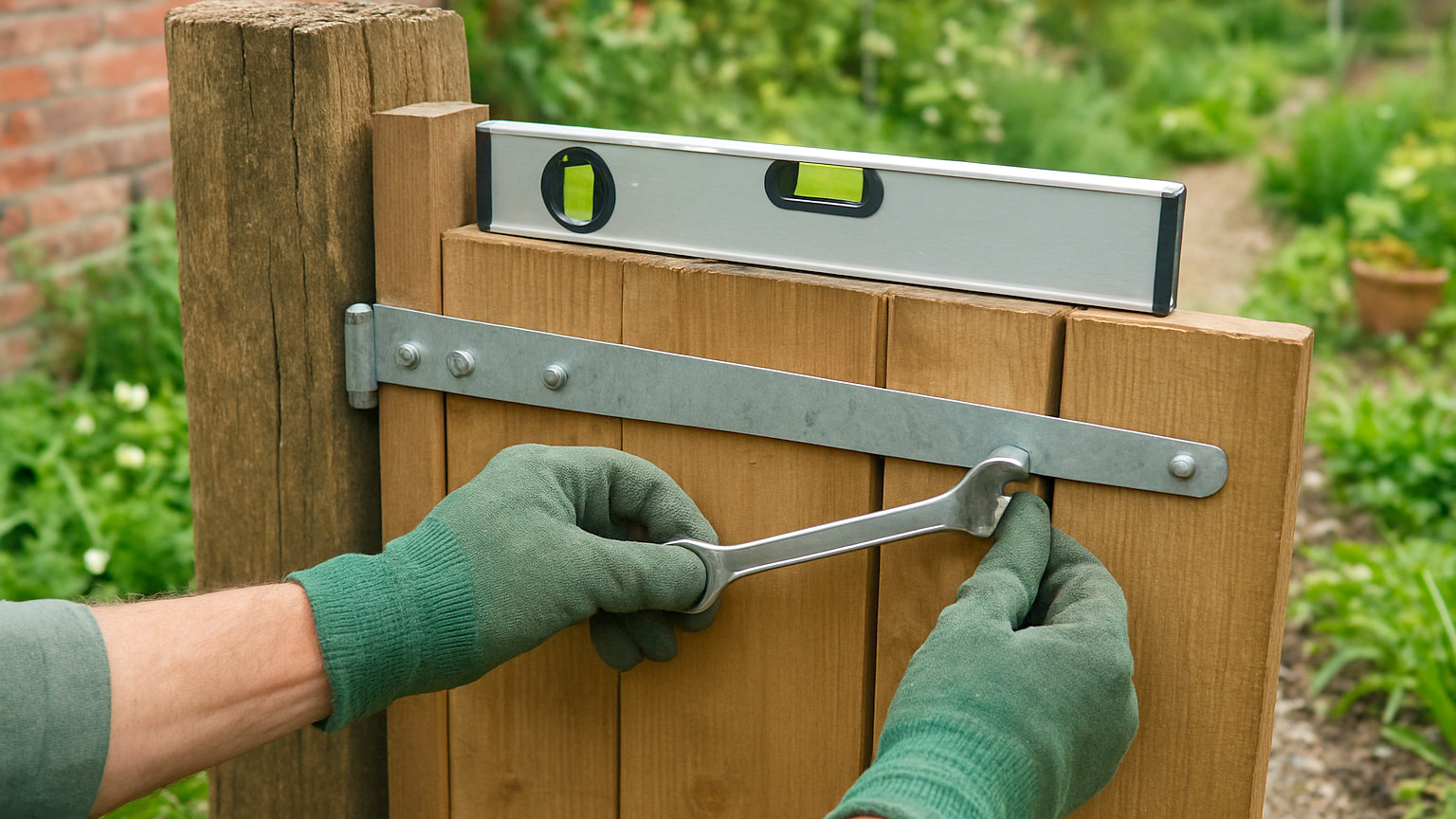
A gate is the one part of a boundary that moves, takes shock loading and carries its whole weight on two points. It needs building accordingly, and most gate problems come from posts that were sized like fence posts.
Width
Measure what has to pass through before deciding.
Nine hundred millimetres is a reasonable minimum for a garden gate.
A wheelbarrow, a wheelie bin, a lawnmower or a bicycle all need more than people assume. A metre is more comfortable.
A metre two hundred allows a wheelchair to pass, and is worth providing on any main access.
For vehicles, allow at least two metres four hundred, and wider on a tight turn.
Remember the clear opening is less than the overall width once the frame and the hinge gap are taken off.
Gate posts
Gate posts must be substantially stronger and deeper than fence posts.
Use at least a hundred by a hundred millimetres for a light gate, and a hundred and fifty by a hundred and fifty for anything heavy or wide.
Bury more than you would for a fence post, typically a third of the total length, and concrete generously.
The hanging post takes the whole weight of the gate plus the leverage of anyone swinging on it, and it is the post that leans.
Where a gate is very wide or heavy, the hanging post may need bracing or a deeper footing.
Let the concrete cure fully before hanging the gate.
Hinges
Use hinges rated for the weight, and err heavier than seems necessary.
Band and gudgeon hinges, with a strap across the gate and a pin in the post, are the strongest and the traditional choice.
Tee hinges suit lighter gates and should be long enough to reach well across the gate.
Adjustable hinges allow the gate to be levelled after hanging, which is useful.
Fix through the gate with bolts rather than screws where you can, since screws pull out of end grain over time.
Use galvanised or stainless fittings.
Bracing against sag
Gates sag at the corner furthest from the hinges, and the brace is what prevents it.
A diagonal brace must run from the bottom hinge corner upwards to the top of the closing edge, so it works in compression.
A brace running the other way does nothing useful, and this is one of the commonest mistakes in a home-made gate.
A tension wire and turnbuckle across the diagonal can be used to pull a sagging gate back into square.
Hanging it
Set the gate on packing so it is at the right height with a consistent gap beneath, usually fifty to seventy-five millimetres to clear the ground and any debris.
Allow a small gap on the hinge side and a slightly larger one on the latch side.
Check it is square and level before fixing anything permanently.
Make sure the ground beneath allows the gate to swing through its full arc, including on a slope.
Latches and security
Choose a latch that can be operated one-handed, since people carry things.
A self-closing spring or a rising butt hinge keeps a gate shut, which matters where there are children, dogs or road access.
For security, fit a lockable bolt or a padlock hasp on the inside, and consider hinge bolts to prevent the gate being lifted off its pins.
A side gate is a common point of entry to a property, and a solid lockable gate is worth having.
Which way it opens
Generally inwards into the garden, so it does not obstruct a path or a pavement.
Consider the slope, prevailing wind, and where people will stand while opening it.
Maintenance
Oil the hinges annually, check the fixings, and treat the timber with the rest of the fence.
Deal with a sagging gate promptly, since it drags on the ground and wears both the gate and the surface beneath it.
Matching the fence
A gate in the same material and style as the fence reads as part of the boundary; a contrasting one reads as an entrance.
Both are legitimate, and the decision should be deliberate rather than determined by what the merchant had in stock.
A gate is also a natural focal point at the end of a view, and framing it with planting or an arch makes more of it.


