
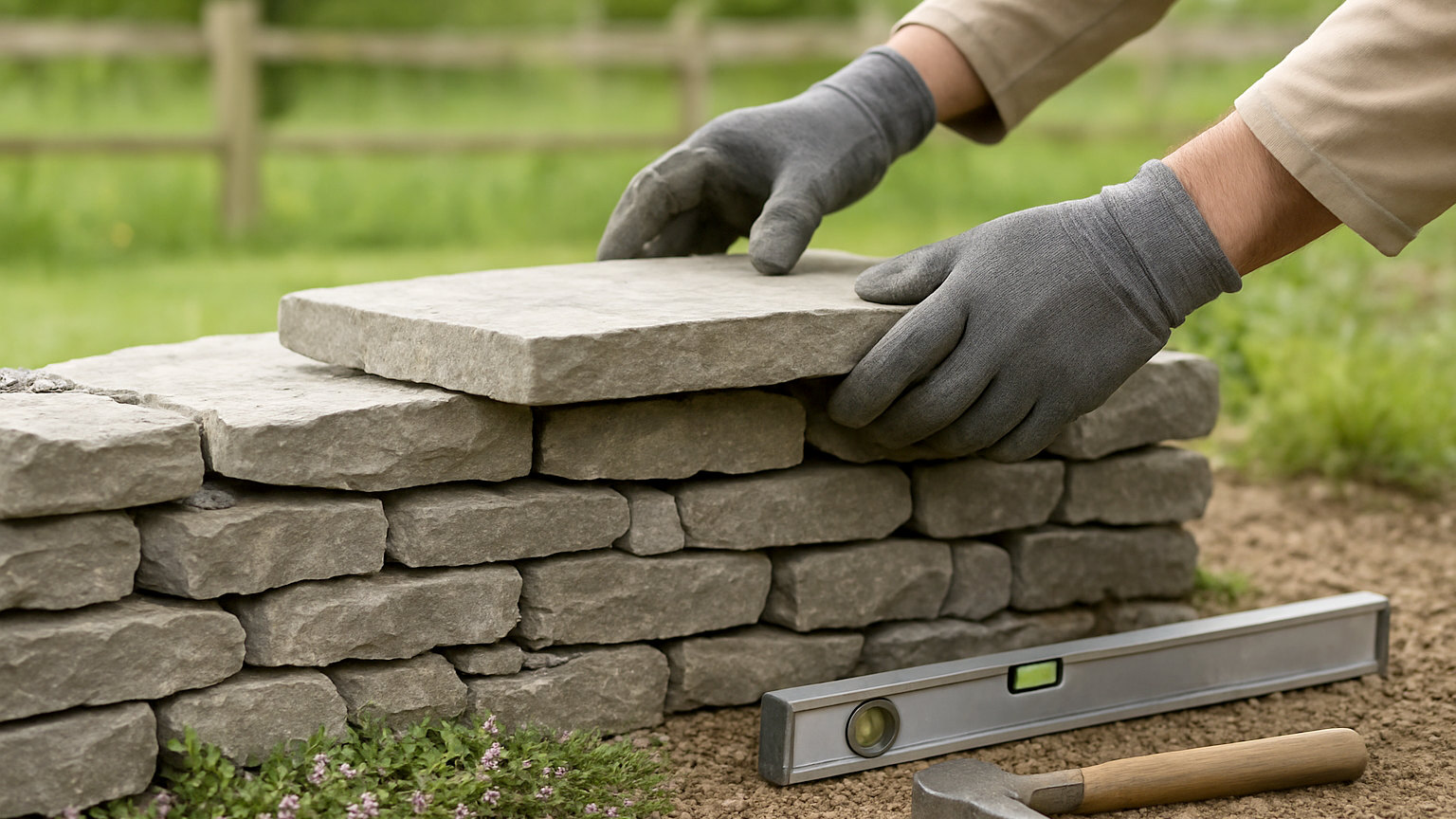
A dry stone wall is built without mortar, held together entirely by its own weight, the friction between stones and the way they are placed. Built properly it stands for centuries and needs almost nothing.
How it works
The wall is essentially two faces leaning inwards towards each other, with the space between filled with smaller stone, and long stones tying the two faces together at intervals.
Because there is no mortar, the structure flexes with ground movement rather than cracking, and water drains straight through it rather than being trapped.
That flexibility and drainage is why dry stone walls outlast mortared ones on unstable ground.
The essential elements
Foundation: a trench down to firm subsoil, with large flat foundation stones bedded into it. The wall sits on the ground rather than on concrete.
Batter: the taper of the wall, wider at the base than the top. This is what makes the two faces lean into each other and is fundamental to stability. A wall with vertical faces falls over.
Hearting: small stones packed tightly into the middle. This is not rubble filling a void; it wedges the face stones and is a substantial part of the structure. Hearting must be packed by hand, not shovelled in.
Through stones: long stones spanning the full width at intervals, usually about a metre apart along a course roughly halfway up. These tie the two faces together and prevent the wall splitting apart.
Coping: the top course, usually stones set on edge, which weighs the wall down and sheds water.
The rules of placing stone
One stone over two, two over one. Every stone should bridge the joint beneath it, so no vertical joint runs up through more than one course.
A continuous vertical joint, called a running joint, is a line of weakness and the wall will fail along it.
Place each stone with its length running into the wall rather than along the face, so it is tied into the structure.
Every stone should sit firmly on two points at least, without rocking. If it rocks, pin it with a small stone or turn it over.
Work from both faces at once, keeping the courses roughly level and packing the hearting as you go.
Choosing stone
Local stone suits the setting and is cheaper to transport, which is much of the cost.
Different stone types build differently. Flat bedded stone such as limestone and sandstone is far easier to work with than rounded field stone or granite.
Order more than you think you need, since a wall consumes stone at a rate that surprises people, and a substantial proportion is used as hearting.
Sort the stone as it is delivered: large for foundations, long for throughs, flat for coping, small for hearting.
Effort and skill
Dry stone walling is a genuine craft and it is learnable. Courses run by walling associations are widely available and worth taking.
It is slow and physically demanding. A metre or two of finished wall in a day is respectable for a beginner.
Wear gloves and steel-toed boots, lift with your knees, and get help with large stones. Crushed fingers are the usual injury.
In a garden
Dry stone suits rural settings, sloping ground and informal gardens, and it looks out of place against crisp modern materials.
It is superb habitat. The voids shelter insects, spiders, amphibians, slow worms, small mammals and nesting birds, and the sunny face suits ferns, sedums and saxifrages planted into the joints.
A low dry stone retaining wall works well on a slope, and anything retaining more than about a metre needs proper design.
Repairs
Where a section has bulged or collapsed, take it down to sound work on both sides of the failure and rebuild rather than patching the face.
The cause is nearly always inadequate hearting, missing through stones, or running joints.
Existing walls
Old field walls may be protected, particularly in national parks, and some are of historic interest. Check before altering or removing one.
Cost
Stone is heavy and transport is much of the expense, so local material is significantly cheaper.
Labour is the other cost, and dry stone walling is slow. A professional waller charges by the square metre of face and the figure surprises people.
Building it yourself costs only the stone and a great deal of time, which for a short garden wall is a reasonable trade.


