
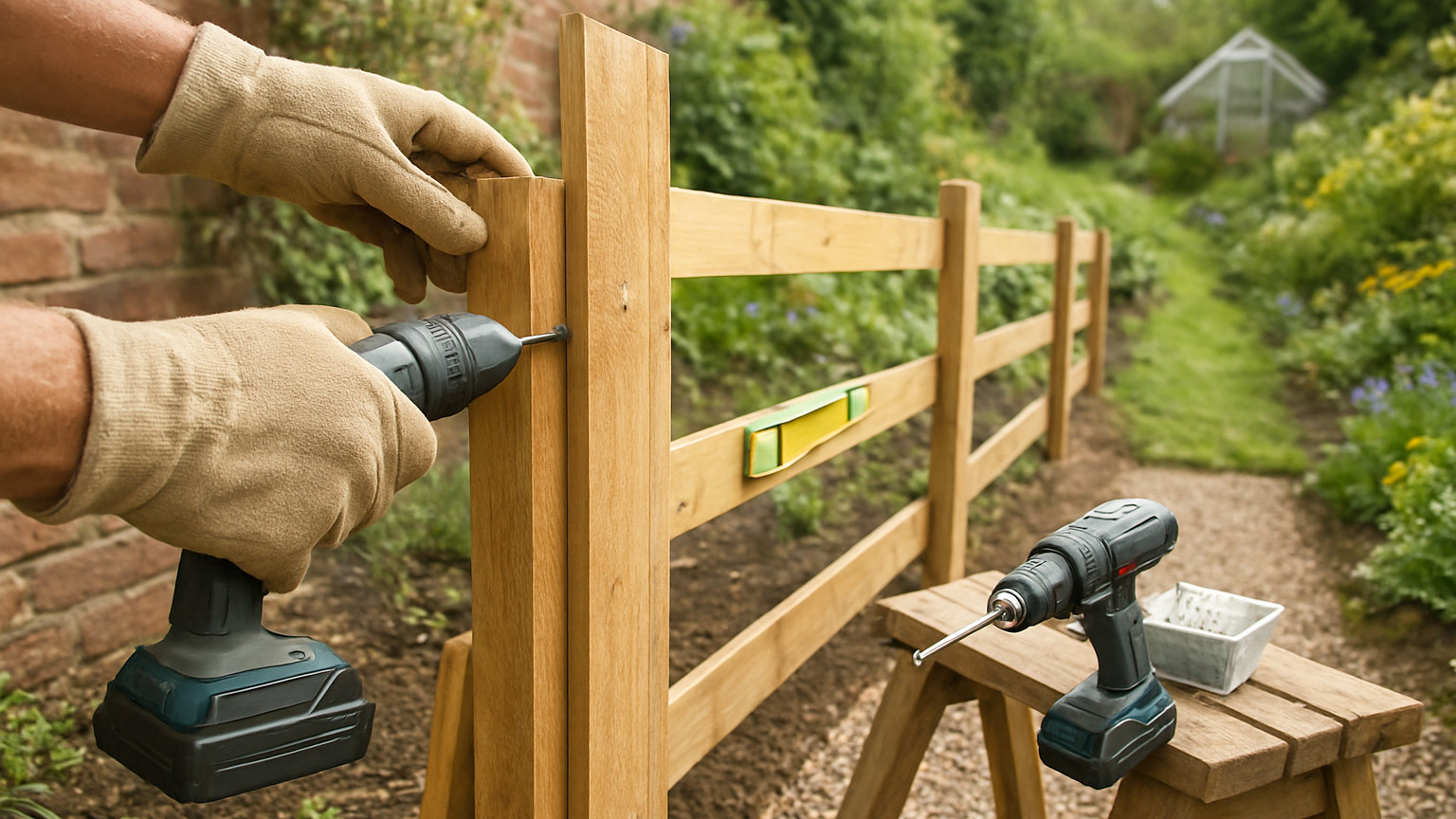
Close-board fencing is built in place from individual components rather than assembled from panels. It costs roughly twice as much and lasts roughly twice as long, and it can be repaired indefinitely.
The components
Posts, typically a hundred by a hundred millimetres in timber, or concrete slotted or mortised posts.
Arris rails, triangular in section, running horizontally between posts. Two rails for a fence up to about a metre and a half, three above that.
Feather-edge boards, tapered in section from about six millimetres to sixteen, nailed vertically to the rails with each board overlapping the last.
Gravel board along the bottom, keeping the boards clear of the ground.
Capping rail along the top, protecting the end grain of the boards.
Why it lasts
The construction is substantially heavier than a panel, the boards are thicker, and the fixings are into solid rails rather than a light frame.
Water sheds off the overlapping boards rather than sitting in them.
The capping rail protects the vulnerable end grain at the top, and the gravel board keeps everything clear of damp ground.
Crucially, any individual board, rail or gravel board can be replaced without dismantling the fence.
Posts and setting out
Posts at up to about three metres apart, though two and a half or less gives a stiffer fence.
Bury a quarter to a third of the post length and concrete them in, on a bed of compacted hardcore, sloping the top of the concrete away from the timber.
Set the end posts first, run a string line between them, and position the intermediate posts to it.
Fitting the rails
Arris rails sit in mortices cut into timber posts, or in the slots of concrete posts, or are fixed with metal brackets.
Mortised joints are the traditional and strongest method. Bracket fixings are quicker and easier to repair later.
Set the rails level, and space them so the boards are supported near top and bottom rather than at the extreme ends.
Nailing the boards
Boards are fixed thin edge over thick edge, with each overlapping the previous one by around twenty to twenty-five millimetres.
Nail through the overlap into the rail, using one nail per rail per board rather than two, so the boards can move slightly with moisture without splitting.
Use galvanised or stainless nails, since ordinary steel corrodes in treated timber and stains the boards.
Check the boards are vertical every few boards with a level, since small errors accumulate quickly.
Keep the boards clear of the gravel board rather than resting on it.
Following a slope
One of the genuine advantages. Because the fence is built board by board, the rails can be set at an angle and the boards cut to follow the ground.
This gives a smooth raking line rather than the stepped effect of panels, which looks far better on sloping ground and leaves no triangular gaps.
Capping and finishing
Fit a capping rail along the top to shed water off the board ends. This adds years to the life of the fence.
Treat every cut end with end-grain preservative.
Fit post caps to timber posts.
Repairs
Individual boards can be prised off and replaced in minutes.
A broken arris rail can be repaired with a metal rail bracket without dismantling anything.
A rotted gravel board can be replaced by lifting the boards slightly at the bottom.
This is why a close-board fence can be kept going for decades while a panel fence is simply replaced.
Cost and effort
More expensive in materials and considerably slower to build than panels.
It is entirely achievable for a competent amateur, and it takes several times as long as dropping panels between posts.
For a long run, the cost difference is significant, and over twenty years it is usually the cheaper option.
Concrete posts
Slotted concrete posts with concrete gravel boards outlast timber substantially and never rot at ground level, which is where timber fences fail.
They are less attractive and largely disappear once a fence is planted or weathered.
For a boundary intended to last thirty years with minimal intervention, concrete posts with a timber close-board infill is the pragmatic combination.
The timber can then be replaced when it eventually fails without disturbing the posts, which is the expensive and laborious part.


