
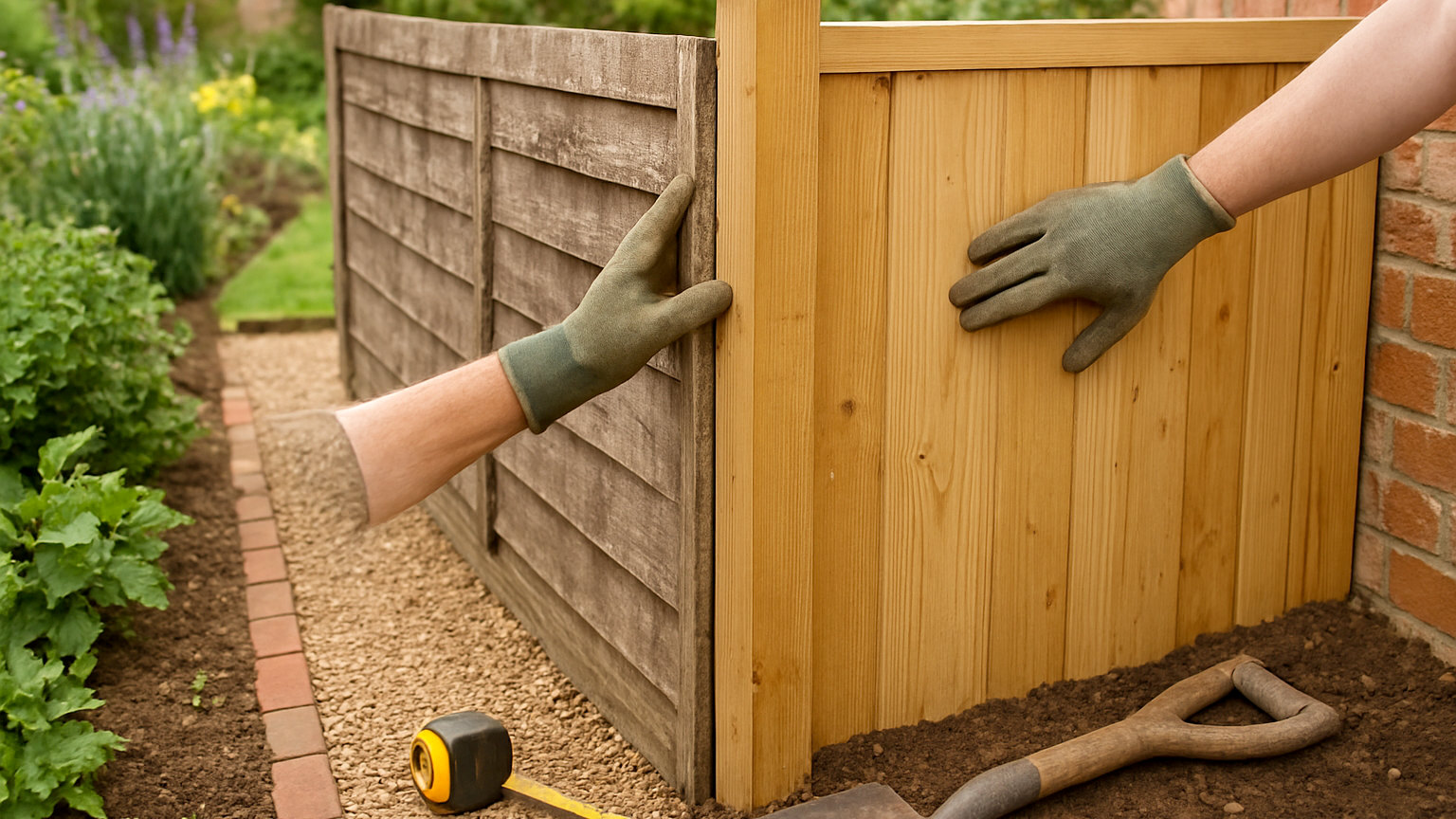
Fencing decisions are usually made on price and appearance, and the factor that matters most over twenty years is how long it lasts and how easily it can be repaired.
Panel fencing
Prefabricated panels dropped between posts, usually overlap or waney-edge boards on a light frame, or interwoven panels.
Cheapest to buy and quickest to erect, and the least durable. A typical overlap panel lasts perhaps seven to ten years, less in an exposed position.
Panels catch wind like a sail and are what blows down in a gale, taking the posts with them.
The advantage is that a damaged panel can be replaced individually in half an hour.
Closeboard-effect panels and heavier framed panels are considerably better than the cheapest overlap.
Close-board fencing
Built in place from vertical feather-edge boards nailed to horizontal arris rails, on substantial posts.
Roughly twice the cost of panels and roughly twice the life, at fifteen to twenty-five years or more.
It is far stronger, follows sloping ground properly rather than stepping down in blocks, and individual boards can be replaced when they fail.
For a boundary you intend to keep, it is usually better value despite the higher initial cost.
Post and rail
Horizontal rails between posts, with no infill. Rural, inexpensive, long lasting and offering no privacy at all.
Suits a boundary where the view matters more than screening, and it can be combined with stock netting or a hedge planted through it.
Picket fencing
Spaced vertical pailings on rails, traditionally around a metre high.
Suits front gardens and cottage settings, defines a boundary without enclosing it, and needs painting or treating regularly.
Hurdles and woven panels
Hazel and willow hurdles are attractive, informal and short lived, at perhaps five to ten years for hazel and less for willow.
They are permeable, so they filter wind well, and they suit a natural or productive garden.
Slatted and contemporary fencing
Horizontal slats with gaps, in timber or composite.
Filters views rather than blocking them, looks well in a modern setting, and is more expensive.
Horizontal slats are climbable, which matters where security or small children are a consideration.
Metal and composite
Railings suit period and front boundaries, last a long time and need repainting.
Composite fencing costs considerably more, needs no treating and lasts well, and the appearance divides opinion.
Solid is not always right
A solid fence creates turbulence on the sheltered side that can be more damaging than the open wind.
A permeable barrier of around fifty per cent openness slows air passing through and gives real shelter for a distance of several times its height.
In an exposed garden, slatted fencing, hurdles or a hedge protect planting far better than close-board.
Solid fencing also casts more shade and looks more oppressive in a small garden.
Cost over time
Cheap panels replaced twice in twenty years cost more than close-board erected once, and involve two lots of labour and disruption.
Concrete posts with gravel boards outlast timber posts substantially, look less attractive, and are the pragmatic choice where longevity matters most.
Practical points
Check the height rules before choosing, since generally two metres is the limit under permitted development, reduced to one metre where the boundary adjoins a highway.
Establish who owns the boundary before altering it, and remember you cannot attach anything to a fence you do not own without permission.
Talk to the neighbour first, since a boundary affects both sides and disputes are expensive and must be disclosed when selling.
Consider maintenance access. A fence that needs treating every two years is awkward once a border is established in front of it.
What lasts longest
A wall, at many decades. Then a hedge, which improves with age. Then close-board on concrete posts, then close-board on timber posts, then panels.
Wildlife
A solid fence is a barrier to hedgehogs, which travel considerable distances at night and are blocked by continuous fencing.
Leaving a gap of about thirteen centimetres square at the base, or cutting one in a gravel board, costs nothing and connects gardens into usable territory.
A hedge or a permeable fence supports far more wildlife than a solid panel and gives better shelter to the planting behind it.


