
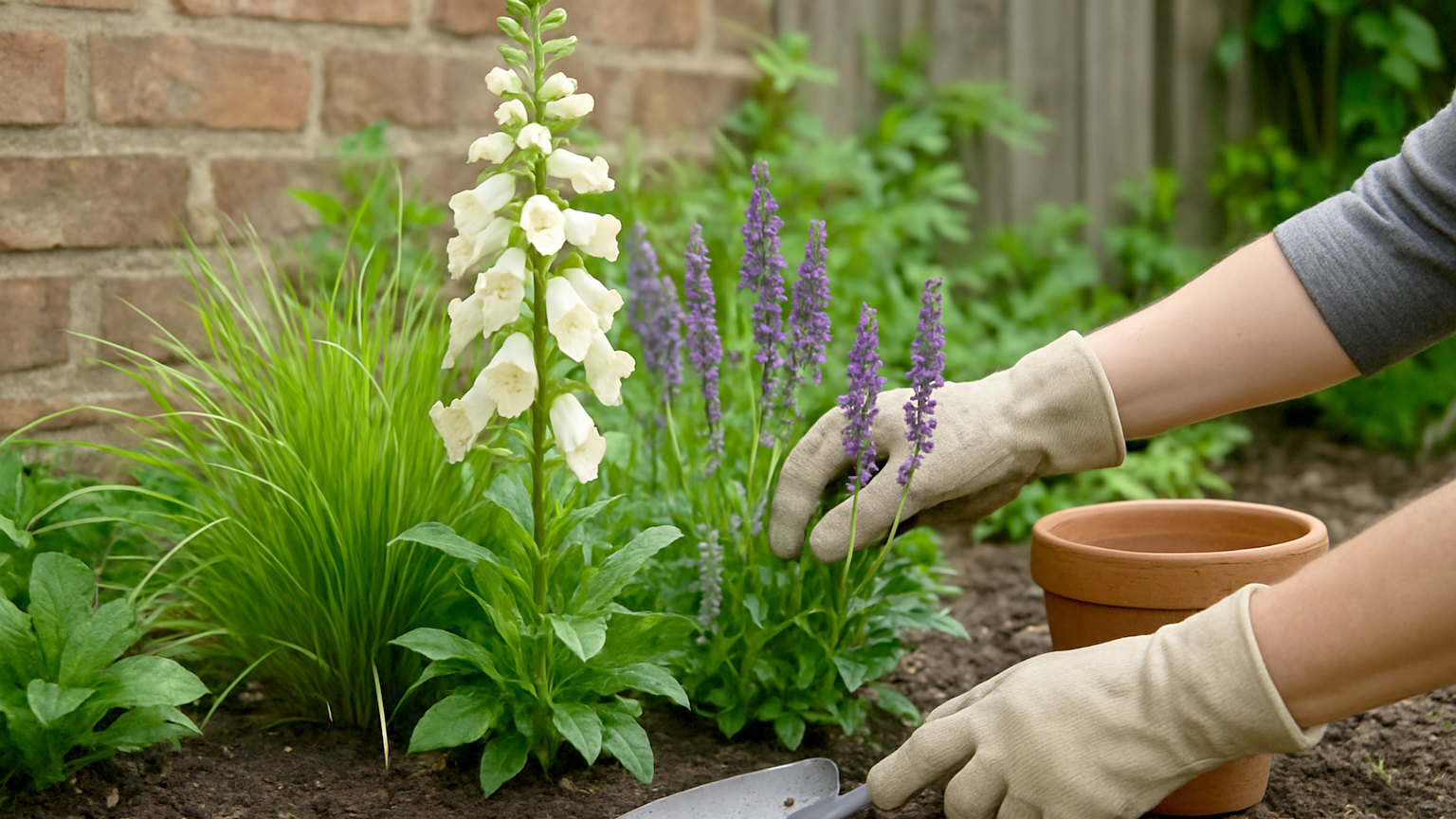
Colour is the first thing people think about and the aspect most often overdone. A border using four or five colours deliberately reads far better than one using every colour available.
Harmony and contrast
Colours next to each other on the colour wheel harmonise: blues with purples, oranges with reds, yellows with limes. Schemes built this way feel calm and coherent.
Colours opposite each other contrast and intensify one another: purple with yellow, blue with orange, red with green. These schemes feel lively and can become restless if overused.
Most successful borders use one approach as the basis and a small amount of the other as punctuation.
Hot and cool
Hot colours advance and cool colours recede. This has practical consequences.
Reds, oranges and strong yellows jump forward and appear closer than they are. A hot border at the end of a small garden shortens it.
Blues, purples, pale pinks and greys recede and appear further away. Cool colours at the end of a garden make it feel longer.
Pale colours also read at dusk when strong ones disappear, which matters for anywhere used in the evening.
Limit the palette
The single most useful discipline. Choose three or four colours and stick to them, allowing green as a given.
Everything else follows from that. It makes plant choice easier, produces coherence, and prevents the border becoming a collection.
Common schemes that work: purple, pink and silver; blue, yellow and white; hot reds, oranges and bronze; white, green and cream.
If you want everything, use colour schemes in different parts of the garden rather than mixing them in one border.
Green is doing the work
Green is the dominant colour in any border, and its variation is what holds the planting together.
Blue-green, grey-green, lime, olive, bronze and near-black foliage all read as distinct colours in their own right, and a border built on foliage variation works for the whole season rather than for a few weeks of flowering.
Where a scheme looks unresolved, adding more green usually helps more than adding another flower colour.
White
Reads as a colour rather than an absence, and it is stronger than people expect.
White separates colours that would clash, lifts a shaded corner, and glows at dusk when everything else has gone.
Used alone with green and silver it produces the classic white garden, which depends entirely on foliage and form to work.
Too much white scattered through a border can look spotty, so use it in groups.
Yellow
The most difficult colour, and the one that causes most objection.
Strong yellow dominates anything near it. Soft, creamy and lime yellows are far easier to place and combine well with blues and purples.
Yellow with purple is the strongest contrast available and works well used deliberately.
How much of each
Uneven proportions look better than equal ones. A dominant colour, a secondary colour and a small amount of an accent reads as a scheme; three colours in equal quantity reads as indecision.
Roughly two thirds, a quarter and a small remainder is a useful starting point.
Colour changes through the season
A scheme that works in June may not in September, when the palette naturally shifts towards yellows, rusts and purples.
Plan the scheme for each season rather than one moment, and accept that a border cannot hold a single colour scheme all year.
Light affects colour
Strong sun bleaches pale colours and suits strong ones. Shade suits pale and white flowers, which glow, while deep reds and purples disappear into it entirely.
Colours also change with the weather and the time of day, so judge a scheme over a period rather than on one visit.
Test it
Collect photographs of the plants you intend to use and lay them out together. Clashes are obvious on a table and expensive in a border.
Colour and distance
Strong colours read from a distance and subtle ones do not. A pale scheme viewed from the house may register as nothing at all.
Place subtle combinations where they will be seen close to, beside a path or a seat, and use stronger colour where it must carry across a lawn.
Repeating colour
A colour repeated through a border in different plants unifies the planting without repeating the same species, and works even where the flowering times differ.


