
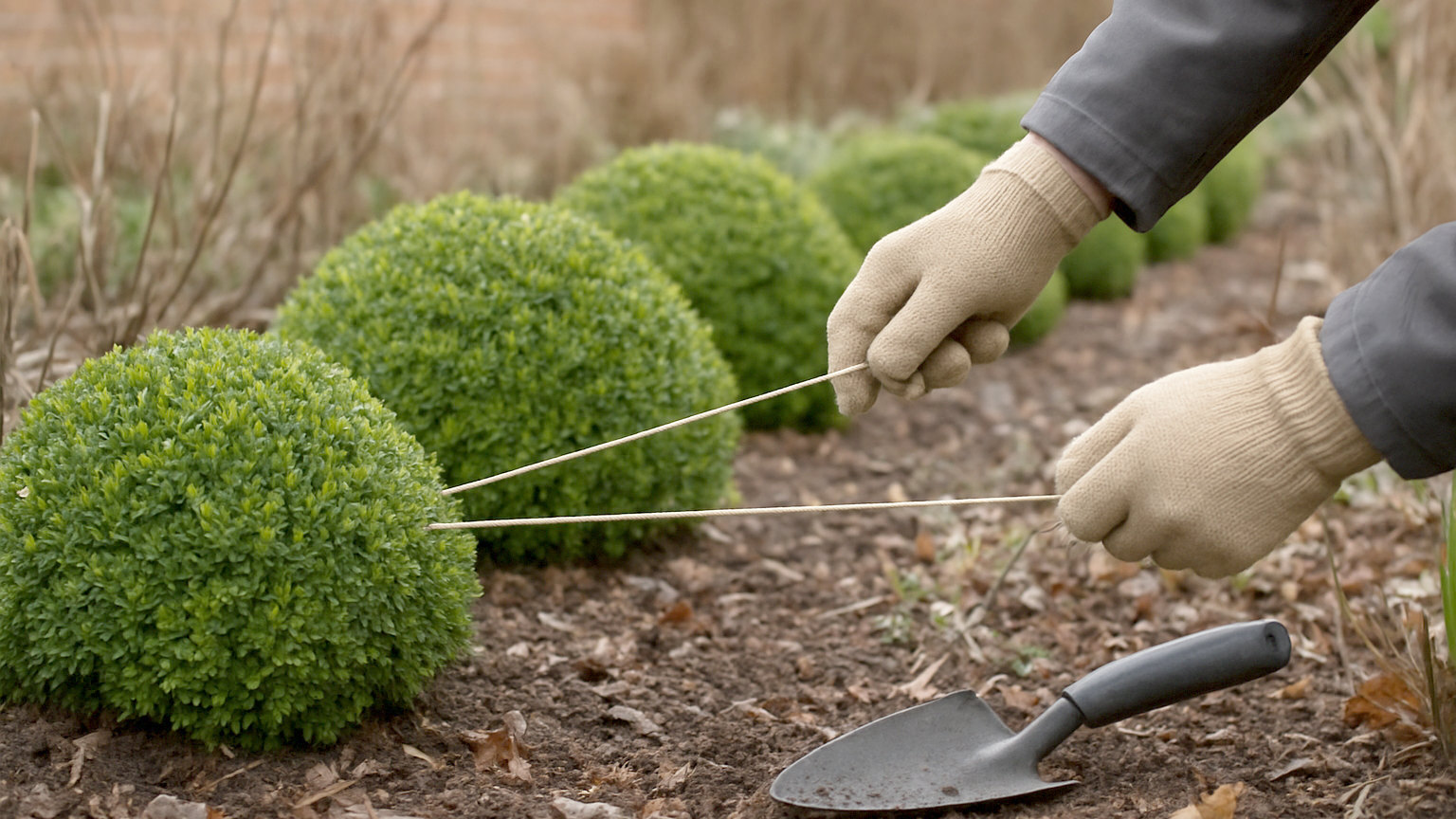
A border made entirely of herbaceous perennials is spectacular in July and bare ground from November to March. Structure planting is what carries it through the other half of the year.
What counts as structure
Anything with permanent physical presence: evergreen shrubs, clipped shapes, small trees, and deciduous shrubs with a strong branching habit that reads in winter.
It is the framework that the seasonal planting hangs on, and it is visible from the house in the months when you are indoors looking out.
How much
A useful guide is that around a third of a border should be structural, though this varies with style and situation.
Less than that and the border disappears in winter. Considerably more and it becomes a shrubbery with insufficient seasonal interest.
Structure should be distributed through the border rather than concentrated at the back, so it holds the whole planting together.
Evergreen shrubs
Box alternatives such as Japanese holly and compact euonymus, for low structure.
Sarcococca, which is unremarkable for eleven months and scents the garden in January.
Viburnum tinus, choisya, hebe, osmanthus and pittosporum for medium height.
Yew, holly and Portuguese laurel for larger structure and clipping.
Daphne and skimmia for smaller positions.
Clipped shapes
The most effective structural device in a mixed border, and the one that most distinguishes a designed planting.
Domes, cones, balls or low blocks of yew, box alternative, holly or pittosporum, repeated at intervals through a border, hold the composition together and read strongly under frost.
They also give the eye somewhere to rest among loose planting, which is why naturalistic schemes so often use them.
Repeat the same shape rather than using several different ones.
Deciduous structure
Some deciduous plants read strongly in winter through their form rather than their foliage.
Multi-stemmed amelanchier or birch, cornus with coloured stems, hydrangea paniculata with its dried heads, and shrubs with a distinct branching pattern all count.
Ornamental grasses left uncut hold their form until February and act as structure through most of winter.
Small trees in borders
A single small tree lifts a border and relates it to the house.
Amelanchier, crab apple, hawthorn, birch, cercis and multi-stemmed forms all suit a domestic border.
Check the eventual size and consider the shade it will cast on the planting beneath, which changes what will grow there.
Placing it
Position structure first, before any other planting, and work everything else around it.
Put it where it will be seen from the house in winter and where it does the most work: at the ends of a border, at the point where a path turns, and either side of an entrance.
Repeat the same structural plant at intervals along a border, which ties it together and creates rhythm.
Avoid placing all the evergreens along the back, where they read as a hedge rather than as structure.
What it does beyond winter
Structure planting also gives a border a shape when the perennials are cut down, provides a background against which flowers read, and stops the planting looking like a collection.
It supports floppy perennials physically in some cases, and it gives shelter and nesting cover for birds.
Getting it wrong
Too many different evergreens, which reads as a muddle. Choose two or three and repeat them.
Structure that is all the same height, producing a flat line.
Evergreens that outgrow their position and are then cut back hard, since several will not reshoot from bare wood.
Variegated foliage used in quantity, which is busy and works against the calming role that structure should be playing in the border.
And structure that has been allowed to grow out of shape, since a clipped form only works while it is crisp.
The winter test
Stand at the window you use most in February and look at the border. What you can see is the structure, and if there is nothing there, that is what needs adding.
Buying structure
Evergreens are more expensive than perennials and are the part of a planting budget worth protecting.
Buy small and be patient, since a young yew or holly establishes faster than a large one and costs a fraction of the price. Clipped shapes can be trained from ordinary nursery plants over three or four years rather than bought ready-formed at considerable expense.


